


My heart is racing as I write this. My breath shushes and blows with teeth siphoning inhales and whistling sighs.
I just paid my taxes.
I have never known a greater fear than that of the office of revenue commissioners. Sure, they’re not threatening, but if I’m wrong with a single number they could upend my life. Perhaps I’m being melodramatic, but after three years of being on the Basic Income for the Arts here in Ireland and having to register to pay tax (BIA falls under “government levy”), there’s something that just elicits and irrational fear from me. On some level, it comes from disbelief that I deserve help, especially after the surprising announcement that the scheme will be made permanent starting September next year, with the current pilot, originally due to end in August 2025, being extended to February/March 2026.
The relief is almost as scary as the taxman (almost). I had spent the last year panicking, wondering what I’d do without the scheme. Being nine years unemployed (yes, nine!) had traumatised me to the slog that is job hunting, especially as a creative. The threat of AI was only emerging from the depths of Hell (aka OpenAI) when I was informed I was one of the lucky two-thousand participants chosen to take part in this pilot scheme, studying the effects of basic income on the lives and works of those in the creative fields and practices (artists, actors, musicians, writers, directors, sculptors, animators, etc.)
THE LAST YEAR
For a full breakdown of the first and second year on basic income, please follow the links here and here. The basic are;
• Productivity greatly increases!
• Work, life, and expenses feel more manageable.
• People vary in their support greatly.
• I produced two podcast/audiobook series (The Trees Swallow People & One Year).
• BIA helped with an emergency trip to Spain for my partner’s bariatric surgery; I could never have been able to drop everything last minute to care for them for half a month in another country if I had a traditional 9-5 job.
This is starting to feel like a Dragonball Z recap.
Last I left off, my partner was a few months from her bariatric surgery. In total she’s lost forty pounds in fifteen months. Recovery still took time, especially in the earlier months.
I was interviewed once again by another newspaper, this time from Italy. And this time the response compared to “Newspaper News” was much more positive. In the name of impartiality and consistency, since I refrained from naming the last newspaper and reporter, let’s call this newspaper “Mamamia News” (I’m sorry.) The journalist, “Mario” (again, sorry), was doing a number of stories in Ireland at the time (this was during the 2024 election, and we had a candidate running who was a convicted drug lord), so was able to meet up for a coffee. The difference between Newspaper News and Mamamia News really speaks to the difference between Britain and Italy, especially in their view of the arts (and perhaps, to a lesser degree, the Irish.) Where Newspaper News readers focused on shaming and guilting me for daring to be on the scheme, Mamamia News readers were more supportive;
“Finally, someone realizes that in a future dominated by AI, art in all its expressions will be more necessary and vital than ever.”
“I'd gladly pay a tax for a basic income for artists. I think they're greatly needed.”
“If I'm not mistaken, there was already a similar subsidy in Ireland linked to the theatre, and in fact they had produced a series of fantastic playwrights.”
“If you can do it...do it! I, too, would have liked to reduce my working hours (true) and be more present at home, earning an extra €1,200 a month to create something artistic, or pursue a passion, while working full-time, being a housewife, and raising my two children.”
And while not everything I wanted/did say made it into the article, I did feel as though I was listened to this time and that my word’s weren’t twisted.
So, in conclusion, Italians are lovely, Tories are cunts. Grazie!
And speaking of that 2024 election, it was the same one that ousted then Minister for the Arts, Catherine Martin, the architect of the Basic Income for the Arts scheme, replaced by Fine Gael TD (boo!) Patrick O’Donovan. While all parties, including Fine Gael, agreed to retain the BIA scheme, there was a warranted scepticism when it came to the Minister, who remained silent on his plans for the scheme well into the summer, due to end in August. No word for 6 months!
As the August deadline fast approached, I knew it was too good to be true. I knew never to trust a damn Blueshirt! Catherine Martin was spearheading the program, she was the one who made it possible, and she was the only one in government who cared about artists and creatives and the struggles we face. We should have known better than to let a West Brit become minister for a department he didn’t care anything about and…
“Minister O’Donovan announces 6-month extension to the Basic Income for the Arts pilot scheme” -Gov.ie, 19th June 2025
…
I NEVER DOUBTED YA FOR A SECOND, PADDY!
You were always my favourite! I love bluesh- I mean, I love Fine Gaelers! Fuck that Green bitch, am I right! Catherine who, that’s what I say! I don’t care if you look like a forty-year-old man trapped in the body of a fifteen-year-old, you’re a great man!

As of October 2024, the BIA scheme has been made a permanent support scheme, free from means testing, meaning anyone, so long as they can meet two of the three requirements (record of artistic pursuit, income from artistic pursuits, full guild/union membership) can apply in January next year for the September 2026 scheme. Unfortunately, that does mean the pilot scheme is still due to end in February, with a six-month gap until eligible candidates are selected. Can I get lucky twice? Who knows. I can work off savings until April.
I have a few things in the works that can pull through for me in the meantime, but if there is something to criticise the current scheme for it’s the nearly 9-month long processing time, especially when the original selection process in 2022 was done in less time. At the time of writing, it is unclear if the next round of the scheme will be another three years or if the new scheme will be a yearly lottery.
The last year, as it’s been for most people, has been filled with ups and downs. As some of you know, it began with a tragic and traumatic set of circumstances where two men, Martin and Tyler Quinn, sold my partner, unbeknownst to her, a Yorkie puppy, Pip, infected with Leptospirosis, a highly contagious zoonotic disease. We spent much of our Christmas and New Year holidays struggling to care for and, in the end, putting to rest a beautiful puppy that was brutally abused and mishandled by his previous owners who were only interested in making a sale. Then, in April, we had to make the same tough decision again regarding our fifteen-year-old Yorkie, Poppy, who some of you may know as the dog in The Trees Swallow People podcast series. In total, vet care and cremation expenses cost me approximately €2,000. Let no one say I don’t love dogs.


Setbacks weren’t solely grief-stricken. For a third time I submitted for local funding to producer another podcast series, seeing as the previous two were successfully selected. This project would have included a full cast and was based on my horror novella, Her County. No such luck this time, which is understandable; it would have looked suspicious if the same person had been awarded three times in a row. And my poetry podcast series “One Year” didn’t get traction. Shock; no one likes poetry. And then, of course, like any good creative, I spent most of my time applying for grants. There is a surprising amount of paperwork in being creative. Off the top of my head, I can’t even give a number to all the grants I applied for. Nor to all that I was rejected for.
You can see now why after struggling with obligations, emergency bills, and applying for grants only to get rejected that just having enough time and money to pay my taxes feels like a herculean triumph.
DATA
Now it’s time for the part you’ve really been waiting for! Let’s get ready for DAAAAAAATAAAAA!

First, a quick overview of reports published by the Irish state about the scheme. According to gov.ie;
• For every €1 spent, €1.39 of (economic) value was created.
• Tax paid by participants reduce costs by €30 million.
• Participant income increased by €500 per month.
• The scheme contributed €80 million in recognised benefits to the state.
• Year on year, the annual cost of the scheme decreased.
• Year on year, participant tax paid stayed consistent, approximately €12 million.
• Year on year, savings from participants leaving social protection support increased.
• Year on year, net fiscal cost decreased.
• Year on year, social benefit value increased.
• Productivity increased by 11 hours per week for participants.
• Recipients spoke of being able to generate savings and invest for the first time.
• The BIA improved art work viability and visibility, as well as improving the working conditions of participants.
As part of the scheme, I needed to track my own time, expenses, and experience working on creative projects. The following is based on my own collected data over the last three years.
• Over the last three years, a total of 1,807 hours and 3 minutes were dedicated to my creative projects.
o Year 1: 627 hours and 11 minutes.
o Year 2: 573 hours and 13 minutes.
o Year 3: 641 hours and 52 minutes.

• The lowest weekly total was 1 hour and 30 minutes in year 2, week 11.
o This was due to being in Disneyland Paris.
• The highest weekly total was 25 hours and 3 minutes in year 2, week 31.
o This was due to my partner leaving me to go on a family holiday.
o For three years in a row, my productivity has spike when my partner has left me alone… Make of that as you will.

• The average weekly time spent on creative projects was 11 hours and 48 minutes. Note this is in line with the government’s findings.
o Year 1: the average was 12 hours and 3 minutes.
o Year 2: the average was 11 hours and 1 minutes.
o Year 3: the average was 12 hours and 20 minutes.
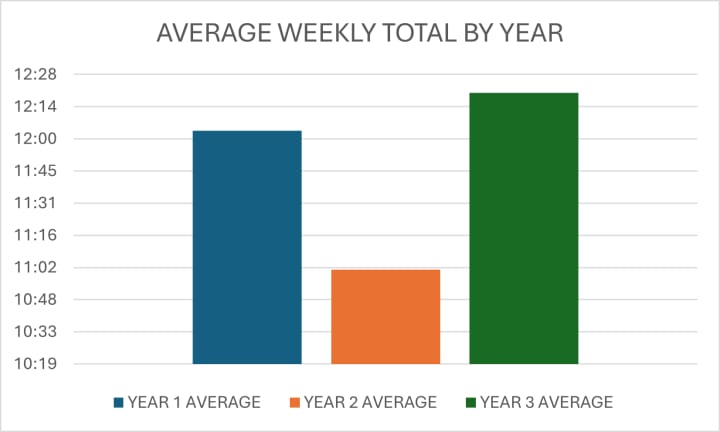
What can we see? Looking to the weekly total comparison, we can see productivity wildly fluctuates. It should be clarified that because the scheme began in October/November 2022, the years recorded don’t begin in January. The dip present in each year around week 8 is the Christmas and New Year holidays. And while the overall trend seems to indicate the middle of the year (spring/summer) as my most productive time, there was little consistency year-on-year between weeks (the biggest gap being week 19 of years 1 and 3, in favour of year 1 despite year 3 accumulating the most hours in total.)
The trend becomes easier to notice if we look at quarterly results.
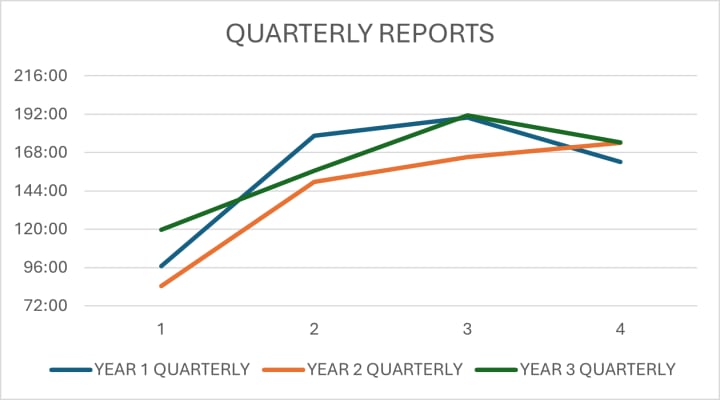
These quarters (1-4) represent winter, spring, summer, and autumn respectively. It’s no surprise that with winter involving the most social events and obligations (birthdays, Halloween, Christmas, New Years, beginning of school) it should be the most “unproductive” time. From there productivity increases in spring (2) and continues into summer (3) before starting to dip in autumn (4). The quarter with the most total hours was summer (3), according for as much as 33% of the three year total.
Productivity, as we can see, is less consistent week by week but rather seasonal, with yearly consistent dips and peaks. This is in strong contrast to the hustle-culture mindset that productivity must be constant, exponential, and that any slowdown is a failing. The result speaks for themselves; not only is “unproductivity” natural but it doesn’t set you back from returning to a consistent level. Life is, quite literally, seasonal.
“BUT WHAT ARE YOU GOING TO DO IN THREE YEARS?”
These were the words my mother asked me at the beginning of the scheme when I told her I had been selected. My response was something to the effect of it being an unfair question. No one can know what’s going to happen in three years. I didn’t know it would be made a permanent scheme. I didn’t know my partner would get life-changing surgery. I didn’t know I would have produced podcast and audiobook series, with three self-published eBooks which you can buy right now (HINT! HINT!) And, truth be told, I still don’t know what’s going to happen come next year. But that is very much life.
It's unpredictable. You can get an amazing opportunity. You can miss out on a few. You can get years out of a loving pet, or tragically watch them slip away in mere days. You can have long spells of fulfilment, followed by an entire season that feels like a slog. You can be working away in a bedroom in Ireland on Monday and then find yourself working in a hotel room in Spain come Friday. Three years ago, I was lying in bed, exhausted from working a night-shift job, when I got an email that changed my life. I could never have imagined what I’ve been writing about.
I don’t mean to be anticlimactic, but there isn’t really an end to tie everything together. Perhaps that’s the point; UBI isn’t anything magical. It’s not a socialist utopia or a capitalist hellscape. It’s an opportunity to let people live, and trust they’ll make the right choices. That’s all this experiment boils down to; trusting people.
Thank you for trusting me.
#HI
About the Creator
Conor Matthews
Writer. Opinions are my own. https://ko-fi.com/conormatthews
Keep reading
More stories from Conor Matthews and writers in Journal and other communities.
2 Years On Basic Income
An early draft of this piece was written in a hotel room from the sunny coastal town of Denia, Spain. The temperature was forty degrees (about a hundred, for you yanks), and I was in an air-conditioned room, naked, typing. I have receipts beside me as a I tried to justify some tax deductions (an ice-tea is an expense since I’m working while drinking it, right?), and a cup of coffee begging to be refilled. The sun is radiating down on the sweat stained clothes drying on the balcony, flittering through the palm branches gently rocked by the Mediterranean breeze.
By Conor Matthewsabout a year ago in Journal
Stability Through Structure: How Enterprise Risk Management Frameworks Protect Modern Organizations
Enterprise risk management plays a key role in helping organizations stay steady when challenges arise. Companies face risks every day. Some risks are small. Some risks can threaten the entire business. Enterprise risk management frameworks help leaders understand these risks and respond with confidence. They give teams a clear way to identify, measure, and monitor threats before they cause serious harm. These frameworks also support strong decision-making. As a result, they help build long-term stability in a fast-changing world.
By Adam Adler5 days ago in Journal
Early March 2026: 4 Goals Accomplished
It's early March and I've now accomplished my 4th writing goal for the year of 2026. Before diving into the behind-the-scenes of it... why not tell you up front what that accomplishment was? I was published in a 2nd publication for this year. Published in Helix Literary Magazine out of Central Connecticut State University. You can read it for free right now!
By Stephen Kramer Avitabile5 days ago in Writers


Comments
There are no comments for this story
Be the first to respond and start the conversation.