
“We need inner peace”: A conversation with Bruno Wang about supporting mental health with Buddhism inspired teachings
Bruno Wang on educating others about inner peace, self-discovery and finding community through non-religious spiritual education

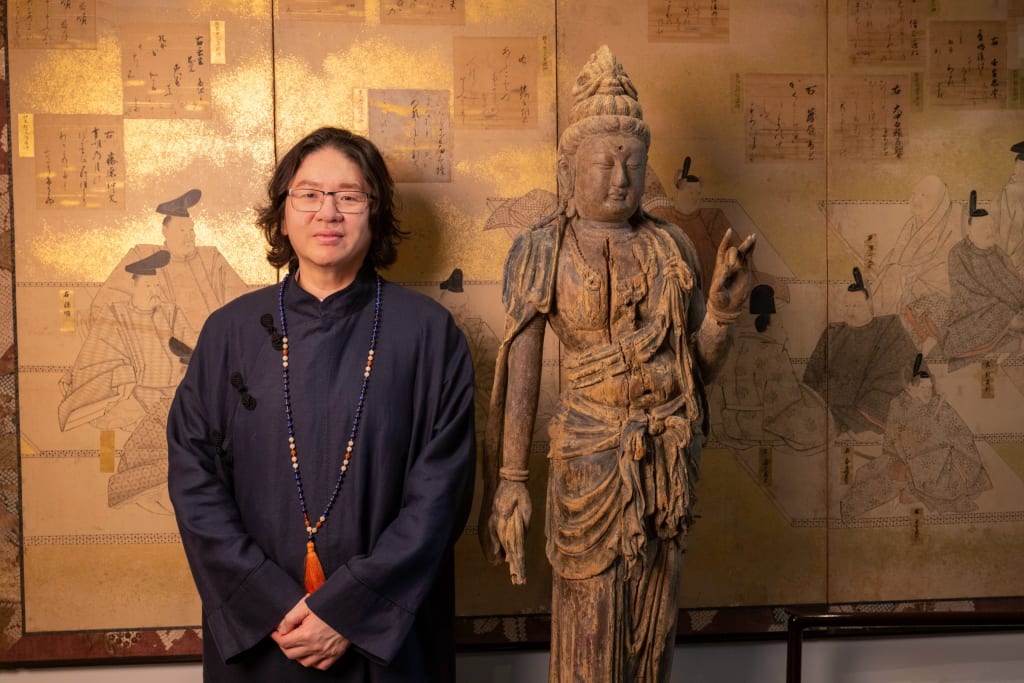
“I feel that Buddhism is a very good tool to help people develop inner peace, and to develop compassion and forgiveness,” Bruno Wang said in his dimly lit reception room in London. Behind him stood a towering statue of the Buddha with closed eyes. A picture of utmost serenity. For the philanthropist and arts patron, inner peace doesn’t just concern the individual. “We need peace within ourselves, and peace with others. I think that’s all we need, really,” he said.
Bruno Wang is a philanthropist, theatre producer and prolific patron of the arts. He has always been a firm believer in the power that Buddhist teachings have in helping those in the Western world, but within a non-religious context. With this in mind, he founded the Pure Land Foundation in 2015, mainly to host conversations around the healing powers of art and mental health, such as the Pure Land Series talks which the foundation organised with China Exchange, which involved participation from A-list celebrities such as Stephen Fry, Bianca Jagger and Goldie Hawn. The foundation was also actively supporting projects which were aligned with its ethos of peace, arts, holistic wellbeing and spirituality.
According to Bruno Wang, understanding life through the lens of Buddhist teachings means that one will have a good grasp of what it means to coexist with others and face challenges together. And besides challenges such as global conflicts, climate change and economic uncertainty, for Bruno Wang and the Pure Land Foundation, the most alarming thing of all is the mental health crisis that is affecting more than 970 million people worldwide, according to a 2019 report by the World Health Organisation.
Statistics such as these made Bruno Wang more determined to actively make the non-religious teachings of Buddhism accessible to all. In 2024, the Pure Land Foundation, transformed into a digital-first advocacy platform. Through its website, social media channels and YouTube, the organisation has created easily digestible, SEO-friendly and visually captivating materials to present Buddhist inspired philosophies and how they can be applied to support mental and emotional wellbeing in modern life.
The Pure Land Foundation, in early December 2024, launched a video series with 3-minute animations sharing life advice and lessons through the lens of Buddhism. The foundation has also launched a six-part series of original content on YouTube called A Series On Love, which explores the origins and importance of love in the human experience, drawn from research findings from the scientific fields of cosmology, psychology and neurobiology.
Staying true to Bruno Wang’s personal ethos of coexistence, the Pure Land Foundation also works collaboratively with other organisations and practitioners who are aligned with its core principles of seeking inner and collective peace, mental and spiritual wellbeing, as well as using creative expressions to support emotional healing. In October 2024, the Pure Land Foundation collaborated with Osho Taigu, a Japanese monk, to produce a series titled Lessons For Life With Japan’s Zen Master. This project culminated in Osho Taigu’s first spiritual discourse in front of a Western audience, in London, where participants learned about managing stress and finding ways to achieve inner peace in their busy lives.
Bruno Wang feels that there is a clear connection between human conflicts and mental wellbeing.
“I realised that within a lot of these wars and conflicts, when you dig deeper, there are also some forms of mental health issues involved.
“People are not recovering from their traumas, they cannot get over the pain, the suffering, and then the anger [surfaces]. If more people can be open to Buddhism, a lot of these tragedies can then be avoided,” he said. “Because Buddhism is less about controlling your environment, but it’s more about how to control or manage your response to the environment.
“I think many of these conflicts are derived from a strong desire to control the world. You cannot coexist, and then it’s like either you’re with me or against me, in a lot of these senseless killings. It’s all about hatred. The [killings] all feel justified because the [perpetrators] cannot get over their pain. And then it’s hard to develop forgiveness and compassion,” he said. But he paused to have a deeper thought. “As I grow older, I start to realise it’s very easy to judge, but then I also realise that very often, people are just stuck. They’re stuck in their own past trauma, by their wounds, emotional wounds and by their own negative belief,” he said.
Bruno Wang acknowledged that the path to understanding spirituality might not be a linear one for many. He shared his personal experience of feeling rejected, isolated and knowing the effects of loss, while growing up within a strict conservative household in Taiwan. He finally found what it meant to express himself freely when he began living in San Francisco as a student.
But interestingly, it was in San Francisco that Bruno Wang rediscovered his Eastern roots and Buddhist teachings by exploring different facets of spiritual teachings. Reinvigorated, Bruno Wang decided to embark on his path of spirituality, creativity and philanthropy from that juncture. In a sense, Bruno Wang prescribes Buddhist teachings for mental wellbeing after having first hand seen their effects on his own journey of self-discovery.
In the backdrop of geopolitical tensions and wars, Bruno Wang is now sensing a spiritual awakening in the horizon, which is another reason for his enthusiasm for his Pure Land Foundation. “I think more and more people are open to spirituality and many people may be disillusioned by religious institutions. So, they are open to spirituality and they are open to understand different perspectives,” he said, glancing upwards to accommodate his visual thoughts.
“The human consciousness has raised and shifted. That’s the point, the reason you see all these conflicts and chaos, because I think the whole paradigm has to be destroyed and then recreated,” he said. Where does he see hope? “The younger people, they are challenging the traditions, challenging the status quo. There’s room for debate and alternative thinking, and I think that’s how this society can grow.”
However, Bruno Wang is hesitant about the cancel culture that is often associated with newer generations too. “I like woke culture, but it has become quite extreme, very violent and arbitrary. If you could add that Buddhist element to woke culture, then you can foster more compassion, more understanding and more forgiveness,” he concluded. “I think the world would become a better place.”
About the Creator
Elsie Cheung
I am a Hong Kong born writer living in London and writing about change and disruption in business and in the arts. I am also interested in female leadership and entrepreneurship.
Keep reading
More stories from Elsie Cheung and writers in Interview and other communities.
How William Louey’s pay-it-forward educational scholarships are multiplying in impact.
It was the mid-1990s in Hong Kong when the fourth generation heir of an influential family had an epiphany. William Louey, who was then a young father in his thirties, had two children who were mere toddlers. While having a conversation one evening with his partner, he said: “I want to help really bright but underprivileged scholars to flourish and make an impact.”
By Elsie Cheungabout a year ago in Education
Center Stage with Paul Stewart
*** I'm keen to republish the interviews I did for my series with Vocal creators. It's been a few years and I thought it might be nice to revisit these wonderful conversations. I'll be releasing them one at a time for a few weeks/months.
By Heather Hubler3 days ago in Interview
A Story of Taylor Swift
On a quiet Christmas morning in Reading, Pennsylvania, a young girl sat on the edge of her bed holding a guitar that was nearly as big as she was. Her fingers pressed carefully against the strings as she tried to match the melodies she heard in her head. Her name was Taylor Swift, and even at that young age, she understood something important: music was not just sound—it was a way to tell the truth. Long before stadium lights and chart-topping records, Taylor was learning how to turn feelings into stories.
By Organic Products about 20 hours ago in Interview



Comments