
How William Louey’s pay-it-forward educational scholarships are multiplying in impact.
William SD Louey Foundation Scholars are expected to pay-it-forward. And that is exactly what they are doing.

It was the mid-1990s in Hong Kong when the fourth generation heir of an influential family had an epiphany. William Louey, who was then a young father in his thirties, had two children who were mere toddlers. While having a conversation one evening with his partner, he said: “I want to help really bright but underprivileged scholars to flourish and make an impact.”
William Louey had been exposed to charitable giving since the age of seven. His late grandmother had frequently taken him on visits to charitable organisations for elderly and disabled people. Only at her funeral did he realise the true extent of her philanthropy: that she had herself built the institutions they had both visited, and her charitable giving had helped thousands of people.
William Louey wanted to carry out his philanthropy in a similarly quiet manner, just like his grandmother. But instead of helping thousands, he focused on funding the best possible education a few people that he could give his money, time and personal attention to.
He wanted to sponsor full scholarships for those who were not only academically gifted, but equipped with natural leadership skills, so they could pay-it-forward and help more people in need when they are able to in the future. “You’re trying to create the multiplier effect,” he said, adding that helping talented but underprivileged students access the same education that he had the privilege of could create a positive ripple effect.
William Louey, who was based in Hong Kong, which was still under British rule at the time, wanted to help students from mainland China; a country that at that time was still just starting out as a manufacturing hub for the world. While the country produced many academically gifted students, particularly in STEM subjects, overseas scholarships were unheard of.
William Louey contacted his friend Richard Yan, who was then the only Young Presidents’ Organization representative for China, and told him of his plan. Then in 1995, William Louey set up the William S.D. Louey Educational Foundation, named after his late grandfather. The aim of the organisation was to provide full overseas scholarships for academically gifted students from poor economic backgrounds.
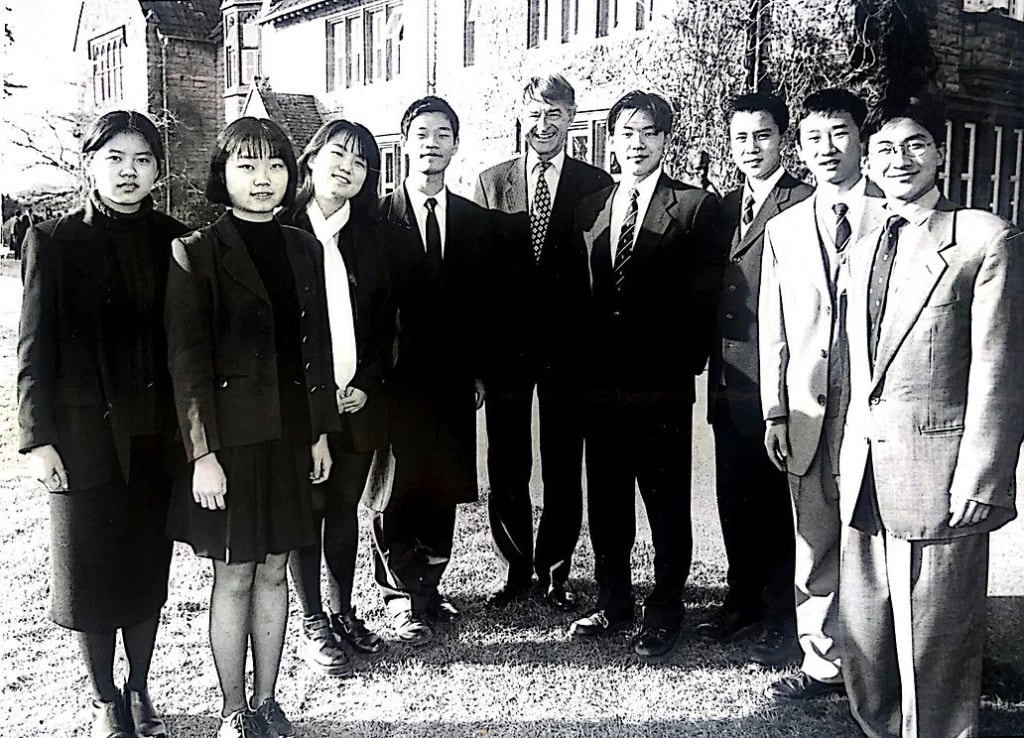
“Nobody knew what it was about other than that he was a successful Hong Kong businessman who had a lot of patriotism and just wanted to do charitable work in China, particularly in education,” says Charlie Feng Gao, one of the first batch of scholars who were selected in 1995.
Charlie ended up studying at Millfield School, one of the UK’s top boarding schools that William Louey himself had attended. It was where most of William Louey's scholars were sent to. After pursuing engineering at Cambridge, Charlie has become a successful finance professional who has been ranked in 2021 as one of China’s top 100 private equity investors. He holds over 20 years of experience in finance, having worked at Morgan Stanley and KKR and founded his own business, Fengshion Capital.
There is a reason why William Louey began his philanthropy early, unlike many of his wealthy peers. William Louey, whose grandfather founded the Kowloon Motor Bus Company in 1921, was conscious of his privileged position after he achieved financial independence at the age of 18 following the death of his father who was only 49. Several other men in his family also died young, so William Louey became eerily aware of his own mortality. “I thought I was dying at 50,” he said. “So that’s why I set up the scholarship early.”
Fast forward 30 years, and the philanthropic project has benefited more than 60 Chinese scholars, many of whom are now successful individuals themselves. The William SD Louey Educational Foundation is ongoing today, but focuses on post-graduate students.
The only condition that William Louey placed upon his scholars is an obligation to pay-it-forward. And most of the scholars have gone on to their own philanthropic pursuits, inspired by his pay it forward philosophy. “I told them from the very first day that they’d never have to pay me back, but they do have to pay it forward. That’s the only condition" says William.
The multiplier effect that William Louey wanted to create with his original idea has been bearing fruit. In 2018, a group of William Louey scholars founded the Pay It Forward scholarship, which sits under the China Oxford Scholarship Fund. This organisation helps underprivileged students from China to receive higher education in Oxford.
One scholar who wholly believes in the power of William Louey’s unique style of philanthropy, and who is also a founding member and active contributor to the Pay It Forward scholarship, is Harry Jinyang Liu. Harry was a 2005 scholar who pursued a degree in Mathematics at Cambridge.
Today Harry is a successful finance professional at Goldman Sachs, with experience in Morgan Stanley, Ashmore and PingAn Bank in China. “Each year, we will contribute small amounts of money from every one of us…we are always trying to sponsor one or two students every year to continue their university life in the UK. We’ve been doing that for years now.”
Harry is also a donor at Trinity College, Cambridge, and a supporter of charities for children both in Hong Kong and mainland China. “Once you realise the amount of help you have been given in your life, then you understand the true meaning of giving back to the rest of society, who are less fortunate than you.”
Harry admires the fact that William Louey, not only gave his money away — he also gave his personal time and energy to each scholar to ensure that they had adequate support throughout their educational journey. “We wrote to each other,” Harry said of William Louey’s interaction with him during his education in the UK.
William Louey also arranged for Harry and many other scholars to be mentored and looked after by an English guardian, a retired teacher from Millfield School. “I learned the most about English culture from her, you know: the dinner table, afternoon tea, the church experience, the road trips with her,” Harry said.
Harry said these interactions provided him with a close-knit network, which he still keeps in touch with today. “William sometimes travelled to the UK and we’d meet, and he would also connect us with other scholars. It was a great mentorship throughout the years, not just with William, but with other scholars as well. We talked about schools, education, career, family, everything. That connection was special.”
Albert Lei Shen, one of the William Louey's first batch of scholars in 1995, is the brains behind the Pay It Forward initiative, who is also the founder and donor of Shen Lei Hope School in China. A scholar who studied engineering at Oxford, he went on to work at J.P. Morgan, ANZ and BNP Paribas before founding his own educational consulting firm in Hong Kong. He is also a lecturer at Peking Business School. “William put in his time and effort to get to know us, and expects nothing in return other than to go on and help others - that was always William’s dream."
Anna Jin Xiang Zhao was a 1997 recipient of the William S.D. Educational Foundation scholarship, who pursued an engineering degree at Cambridge. She is now an investor with experience working at Goldman Sachs and Bank of America Merrill Lynch, and is the founder of her own philanthropic institution, the Wang Family Foundation, which sponsors scholarships. She is an active philanthropist who is involved in charities such as Sea Star Children’s Foundation and Food Angel in Hong Kong. She is grateful to William Louey for not only sponsoring her education in the UK, but also for mentoring her to become a philanthropist like himself.
“Now I really appreciate the importance and joy of doing charity work myself. I hope my children can continue the same and hopefully make the world better,” she said. In fact, Anna is convinced that the seeds of charitable giving have already been sown in the next generation. This year, my child is applying for her school scholarship. So you know, my daughter has already said if she got the scholarship, she’s going to donate everything away as well.”
William Louey has been tirelessly sharing his philosophy of giving for the last 30 years, but not many people at his level of wealth are convinced about doing more than just giving their money away. “It’s very hard to convince people to give their time, but in my experience time is the biggest and greatest investment you can make. You have to mentor them. You just need to give them just a little push, and they will flourish.”
Although still reluctant to reveal the full extent of his philanthropic activities, William Louey is proud of the legacy he is leaving behind for his children. “I can’t really tell them how much I enjoy doing what I do, but to me it feels like I have a big family. I go to their graduation, I go to their weddings, I go to see their newborns. It feels like a very special relationship.”
In 2013, The University of Oxford awarded William the Elizabeth Wordsworth Fellowship, the first accolade of its kind, for his contribution to higher education.
About the Creator
Elsie Cheung
I am a Hong Kong born writer living in London and writing about change and disruption in business and in the arts. I am also interested in female leadership and entrepreneurship.
Keep reading
More stories from Elsie Cheung and writers in Education and other communities.
Philanthropy: A Tool for Human Empowerment and Self Improvement
Philanthropy, derived from the Greek term for "love of humanity," is the act of promoting the welfare of others through the generous donation of money, time, or resources. It's a powerful tool that empowers individuals and businesses to create meaningful change. For individuals, philanthropy provides a sense of purpose and fulfilment. A study by the Women's Philanthropy Institute found that individuals who give to charity are 43% more likely than non-givers to say they're 'very happy' about their lives.
By Elsie Cheung2 years ago in Motivation
The Politics of Playing Dress-Up
Well, to start off I'd like to say a happy world book day to all who celebrate. I know I haven't really posted anything on my socials about it but I'm not a jubilant kind of person. I lay low most of the time. Let's start off with a popular anecdote from the vaults...
By Annie Kapur7 days ago in Geeks


Comments