
“Unlocking Success: How Prioritizing Employee Experience Fuels Unmatched Customer Satisfaction”
One thing has remained true for companies regardless of their scaling plans; losing key people unexpectedly is enormously expensive and disruptive.

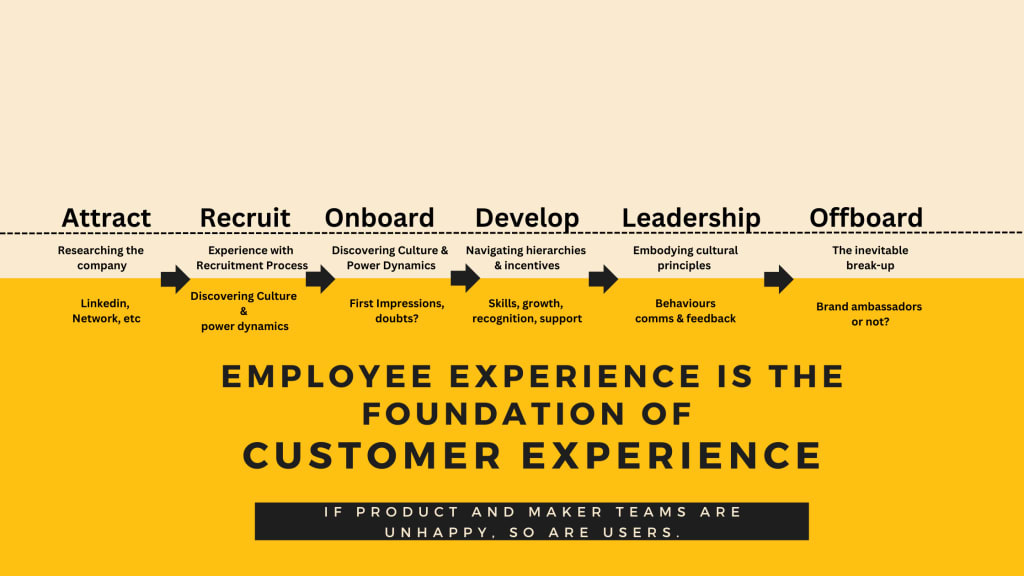
When employees leave, they take with them their knowledge, skills, and relationships, leaving a void that can be challenging to fill. This is why companies are increasingly recognizing the importance of employee experience in driving both engagement and retention.
To make matters worse for leaders and their budgets, at least 1 out of every 5 new hires will leave within 90 days anyway, before even making a contribution to company growth. Replacing them — or anyone who leaves abruptly — can cost the business 2x their salary*.
(*recruitment fees, onboarding costs, search & interview time loss, productivity loss, engagement & morale loss, training & orientation, knowledge loss, cultural impact).
With the costs of re-hiring so high, and with every company needing to replace 10–20% of its workforce every year just to stay the same size, it should be clear that investing time and resources in keeping people happy is a lot cheaper than paying to replace them.
Engagement and Retention
It’s been pretty well established by now that making employees happy will mean they stay longer and contribute more to the business. Research has shown that engaged employees are 20% more productive and 20% less likely to leave than their unhappy colleagues. When employees feel valued and supported, they are more likely to go above and beyond in their roles, resulting in improved customer satisfaction.
Mapping Employee Experience
Whether a company’s headcount is 20 or more, and whether these experiences have been intentionally designed or not, they are happening. The business is preserving or spending money, time, and employee well-being every day as a percentage of its operating system. To truly understand and enhance employee experience, it is important to map out the key elements that contribute to their satisfaction.
Things employees care most about:
- Ability to do what they do best
- Work-life balance and personal well-being
- Stability and job security
1. Ability to do what they do best
Employees thrive when they are able to utilize their skills and expertise to make meaningful contributions. When they are given the autonomy to excel in their areas of strength, they feel a sense of accomplishment and fulfillment. Companies that understand this and provide opportunities for professional growth and development are more likely to have satisfied employees.
2. Work-life balance and personal well-being
In today’s fast-paced world, work-life balance is becoming increasingly important. Employees value companies that prioritize their well-being and offer flexible work arrangements, wellness programs, and other initiatives that support a healthy work-life balance. When employees feel that their personal lives are respected and supported, they are more likely to be satisfied and productive in their roles.
3. Stability and job security
Job security is a significant concern for employees. They want to feel confident that their jobs are stable and that their efforts are contributing to the long-term success of the company. When companies provide clear communication, transparency, and a sense of stability, employees are more likely to feel secure and satisfied in their positions.
Breaking things down
A startup with plans to double or triple its headcount should clearly focus on its recruitment & onboarding strategy, process, and tools first, as that is where most time and money risks being wasted. Once teams are designed, built and safely onboarded, budget and focus can switch; keeping them happy, engaged and productive by designing the rest of the employee experience with them, collaboratively.
If a company needs to freeze hiring, consolidate teams, and identify areas for efficiency, it’s more important to have a strategy and tools for transparently benchmarking skills and competencies across each team. Grounding organizational (re)design projects in ‘skills’ rather than ‘roles’ is a more effective and fair approach; job titles alone typically fail to capture the total contribution and impact an individual brings to the business, or represent all the different skills a person has.

Discovery
User research for employee experience projects should be easy, all the participants already work for the business after all. The challenge is they also probably want to keep their jobs and not be labelled ‘negative,’ so they need to feel safe sharing unfiltered thoughts and feelings about their employers. To get honest feedback, employees must believe that their input will lead to positive change within the organization.
The people-ops systems that are going to be created will indicate which groups of people and stakeholders to speak to, and what to ask;
- Recruitment & onboarding
- Skills growth & development
- Roles & career paths
- Feedback & people data
- Compensation & benefits
- Communication & alignment
- Culture & leadership
A big part of the challenge of this discovery work is that there are three distinct user groups, whose incentives don’t obviously align; the business leaders, the people managers, and the employees.
Finding solutions that meet everybody’s needs is an iterative process that all three groups need to be actively involved in (understanding that they won’t all initially have the vocabulary or experience to do this super well).
For each EX phase/system, we want to know:
- How do these things currently work for people & the business?
- Where are the pain points for everyone?
- What needs aren’t being met?
- What are the outcomes/metrics/baselines that define improvement?
- What is the current best practice / what is the competition doing?
- What are the relevant People systems, processes, and tools involved? Which ones can be changed/consolidated/improved?
From this, organizations can quickly design and deploy new or improved processes and tools to a small number of users, precisely targeted at the desired outcomes. These can be tested and improved based on real-user feedback, insights, and data, before deploying to more people.
The key measure of success for people-ops initiatives is their ability to fix real problems without adding needless complexity. The more aligned solutions are to real-world experiences, and the more obviously user needs and wants have been uncovered and met, the lower the risk of ‘organ rejection’ by teams.
Getting things right
The sad fact is, most companies don’t take employee experience seriously until the pain of having ignored it is already acute. At scale, cultivating meaningful cultural and organizational change is exponentially slower, more complex, and more expensive than fixing issues before they become entrenched. It is crucial for companies to proactively address employee experience to avoid negative consequences in the long run.
There are illusory short-term business incentives to simply ignore how employees feel about their work, provided they keep doing it regardless. But not appreciating the differences between ‘doing the work’ and ‘enjoying the work’ is organizational self-sabotage.
Start by listening
The trick to knowing precisely what to do and where to improve things for people — and thus for the business — is to simply ask and actually do something with the answers. Conducting regular employee surveys, focus groups, and one-on-one interviews can provide valuable insights into the areas where improvement is needed. It is important for companies to actively listen to their employees’ feedback and take action based on their input.
The trick to knowing precisely what to do and where to improve things for people — and so for the business — is to simply ask, and actually do something with the answers.
But at less than 100 people, the mistake founders typically make is assuming they can intuit how their people feel without help; that proximity and intimacy somehow negate the need for dispassionate interlocutors or tools in obtaining unfiltered feedback.
Creating a culture of feedback takes time and consistent effort, and is best started early, but it shouldn’t be considered altruism or empathy to get things right for people.
Conclusion
In conclusion, employee experience plays a vital role in driving customer satisfaction. Engaged and satisfied employees are more likely to go above and beyond for customers, resulting in improved overall customer experience. Companies that prioritize employee well-being, provide opportunities for growth and development and actively listen to their employees’ feedback will create a positive work environment that fosters high levels of employee satisfaction and, in turn, customer satisfaction. By investing in employee experience, companies can ensure that their product and maker teams are happy, and as a result, so are the users!
CTA: To learn more about enhancing employee experience and driving customer satisfaction, subscribe to the newsletter for regular updates and insights!
And as always thanks for your time…
About the Creator
Leonardo Tognetti
HeadHunter & Coaching Specialist in the Tech Sector. Always open for a chat!
Keep reading
More stories from Leonardo Tognetti and writers in Interview and other communities.
Why Startup Leaders Fail: Micromanagement
However, despite this understanding, many startup leaders often fall into the trap of micromanagement. In this article, we will explore why micromanagement is detrimental to both the leader and the team and how it can hinder the growth of startups.
By Leonardo Tognetti3 years ago in Interview
Center Stage with Paul Stewart
*** I'm keen to republish the interviews I did for my series with Vocal creators. It's been a few years and I thought it might be nice to revisit these wonderful conversations. I'll be releasing them one at a time for a few weeks/months.
By Heather Hubler3 days ago in Interview
A Story of Taylor Swift
On a quiet Christmas morning in Reading, Pennsylvania, a young girl sat on the edge of her bed holding a guitar that was nearly as big as she was. Her fingers pressed carefully against the strings as she tried to match the melodies she heard in her head. Her name was Taylor Swift, and even at that young age, she understood something important: music was not just sound—it was a way to tell the truth. Long before stadium lights and chart-topping records, Taylor was learning how to turn feelings into stories.
By Organic Products a day ago in Interview




Comments
There are no comments for this story
Be the first to respond and start the conversation.