
The Worlds Between: Mashael Alqahtani Writes the Space Where Fear Meets Freedom
The Saudi-born screenwriter behind Tafheet and Sila is redefining what global genre storytelling can look like—bridging cultures, tones, and taboos with scripts that pulse between laughter and dread.

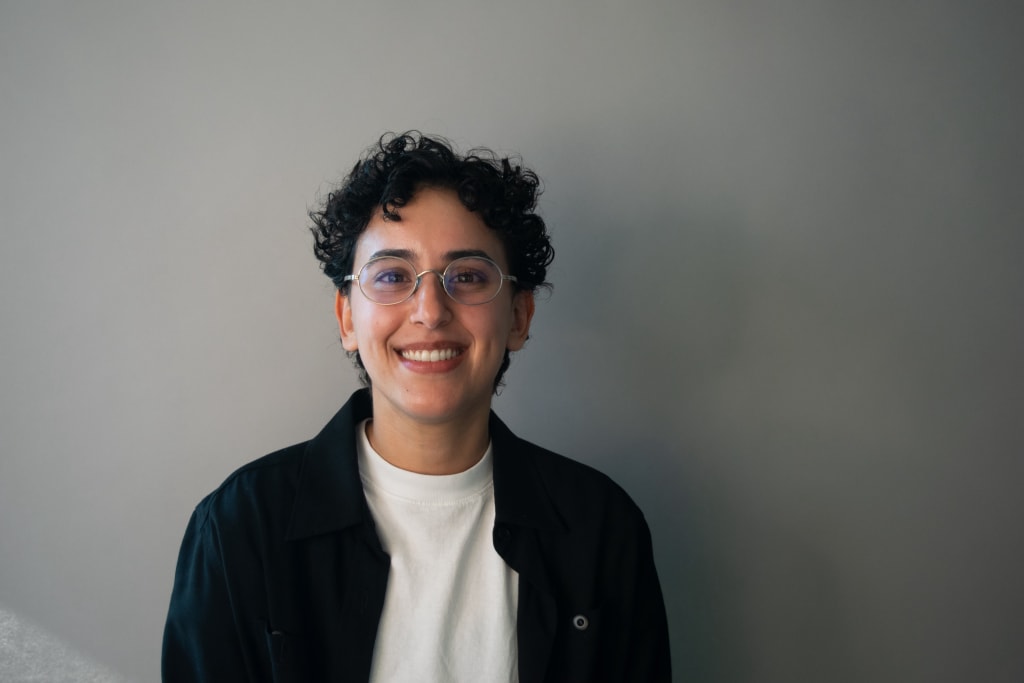
When Mashael Alqahtani says she wanted “a career doing what made me feel less alone,” she isn’t confessing a sentiment so much as mapping a survival strategy. For her, writing was never a hobby or even a goal; it was a practice of return, a ritual learned young from a small red diary gifted by her aunt after watching The Princess Diaries. In that notebook, a child’s loneliness began to mutate into story. The entries weren’t purely autobiographical; they were miniature worlds refracted through humor and exaggeration, the kind of half-true imaginings that made discomfort not just bearable but shapable. “I learned how to interrogate my feelings,” she recalls. “It made me feel comforted by myself and the power of my own imagination.”
That line, "the power of my own imagination", hums like a thesis across her career. It threads through her early training in Boston, Los Angeles, and finally at the American Film Institute, each stop tightening her command of screenwriting as both art and architecture. From the hands-on production fluency of Emerson to the structural discipline of USC, and finally the networked precision of AFI, Alqahtani assembled what she now calls a “tradecraft toolkit”: a balance of creative freedom and practical literacy that allows her to write with both emotional specificity and marketplace clarity.
It shows. Her work, which spanning horror, comedy, and genre hybrids, resists neat categorization. Tafheet, the script that won Script Pipeline’s First Look competition in 2024, began as something almost comically literal: a desire to learn how to drive. “As I wrote about a protagonist who loved driving for recreation and sport, I realized I had to learn with her,” she says. That parallel of writing the act while living it turned the process itself into a kind of collaboration between creator and character. The story evolved into an action-comedy about identity, agency, and movement, all set within a Saudi context rarely given cinematic playfulness. Winning Script Pipeline confirmed what she’d already felt instinctively: that Tafheet deserved a global audience. Not Western or Saudi, but both.
If Tafheet embodies speed and freedom, Sila moves in another rhythm entirely: that of folklore and fear. The project, which advanced to the second round of the Sundance Development Track in 2025, refracts horror through a distinctly cultural lens. “The feedback strengthened the horror mechanisms in my story,” she says. “I was able to hone in on the lore: the culture, faith, and family, to the scares.” For Alqahtani, horror and faith are not opposites but cousins: both rely on belief, repetition, and moral architecture. The monster, like the miracle, is a way of confronting what the rational world refuses to name.
It’s no surprise, then, that one of her literary touchstones is Noël Carroll’s The Philosophy of Horror. Carroll’s insistence on catharsis; that the purpose of horror is not terror but relief, governs the way she approaches all genre writing. “Horror and comedy are two halves of the same coin,” she explains. “They rely on rhythm and pace to build tension and release it. The idea of offering relief at the end of every beat, joke, or scare is just as important as the relief at the end of a story.”
In Sila, that principle manifests in a scene as bizarre as it is revealing: a bullied protagonist, a sudden bark from her crush, and a moment suspended between laughter and dread. “It’s both incredibly goofy and terrifying,” Alqahtani says. “Depending on my intentions, I build toward the tension of a regular scare, then land the moment with levity.” That tonal calibration, a tightening of setups, delaying of releases, reframing of agency, is her signature. In her hands, horror isn’t an end but a method: a way to make emotional truth visible.
Her projects share a thematic core: arrested adolescence colliding with adult responsibility. These are stories of becoming: awkwardly, painfully, sometimes hilariously, within structures that demand composure. “It comes from a personal place,” she admits. Having lived between Saudi Arabia and the United States for most of her adult life, Alqahtani knows the dissonance of adaptation. The cultural code-switching, the oscillation between expectation and autonomy, becomes her material. “Over the years, I’ve had to process my own culture shock and adaptability,” she says. “The waves of my life inform the themes I write about.”
Geography doesn’t just inform her work; it splits it open. Between Los Angeles and Riyadh, she keeps the same writing routine; consistency as a compass in motion. But the hemispheric shift feeds her sensibility. “I write characters that are specific to my upbringing and history,” she says, “but their stories have a commercial sensibility that’s accessible to a larger, global audience.”
Specificity, for Alqahtani, is the route to universality. Her insistence on maintaining cultural detail, even when notes from collaborators suggest otherwise, is part of a broader commitment to voice. “I’ve gotten feedback suggesting I change a protagonist’s background to be more understandable to a global audience,” she recalls. “The intentions behind those notes are good. But I’ve learned I have to defend my characters.” She pauses, then adds simply, “Authenticity translates.”
Her authenticity has begun to pay dividends. In addition to Tafheet and Sila, she’s developing BANAT, another Saudi-set feature built around friendship and female agency, structured for an international co-production model. Each of these projects, while grounded in a specific context, wields genre as an invitation rather than a filter. “Genre, for me, is a byproduct of character,” she says. “Once I know their voices, the tone follows.”
This character-first approach also guides her collaborations. Having co-written shorts like Two Sisters and The Witch Pricker and the Hare, Alqahtani has learned the quiet politics of authorship. “Writing alone is simple, it’s just you and the page,” she says. “Collaboration means learning how to advocate for your ideas. You have to carry that same confidence into the room.” In practice, that means defending a character’s emotional truth while staying flexible about structure or tone; a dance between protection and surrender.
Her industry experience extends beyond writing. She’s read coverage for development and distribution teams, an apprenticeship in marketplace psychology that permanently changed how she builds a script. “Every company I worked for asked the same question: can this piece of writing hold the reader’s attention within five pages?” she says. “That’s the only real fluency a filmmaker can have; a story that compels.”
If there’s a motif that unites her work, it’s rhythm. Whether in the pacing of a joke or the escalation of dread, Alqahtani writes like a percussionist: each beat deliberate, each silence purposeful. Even her reflections on career strategy carry that tempo. “Submitting widely keeps me engaged with the practice,” she says. “Writing is a privilege, but it’s also a muscle.” That discipline, equal parts humility and momentum, fuels her progress through a landscape where competitions and labs function as both validator and editor. Script Pipeline and Sundance may have conferred prestige, but the real value was precision. “Tighten the pitch,” she says, paraphrasing notes. “Sharpen the first five pages. Find the emotional through-line.”
Those habits have turned her into a rare kind of writer: one equally fluent in feeling and form. Her scripts feel both intimate and engineered, a combination that’s increasingly valuable in a global market hungry for specificity that sells. She attributes part of this balance to her mentors and influences, from professors at AFI to the boldness of Diablo Cody, whose Jennifer’s Body remains a north star for her. “Cody’s work moves through genres with a consistent voice,” Alqahtani says. “That’s what I aspire to.”
When asked what advice she’d give to emerging writers from the region, her answer is characteristically pragmatic. “Stay consistent,” she says. “It’s not just about talent, it’s about the routine of producing work. Consistency will yield results.”
That constancy, paradoxically, allows her to keep evolving. She speaks of writing not as mastery but as translation: of self, of culture, of contradiction. Her scripts are where multiple worlds negotiate space: laughter beside dread, intimacy beside spectacle, the local beside the global. It’s a balancing act, yes, but also a kind of faith; that stories rooted in truth will find resonance beyond the borders of their making.
If Alqahtani’s early diary entries were a rehearsal for connection, her screenplays now extend that impulse outward, to an audience she may never meet but already imagines in conversation with her characters. The diary has become a film set; the solitude, a shared theater. “Writing made me feel less alone,” she said once, almost as if explaining something self-evident. But what her work demonstrates is subtler: that imagination doesn’t just reduce loneliness, it rearranges it, turns it into a language we can recognize in one another.
And perhaps that is what defines Mashael Alqahtani’s place in contemporary cinema: not merely as a Saudi writer in Hollywood, but as an architect of emotional universes that speak across hemispheres. Her stories drive, tremble, and laugh in two languages at once. They remind us that even in fear, there is rhythm; in solitude, a pulse; in specificity, the most human kind of recognition.
About the Creator
Twenty-First Century Disability Podcast
Twenty-First Century Disability was created and is hosted by Hollis Peirce, a chronically physically disabled man with Congenital Muscular Dystrophy. Mr. Peirce, who is on a ventilator, can narrate his podcast using only his bottom lip. His voice is intelligible and intelligent.
By Frank Racioppi4 days ago in Interview
Why I Built an AI Therapist
I’ve been a waiter, a construction worker, a DJ, a kitchen hand, a porter, a caregiver, and a supermarket cashier. I’ve washed dishes in Australia and meditated in the Himalayas. I’ve battled addictions, eating disorders, anxiety, depression, and self-destructive behavior. Before I ever sat across from a client as a psychotherapist, I had already lived a dozen lives — and nearly destroyed myself in several of them.
By Laurentis Theofanus7 days ago in Interview
Hottest in the Office
Dear Rafi, You’re very distracting to work around. For the first second I saw you the other day, I thought you were some type of executive. It took a moment to realize no, you were just the new guy, dressed up for the job he wants. Be still, my heart.
By Gabriel Shames6 days ago in Pride



Comments (1)
Hi Author, I’m an avid reader who truly enjoys exploring different stories, and today I happened to come across one of yours. I have to say, I was completely captivated by it. Your writing style has such a unique charm every scene you described felt so vivid and alive. I’m genuinely impressed by your storytelling, and I’d love to know how long have you been writing such wonderful pieces?