
Revolution and Memory: Maddalena Celano on Forgotten Rebel Heroines.
Gianfranco Ferraris (Interviewer): Welcome, Maddalena, it’s a pleasure to have you back with us. I’d like to start with a question you may have heard many times before, but I believe it’s essential to understand your figure: how did your interest in the forgotten female figures of history begin?
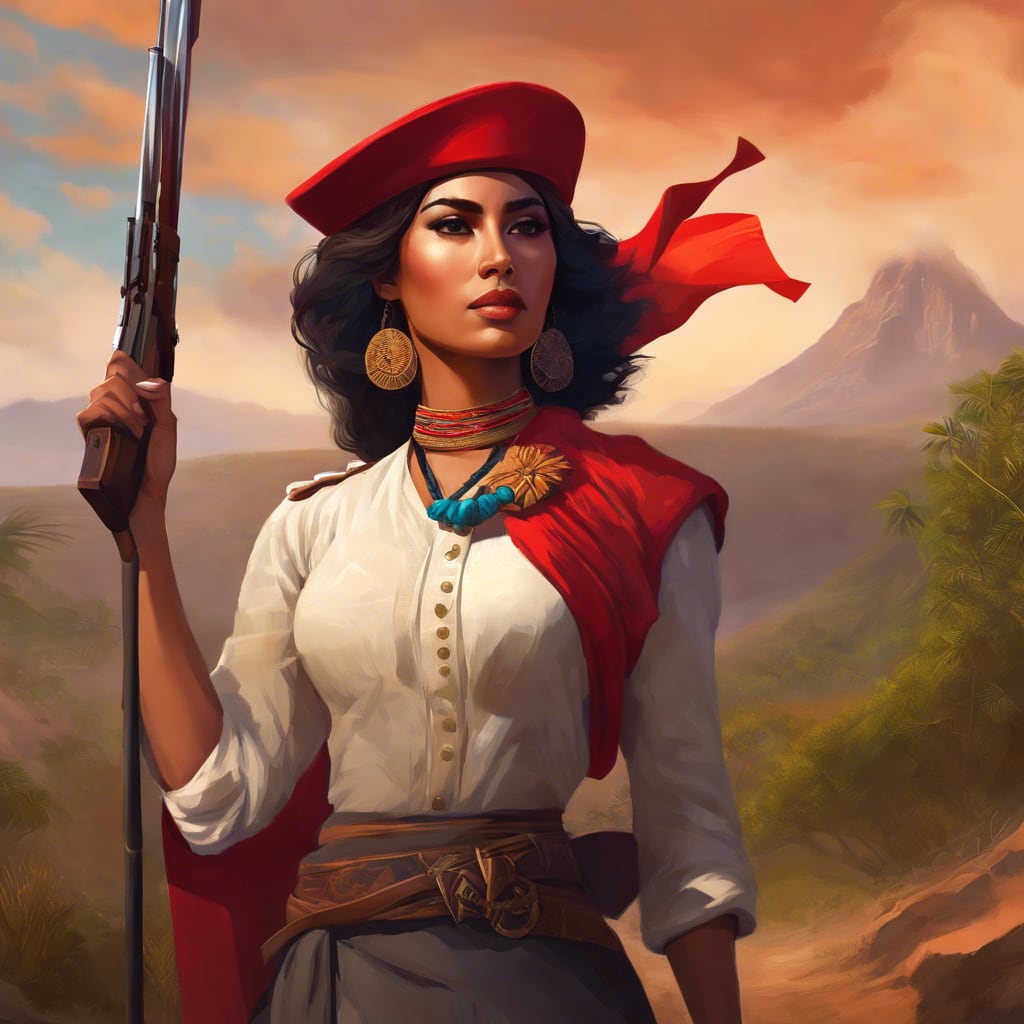
Gianfranco Ferraris (Interviewer): Welcome, Maddalena, it’s a pleasure to have you back with us. I’d like to start with a question you may have heard many times before, but I believe it’s essential to understand your figure: how did your interest in the forgotten female figures of history begin?
Maddalena Celano: Thank you for the invitation, Gianfranco. My interest in forgotten female figures stems from my personal and political experience. Growing up in a society that often tends to belittle and marginalize women’s contributions, I felt the need to bring back to light voices and stories that have been erased. In studying the history of Latin America, I discovered that many women were crucial in the struggles for independence and in resistance movements, but they were often overshadowed or forgotten. From this, my mission was born: to give these women the place they deserve in history and in our narratives.
Gianfranco Ferraris: In your works, a strong connection between history and political activism clearly emerges. How does your activism for the 21st-century Bolivarian Socialism influence your writing?
Maddalena Celano: Writing and activism are closely linked for me. The 21st-century Socialism, especially the Bolivarian legacy, is based on principles of social justice and equality. These values are central not only in my activism but also in the themes I choose to address in my books. Telling the stories of rebellious women or figures of resistance means speaking about the struggle against oppression, a theme that deeply resonates in my political vision. Writing thus becomes an act of militancy, a way to promote and perpetuate the fight for a more just world.
Gianfranco Ferraris: Let’s talk now about your book on Simón Bolívar and Manuela Sáenz, published by Dei Merangoli Editrice. How did you approach these two historical figures, and what struck you the most in telling their stories?
Maddalena Celano: Working on Bolívar and Manuela has been an extraordinary journey. Bolívar is an iconic figure, the Libertador, but I have always been fascinated by the contribution of Manuela Sáenz, his companion and a revolutionary activist in her own right. Manuela was not just a romantic partner, but a woman who fought alongside him, even in crucial battles. I wanted to explore their relationship from both a political and human perspective, showing how both influenced not only the course of history but also each other's lives. It is a story of struggle, passion, and sacrifice that deserves to be told in a balanced way.
Gianfranco Ferraris: With Mario Michele Pascale Editore, you published another important book, Eroine Ribelli. How did you choose the protagonists of this work, and what criteria did you use to tell their stories?
Maddalena Celano: The protagonists of Eroine Ribelli are women who marked crucial moments in history but have been forgotten or downplayed. The selection was guided by the importance of their contribution to the struggle against patriarchal, colonial, and political oppression. I wanted to tell their stories to demonstrate that social change has never been solely the work of men, and that women have also played a decisive role in revolutions and resistances. The main criterion was their real impact, even if it was not officially recognized.
Gianfranco Ferraris: With Porto Seguro Editore, you published two very different works: Manuela Sáenz Aizpuru and Anatomia di un Suicidio. Can you tell us about these books and their significance for you?
Maddalena Celano: Manuela Sáenz Aizpuru is an in-depth look at this revolutionary figure, a sort of biography that analyzes not only her role in Bolívar's life but also her independent and combative personality. Anatomia di un Suicidio, on the other hand, is a book that touches me deeply, as it tells the tragic story of Alma Sejini, also known as Adelina, a dear friend of mine. Alma was a victim of human trafficking and suffered violence and exploitation in the world of prostitution. But Alma did not give up: she was a feminist and an abolitionist militant who fought against the system that exploited and sought to annihilate her. She dedicated the last years of her life to denouncing trafficking and sexual exploitation, trying to protect other women from this horror. Anatomia di un Suicidio is my way of honoring her memory, remembering her struggle against the lobby and the prostitutive rhetoric, and the system that silenced her.
Gianfranco Ferraris: What is your writing process? How do you transform historical research into an engaging narrative for your readers?
Maddalena Celano: Research is the foundation of everything. I spend a lot of time studying historical sources, documents, biographies, and testimonies. But the biggest challenge is to transform this data into a narrative that touches the hearts of readers. I’m interested in telling not just the facts but also the emotions, motivations, and inner struggles of the people I write about. My writing always seeks to create a human connection, making the reader feel part of the story I am telling.
Gianfranco Ferraris: Can you tell us about your future projects? Are there new books coming out?
Maddalena Celano: Yes, I have several projects underway. I’m working on an essay about the political thought of Simón Bolívar, analyzed in light of contemporary challenges, and I’m also translating a biography by a young Chilean writer of Palestinian descent. Additionally, I’m continuing my research on forgotten female figures because there is still much to tell. Each new project represents an opportunity for me to expand my mission of giving voice back to those who have been marginalized in history.
Gianfranco Ferraris: That sounds really interesting! Thank you so much for your time and for sharing part of your incredible work with us.
Maddalena Celano: Thank you, Gianfranco, it has been a true pleasure.
Let me know if you need any further assistance!
About the Creator
Keep reading
More stories from Maddalena Celano and writers in Interview and other communities.
Revolutionary Voices
Gianfranco Ferraris (GF): Maddalena, thank you for being here with us. I would like to start from the beginning: your academic career is broad and varied, with specializations ranging from philosophy to territorial studies. What led you to choose such diverse disciplines, and how do you think they integrate into your work?
By Maddalena Celanoabout a year ago in Interview
An Interview with Dr. Douglas Sung Won
In modern healthcare, progress often emerges at the intersection of clinical innovation and structural leadership. Few professionals embody that intersection as clearly as Dr. Douglas Sung Won, MD. Over the past two decades, Dr. Won has built a reputation not only as a pioneer in minimally invasive spine surgery but also as a healthcare systems architect responsible for developing vertically integrated clinical infrastructures.
By Robin Milton7 days ago in Interview
My Interview With Marilyn Glover, A Master Poet On Vocal
https://shopping-feedback.today/authors/marilyn-glover-wp6q409z0 Marilyn Glover is a single mom of 3 daughters and one son. She also has two grandsons. She practices Reiki and loves nature. Her current project is her poetry book. She has been a creator on Vocal for five years. She has written over 300 stories on Vocal with 9753 reads so far.
By Mariann Carroll2 days ago in Interview
Author’s Advice
If you would’ve asked me 20 years ago did I know I’d become a writer and an author, I would’ve said “nope, ain’t happening”. As fate would have it I did become an author and I can honestly say I’m loving it so far. It really does feel good to be a writer. I’ve learned a lot on this journey and I feel like with even me being as new to this world as I am, there’s some wisdom I need to share with every other aspiring author.
By Joe Patterson4 days ago in Journal



Comments
There are no comments for this story
Be the first to respond and start the conversation.