
Revolutionary Voices
Maddalena Celano and the Women Who Changed History
Gianfranco Ferraris (GF): Maddalena, thank you for being here with us. I would like to start from the beginning: your academic career is broad and varied, with specializations ranging from philosophy to territorial studies. What led you to choose such diverse disciplines, and how do you think they integrate into your work?
Maddalena Celano (MC): Thank you, Gianfranco, for this opportunity. My passion for philosophy stems from a desire to understand the world in a deep and critical way. Over time, I felt the need to extend this understanding to more concrete fields like literature, education, and more recently, the environment. Territorial studies allowed me to explore the relationships between humans and their natural and social environments, with a particular focus on power dynamics and historical injustices. I believe that, although these disciplines are different, they complement each other in my research, especially when it comes to topics related to history and feminism.
GF: Your commitment to feminism has been evident since your first essay on Manuela Sáenz. What struck you most about this historical figure, and what do you think she can teach new generations?
MC: Manuela Sáenz has always fascinated me for her boldness and independence. She was not just Simón Bolívar's "companion," but a revolutionary leader in her own right. What struck me was her ability to challenge the social conventions of her time and carve out a space for herself in a male-dominated world. I think her story teaches new generations the importance of fighting for what they believe in, without being constrained by society's expectations.
GF: In 2020, you published the essay Cuban Women: The Other Half of the Revolution, a topic that sparked great interest. What drove you to write about this subject?
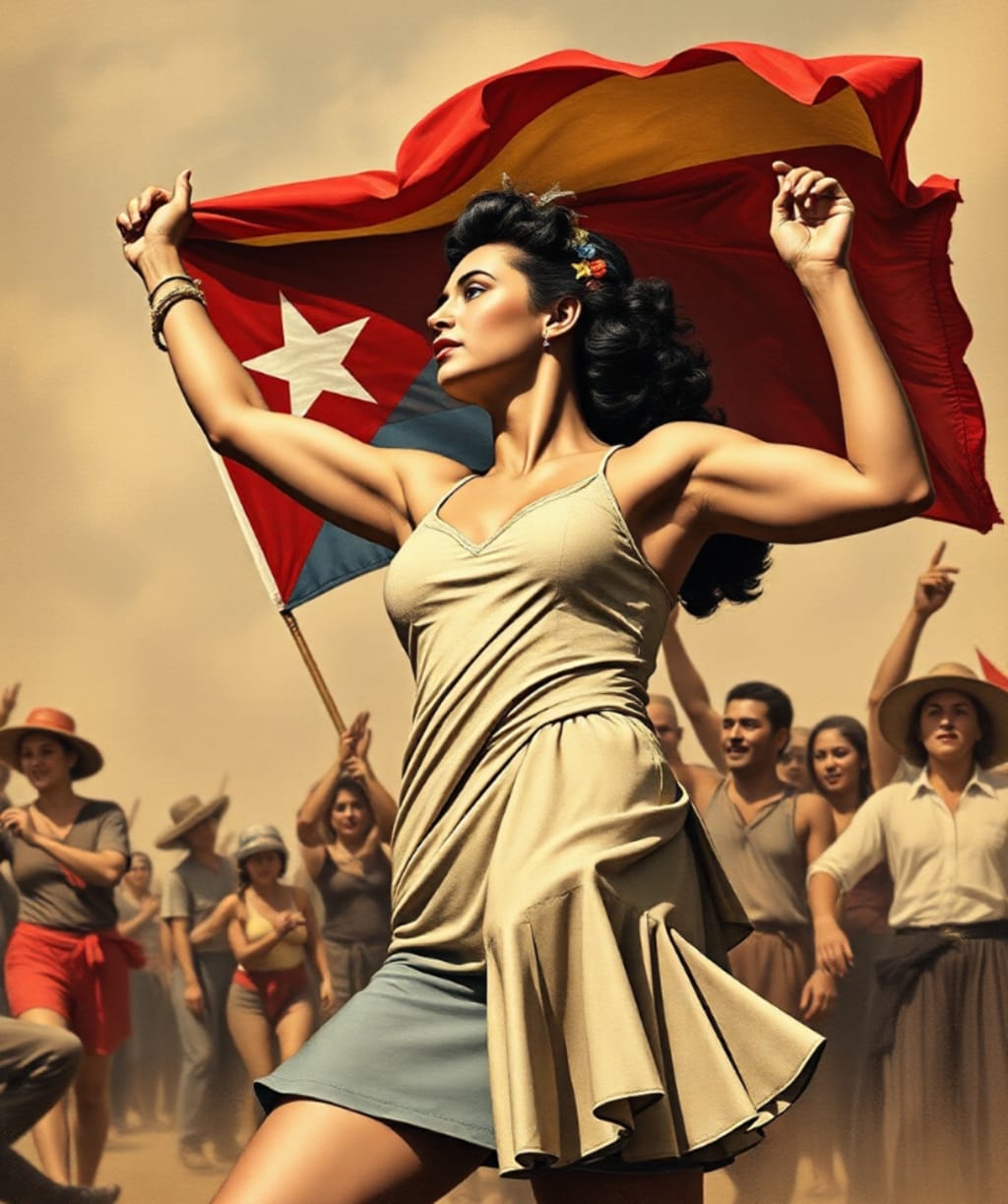
MC: The Cuban Revolution is often viewed through a male lens, with figures like Fidel Castro and Che Guevara dominating the narrative. However, many women played a crucial role in the fight for Cuba's freedom. I felt their story needed to be told. I wanted to highlight the contribution of women to the Revolution, not just as supporters but as active leaders with their own vision.
GF: Recently, you published Rebel Heroines, a poetic essay in which you recount the profiles of courageous women. Why did you choose poetry as the expressive form for this work?
MC: Poetry allowed me to tell the stories of these women in a more intimate and immediate way. I wanted to pay tribute to the emotions, courage, and challenges these women faced. Poetry has an evocative power that can convey not only the facts but also the deep feelings tied to their experience. Rebel Heroines is a way to bring out the emotional dimension of their struggle.
GF: You have also curated the publication of various essays, such as that of Professor Giulio Santosuosso. What attracts you to editorial curation, and how has this experience influenced your work?
MC: Curating an essay is a different kind of work from writing, but equally stimulating. I enjoy working with other authors, helping them develop their ideas, and contributing to a final product that is coherent and impactful. This experience has taught me a lot about the importance of teamwork and the plurality of voices. Each author has a unique vision, and my role as a curator is to shape these visions without distorting them.
GF: Looking to the future, what are your upcoming projects? I know new works will soon be released with Mario Michele Pascale Editore.
MC: Yes, that's right. I'm working on a new book about Simón Bolívar, which will be published with Mario Michele Pascale Editore, the same publisher of Rebel Heroines. Additionally, I'm translating a biographical text written by a young Chilean writer of Palestinian origin, which will also be published by Kulturjam. I am very excited about these projects because they allow me to explore new historical and cultural perspectives, while keeping my commitment to promoting historical female figures and Latin American independence movements alive.
GF: We are really looking forward to reading these new works. Thank you so much, Maddalena, for this interview.
MC: Thank you, Gianfranco, it was a pleasure to share these projects with you.
About the Creator
Keep reading
More stories from Maddalena Celano and writers in Interview and other communities.
Brazil: Rebirth and Progress in a Time of Radical Transformations
Mark your calendars for July 24, 2024, at 9:00 PM, for an unmissable interview with Brazilian anti-imperialist and feminist activist Jisele Farja Rodriguez. This event promises to be an enlightening discussion on Brazil's recent political, economic, and social transformations and the nation's renewed commitment to progressive values under President Luiz Inácio Lula da Silva.
By Maddalena Celano2 years ago in Interview
Part 2 Interview With Joe Patterson, Author Of Melanin Memoirs
This is my second interview with Joe Patterson. His 4th anniversary writing on Vocal will be in March 2026. He has one achievement on Vocal, The Other Foot. He has over 17,000 reads on Vocal since he started on Vocal in 2022. Joe Patterson is very creative poet and rapper. Joe is deep thinker and I feel it is reflected in his latest published book, Melanin Memoirs.
By Mariann Carroll20 days ago in Interview
The Quiet Discipline That Builds a Better You
Self-development is often portrayed as a dramatic transformation—a sudden breakthrough, a burst of motivation, or a life-changing decision made in a single moment. In reality, it rarely works that way. Real growth is quiet, often invisible, and built on small actions repeated over time.
By Lukáš Hrdlička7 days ago in Interview
Unofficial Challenge: Black History Celebration
Forward: February 28th, 10:53 PM, EST... The final hour of Black History Month, 2026. Hello fellow writers. I've had this challenge waiting in my drafts for most of the month. But I held off on publishing it, until now.
By Sam Spinelli4 days ago in Writers



Comments
There are no comments for this story
Be the first to respond and start the conversation.