
Ratna Tata Died
Life Story of Ratna Tata - 1937-2024
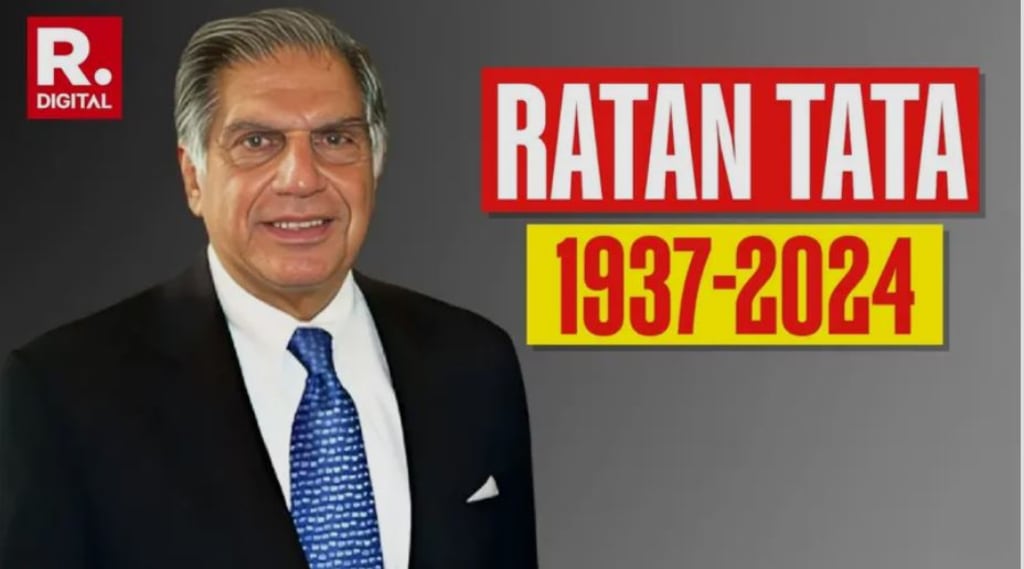
Ratan Tata's Life Story
Ratan Tata is one of India's most respected industrialists, known for his humility, integrity, and visionary leadership. He was the chairman of Tata Sons, the holding company of the Tata Group, from 1991 to 2012, and again served as interim chairman from October 2016 to February 2017. Here’s a brief account of his life story:
Early Life and Education
Born: December 28, 1937, in Bombay (now Mumbai), India.
Ratan Tata comes from the prestigious Tata family, which has played a pivotal role in India’s industrial development. His father, Naval Tata, was adopted into the Tata family, while his mother, Sooni Tata, was from a wealthy and influential Parsi family. His parents separated when he was young, and he was raised by his grandmother, Lady Navajbai Tata.
Education: Ratan Tata attended the Campion School in Mumbai and later graduated from the Cathedral and John Connon School. He pursued his higher education in the United States, obtaining a degree in architecture from Cornell University in 1962. Later, he completed the Advanced Management Program at Harvard Business School in 1975.
Early Career
After completing his education, Ratan Tata returned to India and joined the Tata Group in 1962. He started working on the shop floor of Tata Steel in Jamshedpur, an experience that grounded him in the practical aspects of the business.
Over the years, he worked in various Tata companies and gained valuable insights into business operations, gradually rising through the ranks.
Leadership at Tata Group
Ratan Tata became the chairman of Tata Sons in 1991, succeeding J.R.D. Tata. When he took over, the Tata Group was a loose federation of companies with many semi-autonomous units.
One of his early goals was to consolidate the Tata Group’s holdings and improve the focus of the group’s strategy. Under his leadership, the group became a more unified organization with better synergies between its various companies.
Major Achievements
Global Expansion: Under Ratan Tata's leadership, the Tata Group transformed into a global powerhouse. Some of the key acquisitions include:
Tata Tea’s acquisition of Tetley in 2000.
Tata Motors’ acquisition of Jaguar Land Rover in 2008.
Tata Steel’s acquisition of Corus Group in 2007.
Tata Nano: One of Ratan Tata’s most ambitious projects was the Tata Nano, the world's cheapest car, launched in 2008. His vision was to make an affordable car for the masses in India, though the project faced challenges and did not succeed commercially as expected.
Philanthropy and Ethics: Ratan Tata is known for his strong sense of corporate social responsibility. A significant portion of the Tata Group's wealth is owned by charitable trusts, which fund various initiatives in education, healthcare, and social causes. Even after his retirement, he continues to be a driving force behind the Tata Trusts.
Focus on Innovation: He strongly believed in innovation and technological advancements, which helped the Tata Group to remain competitive and relevant in the rapidly changing global marketplace.
Retirement and Later Years
Ratan Tata retired as the chairman of Tata Sons in 2012, passing on the leadership to Cyrus Mistry. However, he returned as interim chairman in 2016 after a conflict between the Tata Group and Mistry. In 2017, Natarajan Chandrasekaran took over as chairman of Tata Sons.
Even in retirement, Ratan Tata remains active in the business and philanthropic worlds. He is also a mentor to many young Indian entrepreneurs and invests in start-ups.
Personal Traits and Legacy
Humility: Despite his immense success, Ratan Tata is known for his down-to-earth personality and humility. He leads a simple life and is very private about his personal affairs.
Integrity and Ethics: Throughout his career, Ratan Tata upheld the highest standards of ethical business practices. He refused to engage in corrupt practices and maintained the Tata Group's reputation as a responsible and principled company.
Impact on India: Ratan Tata's contributions to India’s industrial and economic growth are unparalleled. He played a significant role in making Tata Group a symbol of Indian business excellence, both domestically and globally.
Ratan Tata remains an inspirational figure for millions of people, admired for his leadership, vision, and commitment to making a positive difference in society.
About the Creator
Keep reading
More stories from Shaik Abdul Khadar Jilani and writers in Interview and other communities.
Do you know why we get a fever?
Do you know why we get a fever? Fever, clinically known as pyrexia, is an abnormal increase in body temperature, usually due to an illness. Commonly thought as an undesirable side effect of diseases, fever is actually an effective way the body uses to fight infections. Patients usually recover faster when they allow fever to run its course rather than suppressing it with fever-reducing medications. This is because a higher temperature slowdown the growth of most pathogens, as well as boosts the effectiveness of the body's immune response. It also increases metabolic rates and thereby accelerating tissue repair. Normally, the hypothalamus keeps the body's temperature within a narrow range around 37degrees Celsius, or 98.6 degrees Fahrenheit. The hypothalamus acts like a thermostat. It receives inputs from heat and cold receptors throughout the body, and activates heating or cooling, accordingly. When the body is too hot, the hypothalamus sends instructions for it to cool down, for example, by producing sweat. On the other hand, when temperature drops, the hypothalamus directs the body to preserve and produce heat, mainly via the release of nor epinephrine. Nor epinephrine increases heat production in brown adipose tissue and induces vasoconstriction to reduce heat loss. In addition, acetylcholine stimulates the muscles to shiver, converting stored chemical energy into heat. Fever is part of the inflammatory response. When immune cells detect the presence of a pathogen, for example, upon binding to a component of bacterial cell walls, they produce inflammatory cytokines. Some of these cytokines are fever-inducers, or pyrogenic. Pyrogenic cytokines act within the hypothalamus to induce the synthesis of prostaglandin E2,PGE2, the major fever inducer.PGE2 acts on thermoregulatory neurons of the hypothalamus to raise the body’s temperature set point. In other words, PGE2 tricks the hypothalamus into thinking that the body is cold, while in fact the temperature did not change. In response, the hypothalamus instructs the body to actively produce heat to raise body temperature above normal. Fever-reducing medications, such as aspirin and ibuprofen, work by suppressing PGE2 synthesis. Once infection is cleared, pyrogens are no longer produced and the hypothalamic thermostatis set back to normal temperature. Cooling mechanisms, such as sweating and vasodilation, are activated to cool the body down. While fever is usually beneficial and need not be treated, precaution should be taken to prevent body temperature from running too high, which may cause confusion, seizures and irreversible damage to the brain. Finally, it is important to differentiate between fever and hyperthermia, the latter is often caused by extended exposures to extreme heat, or heat stroke. Unlike fever, the body’s temperature set point in hyperthermia is unchanged and the body does not produce the extra heat; its cooling system is simply exhausted and fails to compensate for the excessive external heating. Hyperthermia is always harmful and must be treated with various cooling methods. Fever-reducing medications have no effect on hyperthermia as pyrogens are not involved. Here are some short steps to manage or reduce fever: • Stay Hydrated Drink plenty of fluids like water, herbal teas, coconut water, or oral rehydration solutions to stay hydrated and prevent dehydration caused by the fever. • Cool Compress Apply a cool, damp cloth to your forehead, neck, or wrists to help bring down the body temperature. This provides relief from the heat. • Rest Your body needs energy to fight off the infection causing the fever, so it’s important to rest as much as possible. • Wear Light Clothing Wear lightweight and breathable clothing. This helps in regulating your body temperature. Avoid bundling up with heavy blankets unless you have chills. • Take Fever-Reducing Medication Over-the-counter medications like acetaminophen (Tylenol) or ibuprofen (Advil, Motrin) can help lower the fever. Follow the recommended dosage and consult a healthcare professional if necessary. • Lukewarm Bath Taking a lukewarm bath or sponge bath can help cool your body. Avoid using cold water, as it can cause shivering and increase your body temperature. • Monitor the Fever Keep track of the fever using a thermometer, especially if it is above 102°F (38.9°C) in adults or lasts more than 3 days. High or persistent fever should be addressed by a doctor. • Seek Medical Attention If the fever is very high, lasts more than a few days, or is accompanied by severe symptoms (such as difficulty breathing, chest pain, confusion, or persistent vomiting), it’s important to seek medical attention immediately. Thank you
By Shaik Abdul Khadar Jilaniabout a year ago in 01
Part 2 Interview With Joe Patterson, Author Of Melanin Memoirs
This is my second interview with Joe Patterson. His 4th anniversary writing on Vocal will be in March 2026. He has one achievement on Vocal, The Other Foot. He has over 17,000 reads on Vocal since he started on Vocal in 2022. Joe Patterson is very creative poet and rapper. Joe is deep thinker and I feel it is reflected in his latest published book, Melanin Memoirs.
By Mariann Carroll23 days ago in Interview




Comments
There are no comments for this story
Be the first to respond and start the conversation.