
Peru: Between Political and Social Crisis – A Country at a Crossroads*
On October 23, 2024, at 9 PM, Maddalena Celano will interview Carlos Jacinto Brito Vega on the YouTube channel of the Bolivarian Internationalist Movement (MIB). The interview will focus on the serious issues afflicting Peru, a country in crisis for several months. Carlos Jacinto Brito Vega, a prominent figure, is a professional nurse, founder of CONAPI (National Coordination of Peruvian Associations in Italy) and REDCAN (an Caribbean Association).
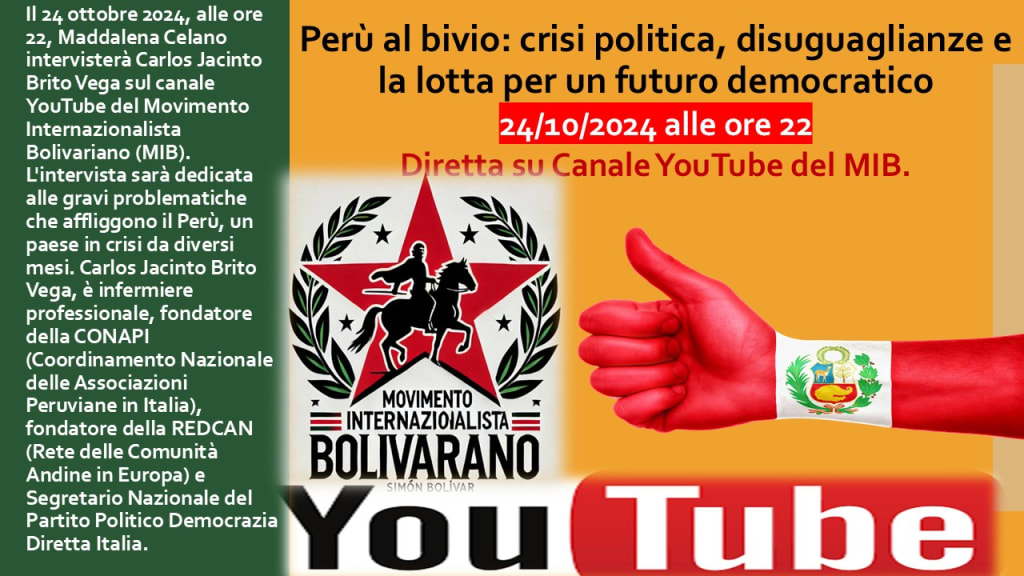
The meeting will address crucial themes related to the political and social situation in Peru, with particular attention to the controversial legacy of Alberto Fujimori and the scandals involving President Dina Boluarte.
Peru, a country with a rich history and complex political landscape, is going through one of the most challenging phases of its contemporary history. Political instability, exacerbated by the ousting of former President Pedro Castillo and the contested government of current President Dina Boluarte, has revealed deep social, economic, and cultural divides that plague the Andean nation. In light of these dynamics, Carlos Jacinto Brito Vega, a prominent Peruvian activist, will be interviewed by Maddalena Celano on the YouTube channel of the Bolivarian Internationalist Movement to analyze the critical situation in
Fujimori and the Legacy of a Controversial Decade
One of the central themes of the current political crisis is linked to the figure of Alberto Fujimori, the former president of Peru, who passed away on September 11, 2024. Fujimori, in office from 1990 to 2000, left an indelible mark on the country's history. On one hand, his government is remembered for neoliberal economic policies that stabilized the country after years of hyperinflation and for fighting against rebel groups such as the Shining Path and the Túpac Amaru Revolutionary Movement. On the other hand, his regime was deeply authoritarian, characterized by violent repression of human rights, endemic corruption, and the establishment of a de facto dictatorial government. Fujimori was convicted of crimes against humanity for two massacres of civilians during the internal war against rebel groups and spent sixteen years in prison.
Dina Boluarte's government's decision to proclaim three days of national mourning and hold state funerals in his honor has deeply divided Peruvian public opinion. While some see Fujimori as a strongman who restored order in a country on the brink of collapse, others remember the brutality of his repression and the systemic corruption of his government.
Dina Boluarte: A Government Under Siege
The current situation in Peru is strongly marked by corruption allegations against Dina Boluarte herself, who is under investigation for "illicit enrichment" in the so-called "Rolexgate" scandal, in which the president allegedly received luxury watches without declaring them to the tax authorities. The case has triggered a wave of resignations among government ministers and intensified calls for Boluarte's resignation from the opposition. However, the president continues to govern, supported by a parliament dominated by conservative and right-wing forces, guided by the United States.
Social tensions erupted after Pedro Castillo's ousting in December 2022. Castillo, a former union leader and leftist, was removed from office after attempting to dissolve parliament to prevent further destabilization of his government, which faced strong opposition from political elites and conservative media. His removal triggered violent protests, with over fifty deaths during clashes with law enforcement, leading to charges of "genocide and aggravated murder" against Dina Boluarte. These tensions remain unresolved today, as disillusionment with democratic institutions grows alarmingly.
A Deteriorating Economic Landscape
Economically, Peru continues to grapple with historical inequalities affecting much of the population, particularly indigenous and rural communities. Although the country has been one of the most dynamic in Latin America for years due to the export of raw materials like copper and gold, economic growth has not translated into significant improvements for the poorest classes. The current political crisis has exacerbated social discontent, with rising poverty rates and inflation burdening basic goods.
The Figure of Carlos Jacinto Brito Vega
In this complex and unstable context, Carlos Jacinto Brito Vega, founder of CONAPI and REDCAN, has become a spokesperson for the demands of the Peruvian diaspora and indigenous communities fighting for their rights. A professional nurse and long-time activist, Brito Vega is also Secretary of the National Political Party Democracy Direct Italy and a member of the Regional Council of CGIL (Lazio). During the interview with Maddalena Celano, Brito Vega will provide an in-depth analysis of the Peruvian political situation, highlighting the connections between the national crisis and the role of Peruvian communities abroad, which play a crucial role in supporting their families who remain in the homeland.
Towards a Solution?
The political crisis in Peru does not appear to have an imminent resolution. Dina Boluarte continues to resist calls for her resignation, but her legitimacy is increasingly fragile. The parliament, dominated by the right, has proven unable to offer political solutions that meet the needs of working and indigenous classes, exacerbated by political polarization and regional tensions. Additionally, the approval of a law declaring crimes against humanity committed before 2002 to be statute-barred, which Fujimori could benefit from, fuels further divisions between those demanding justice for the victims of the internal conflict and those who wish to move on from those turbulent years.
The interview with Carlos Jacinto Brito Vega will be a valuable opportunity to take stock of one of the most severe crises in contemporary Latin America and to reflect on how the Peruvian diaspora can contribute to a peaceful and democratic solution for the country.
Conclusion
Peru is a divided country, caught between the weight of its recent history and the need to find new paths for the future. The controversial figure of Alberto Fujimori continues to provoke debate, as does the authoritarian management of Dina Boluarte. Hope lies in voices like those of Carlos Jacinto Brito Vega, committed to defending the rights of marginalized communities and offering a perspective for change through dialogue and active participation. Peru will face enormous challenges, but the future of the country may depend on the ability of its leaders to listen to these voices and find a way out of the crisis.
Link to access the interview: https://www.youtube.com/watch?v=8JobEfdXtv0
About the Creator
Keep reading
More stories from Maddalena Celano and writers in Interview and other communities.
Revolution and Memory: Maddalena Celano on Forgotten Rebel Heroines.
Gianfranco Ferraris (Interviewer): Welcome, Maddalena, it’s a pleasure to have you back with us. I’d like to start with a question you may have heard many times before, but I believe it’s essential to understand your figure: how did your interest in the forgotten female figures of history begin?
By Maddalena Celanoabout a year ago in Interview
Rickard Sagirbay on Philosophy, Science, and Human Potential: or, Intelligence, Stoicism, and Spiritual Inquiry
Rickard Sagirbay is a Swedish author and online writer of Turkish family origin, born in 1984, who blends philosophy, metaphysics, science, and self-development. Active in niche high-IQ communities including OLYMPIQ, ISPE, and Mensa, he is a multilingual thinker interested in truth, logic, reincarnation, and human potential. His bibliography includes numerous self-published titles, among them "The AI-integrated Human Evolution" and "2150 The World Upside Down." Sagirbay emphasizes endurance, personal transformation, and intellectual growth, often framing life as a struggle through darkness toward greater insight, resilience, and evolving self-understanding in both mind and spirit over time.
By Scott Douglas Jacobsen3 days ago in Interview
History For The Reckoning Podcast On Neglected History
History for the Reckoning is a new podcast that launched on February 19th, 2026. The show defines itself as “a podcast exploring uncomfortable, overlooked, or erased American history through expert interviews.”
By Frank Racioppiabout 10 hours ago in Interview


Comments
There are no comments for this story
Be the first to respond and start the conversation.