
How universities can better prepare their students for a future with AI and face the future of work
In the future, every job will be an AI job: Interview with Professor Cindy Casey, Ph.D

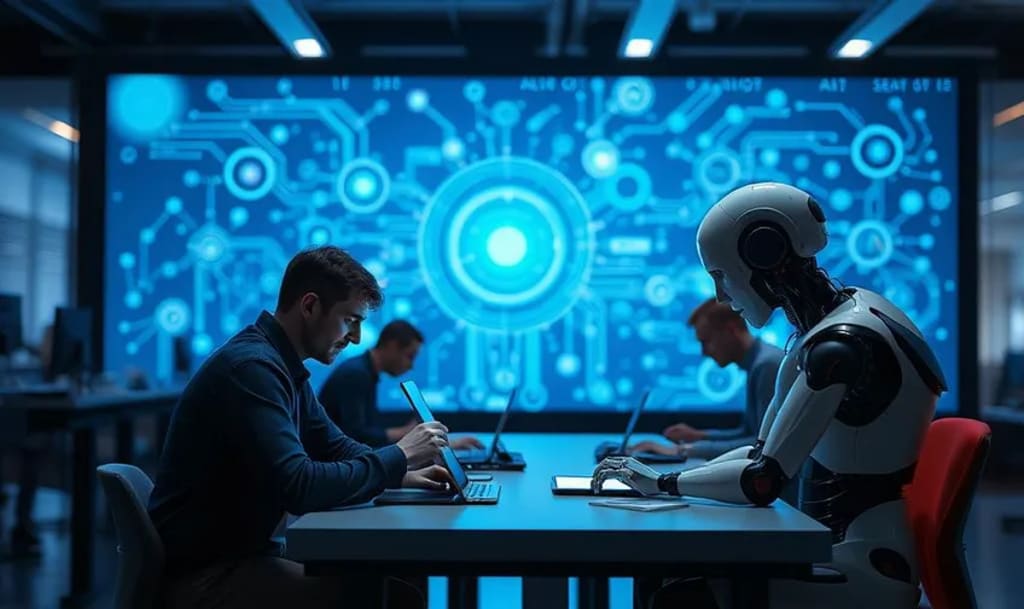
In the future, every job will be an Artificial Intelligence (AI) job. That was the main take away from an exclusive interview with Gwynedd Mercy University Professor Dr. Cindy Casey. Dr. Casey and I discussed how universities can better prepare their graduates to face the future AI jobs.
The future of higher education, the future of work, and Artificial Intelligence (AI) is a shared future. In the coming years, every job will be an AI job. In this light, it is paramount to teach students how to learn —rather than to teach— specific technologies.
I sat down with Dr. Cindy Casey, Program Coordinator and Assistant Professor for Gwynedd Mercy University’s Computer Information Science Program for the School of Arts and Sciences, and Head Computational Sciences, to learn how she is incorporating AI into her courses. Professor Casey earned her doctorate in Artificial Intelligence from Capitol Technology University in Washington, D.C.. Her dissertation on AI Curricula in Post-secondary Education: Are Programs Adequately Preparing Students for Future Technologies? A Model for Developing Artificial Intelligence Curriculum served as the grounds for her and others work in higher education.
Dr. Casey and I discussed how universities can better prepare their students for a future with AI, when every job will be an AI job.
A few years ago, Dr. Cindy Casey started a concentration course in Artificial Intelligence (AI) and Machine Learning (ML) in their Computer Information Science Program. What they did at Gwynedd Mercy University was to implement a hands-on teaching approach.
“We did this with Artificial Intelligence and Machine Learning because we believe that students learn more by doing since it increases their critical thinking and creativity as opposed to just learning all theory; although this is not to say we do not use theory,” Dr. Casey explained.
Gwynedd Mercy University has dedicated lab spaces where students can work on projects. One of their first projects was when they worked on a Xiaomi cyber dog.
“[In the lab,] we have robotic arms, chips, and robotic kits with facial and voice recognition, so the students are actually getting hands-on experience when they are working with the technologies. They are not just reading about them, learning about them, they are actually working with the technologies.”
Susan Fourtané: I read about your work with the cyber dog and your dedicated AI lab spaces. How do you see the future of AI in higher education?
Dr. Casey: I believe AI will continue to play a role in higher ed, and educators need to incorporate Artificial Intelligence technologies into their curriculum and address not just the technology but the ethics and the risks associated with AI, like bias and privacy. On an institutional level, if technologies are not in line with the industry, or industry demands, and with other institutions, they are going to suffer; so it has to be incorporated at all levels.
Susan F: After speaking with faculty from different universities I understand that more and more students who are entering university possess more knowledge on technology than their instructors. Because technology has changed and it is in a continuous and utterly rapid evolution, those instructors who have not kept on top of it quickly fall behind. What’s your view?
Dr. Casey: When we got the cyber dog, for instance, I had never worked with it. So, rather than me sitting there for six months figuring it out, and then importing that knowledge onto the students, we all worked on it together, and it was really successful. I think education and teachers need to take a more hybrid kind of approach, a little bit away from the traditional TPAC (technology, pedagogy, and content) knowledge models and move towards a model in which students are getting more from learning hands-on.
Susan F: Considering future graduates and future jobs, you believe every job will be an AI job, and in fact, many of them are AI jobs already.
Dr. Casey: Yes. Knowledge about AI is now critical, but not just for STEM (science, technology, engineering, mathematics) professions but for all professions. If the students are not prepared, if they are not introduced to the technology, they will be at a disadvantage. A lot of universities and schools are hyper-focusing on one technology, and I’ll just use ChatGPT (generative AI) as an example. They focus on this one technology, and [faculty] might spend a whole year trying to use it and learn it quickly to introduce it to the students. By the time the students graduate, that technology has already changed. That’s why it’s important to teach them to learn rather than to just teach them to learn a technology. That’s what we’re doing at Gwynedd Mercy University; we’re not teaching our students to be a user of technology. We’re teaching them to be innovators and creators of the technologies.
Susan F: We might say that faculty can be divided into two groups. Some believe that students can use ChatGPT and other similar generative AI technologies to cheat, write essays, and so on. Others, on the other hand, support the idea that letting students use the available technologies is an opportunity to help them to develop more creative skills and critical thinking. Can you elaborate which group you belong to?
Dr. Casey: Definitely the latter. If students are going to use the technologies to cheat, they are going to find a way to cheat. I don’t think that the majority of students are in that statistic. It reminds me of the United States in 1988 when there were a lot of math teachers that protested the calculators in class, and we now see that calculators are included in math classes. I say, if you have a technology, you should be using it because companies are using it. And when [graduates] get out into the work world, they need to know about the technology. It’s kind of like taking books away because the students might open the book and cheat. I think it’s important that universities need to use these tools and that they have to evolve with the technology. They have to be flexible enough to change the curriculum as the technology changes and recognise when change is necessary, because there’s a lot of competition from the massive open online courses where students can learn those technologies and get a certificate.
Susan F: Some members of faculty seem to be afraid of AI technology, becoming reluctant to use it, or accepting their students to use it. Do you think fear of AI is a real issue?
Dr. Casey: I do think fear is an issue. I think that there is a lot of fear of the unknown and of these technologies. But I think a lot of it is just a misunderstanding.
Susan F: Behind every technology there is always a human. People usually blame the technology but the technology is just the result of someone’s programming and training the AI model. What are some of your thoughts on the ethics of Artificial Intelligence?
Dr. Casey: It is important that we not only teach the technologies but also the ethics because there is bias. There can be bias in training Machine Learning and Artificial Intelligence. We have to be careful that we also have to look at privacy issues because we want students to be good stewards of the technology. For instance, when they had the AI soap dispenser that only dispensed soap to Caucasian hands, it wasn’t that AI was racist but that it was only trained with a Caucasian so it didn’t recognize an African-American. We have to make sure that when we are training the AI models we take all that into consideration. AI is what is going to be in the future and what is going to be mainstream, and that’s just a matter of time.
Susan F: A last piece of advice to faculty and universities?
Dr. Casey: Institutions should find a strategy just to push Artificial Intelligence forward, incorporating it into every single course, and let the students use it freely instead of having fears that they are going to misuse the technology, cheat, and so on. Introduce the technologies and allow the students to use it, and let them understand where these technologies are being used in their field, and what they need to know.
It is really important that all universities, all programs, and educators realise that AI is in all fields out there and they should be introducing it, or they are putting their students at a disadvantage.
On trust, there is a need for more trust. I think that we need to trust the students more. If they can’t be trusted at the university, where then? I mean, this is where they’re learning, where they are discovering themselves. I think it’s a sad thing to just assume that every student is a cheater. I think they can do marvelous things, and that instructors are professional educators who need to look past their own limitations in technology. Trust the students, because that’s the first thing, in my opinion. We need to trust the students.
Susan F: Indeed. It will be up to them to show us our trust was well placed. As adults, we must give them a chance. It should be in their best interest to do the right thing.
***
About the Creator
Susan Fourtané
Susan Fourtané is a Science and Technology Journalist, a professional writer with over 18 years experience writing for global media and industry publications. She's a member of the ABSW, WFSJ, Society of Authors, and London Press Club.
Keep reading
More stories from Susan Fourtané and writers in Interview and other communities.
Center Stage with Paul Stewart
*** I'm keen to republish the interviews I did for my series with Vocal creators. It's been a few years and I thought it might be nice to revisit these wonderful conversations. I'll be releasing them one at a time for a few weeks/months.
By Heather Hubler2 days ago in Interview
A Story of Taylor Swift
On a quiet Christmas morning in Reading, Pennsylvania, a young girl sat on the edge of her bed holding a guitar that was nearly as big as she was. Her fingers pressed carefully against the strings as she tried to match the melodies she heard in her head. Her name was Taylor Swift, and even at that young age, she understood something important: music was not just sound—it was a way to tell the truth. Long before stadium lights and chart-topping records, Taylor was learning how to turn feelings into stories.
By Organic Products about 7 hours ago in Interview




Comments (4)
So true, the working world would definitely be using AI. So it's best for the students to learn what they can on how to use it properly
great interview and insights. I don't quite know what I think about all it. Mixed feelings on it. I can see the benefits, BUT I can see the downfall too
Great article - I guess I’d never really thought about the person behind the AI. Really thought provoking.
Great insights. Leaves a lot to think about.