
“The Symphony of Second Chances: How a Homeless Musician Rekindled My Faith in Humanity”
"A Street Performer's Melody and the Unlikely Friendship That Composed New Beginnings"
Winter 2018 felt like a point in time where I was drowning-not in the water, just in the unforgiving grind of the corporate world. Days ran into weeks in an endless blur of spreadsheets, deadlines, and sleepless nights. I had been mechanized-numbed by the fluorescent glow of my office and the never-ending hum of the computer. It had become my life: check these boxes, fulfill this never-ending to-do list, and there was no space for joy, no room for spontaneity. I existed, but did not live.
One frigid evening, working my way through a very gray subway station in Chicago, the unexpected happened. The air reeked of damp concrete and the metallic tint of the trains. Commuters passed, their faces buried in their phones or tucked away behind scarves. But then, amidst the noise and the numbness, I heard it-a hauntingly beautiful violin melody that cut through everything around me, its echoes off the walls stopping me dead in my tracks. It was raw and emotional and alive, contrasting drastically with this sterile world I'd been walking around in.
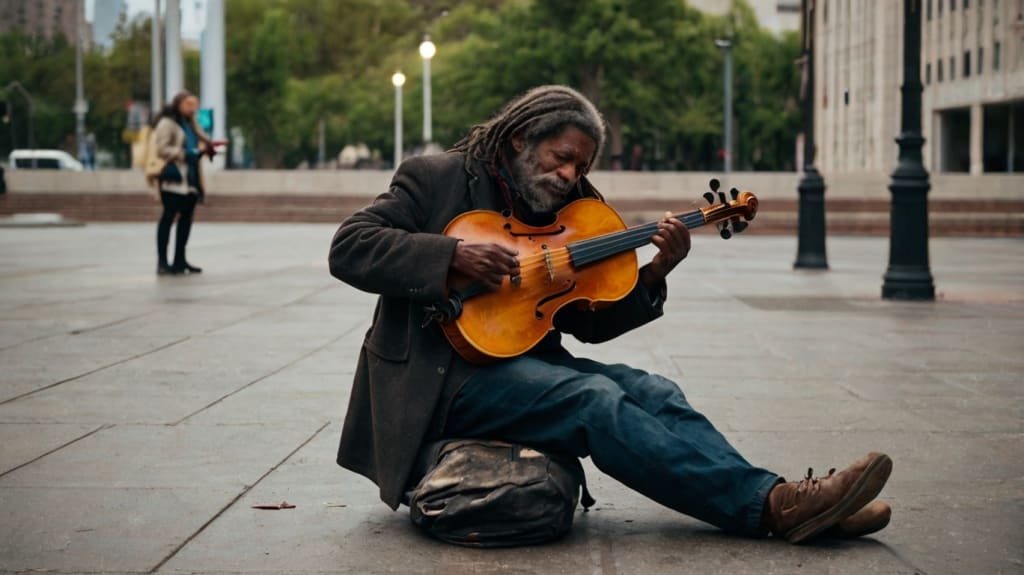
At the end of the tunnel sat an elderly man in a tattered coat, his eyes closed as he played Vivaldi’s Winter with a passion that felt like a punch to the chest. His fingers danced over the strings, coaxing out notes that seemed to tell a story of loss, resilience, and hope. His violin case lay open at his feet, a few scattered coins and bills inside. I stood there, entranced, as the music wrapped itself around me like a warm blanket, thawing the icy numbness that had seized my heart.
That man's name was Henry. For weeks afterward, I lingered in the subway station to hear him play. I would throw spare change into his case, but it wasn't about the money. It was about how his music would make me alive, connected with the human quotient. And, one day, when I was right there, lost, he paused midst-song and faced me directly: "You seem to be unaware of the right way of breathing," he went on, rather gruff and yet not ungallant in tone. He was the very first one who peeked behind a polished veneer and for whom the fissures beneath did come into view.
Henry became an unlikely friend. During breaks from my job, I’d sit with him in the subway station, and he’d tell me stories about his life. He had been a prodigy violinist in his youth, touring Europe and playing in grand concert halls. But addiction and loss had derailed his life, leaving him homeless and alone. Now, he played not for fame or money but to "stitch his soul back together," as he put it. His music was his therapy, his way of making sense of the chaos.
One day, Henry handed me a secondhand violin he had scavenged from a thrift store. "Here," he said, his eyes twinkling. Lets see if you can make this thing sing." I laughed, thinking he was joking, but he was serious. He taught me to play old jazz standards, patiently guiding me through the basics. I fumbled through Summertime, my fingers clumsy and uncoordinated, but Henry just laughed. "Music isn't about perfection," he'd say. "It's about letting the cracks shine.
Those lessons became a lifeline for me. In the midst of my corporate drudgery, they were moments of pure, unadulterated joy. Henry's music-and his philosophy-began to seep into my soul. He taught me to embrace imperfection, to find beauty in the dissonant notes of life. Slowly, I began to see my own life differently. The spreadsheets and deadlines didn't seem so suffocating anymore. I started to breathe again.
And then one day that spring, Henry vanished. For weeks, I combed the subway station, stopping all commuters and store vendors, asking them if they knew anything about my friend. Finally, panicked for the worst, I found him admitted to a hospital, as thin as a stick, attached to machines yet beaming at me. "Stop looking so somber," he wheezed, weakly, filled with his deep warmth. He thrust that weathered violin into my arms. Play something loud at my funeral," he said, his eyes glinting with mischief.
Henry died two days later. At his memorial, held in that same subway tunnel where we had met, I played Amazing Grace on his violin. I played badly, loudly, joyfully-just as he had taught me. Strangers stopped to listen, some clapping, some crying. It was a ragtag symphony of humanity, a fitting tribute to a man who had lived his life on his own terms.
Henry's violin hangs framed above my desk today-a reminder of the lessons he taught me, both about music and about life, but especially about second chances. I quit my corporate job not long after his death, trading in spreadsheets for sheet music. Today, I teach music to foster kids, kids who have been handed a tough lot in life but who, like Henry, have the quiet courage to keep going. I teach them that music is not about perfection, that it's okay to let the cracks shine.
His legacy lives on with every note I play, in every lesson that I teach. Henry taught me that sometimes a second chance doesn't come from some great gesture or explosion of transformation. Sometimes it comes from a very quiet act, picking up a violin and playing-from embracing life's dissonant notes. And for that, I will be eternally grateful.
Eventually, Henry didn't just teach me to play the violin; he taught me how to live. And his music will echo in my heart forever for that.
About the Creator
Keep reading
More stories from BAT-ERDENE GANZORIG and writers in Humor and other communities.
"The Power of Small Wins: How Tiny Habits Can Lead to Big Changes"
We’ve all been there—setting a lofty New Year’s resolution or a grand life goal, only to feel overwhelmed and give up within weeks. The problem isn’t the goal itself; it’s the approach. Big goals often feel intimidating because they require massive effort and discipline. But what if the secret to success lies in focusing on small, consistent wins instead?
By BAT-ERDENE GANZORIG11 months ago in Writers



Comments
There are no comments for this story
Be the first to respond and start the conversation.