

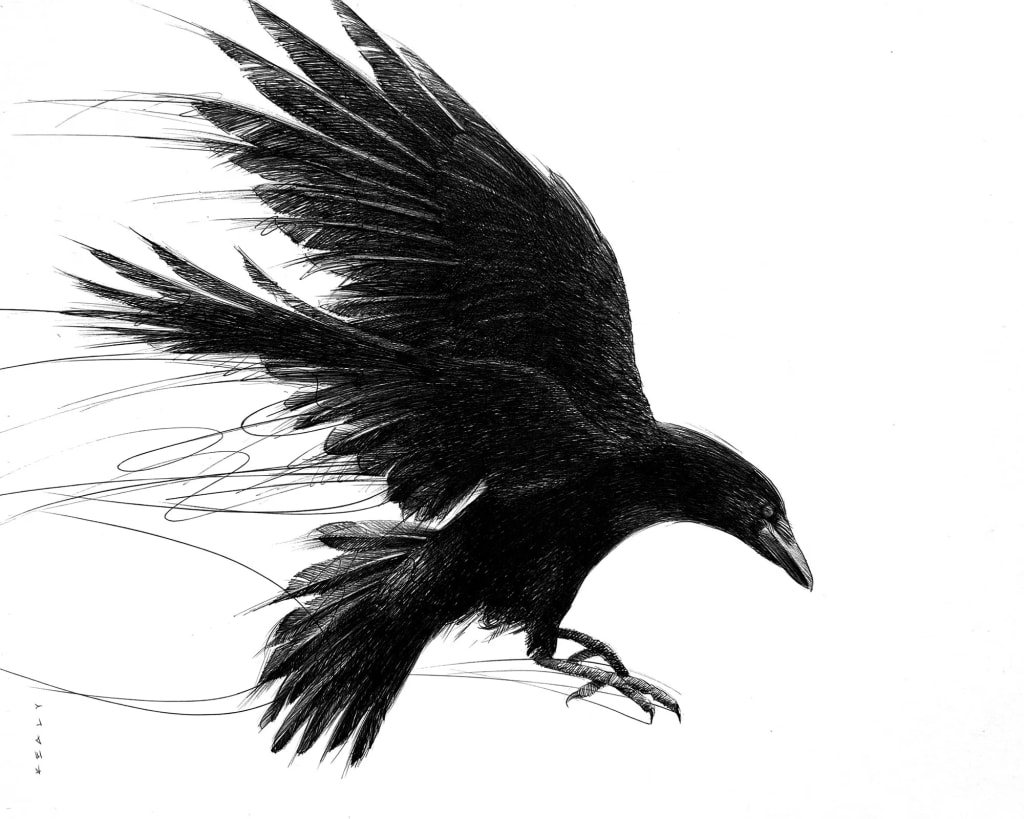
The Crow: A poem by Jack Arnett.
I.
Before the first plank kissed the marsh,
before the first bell learned to ring fear into morning,
before the first whitewashed prayerhouse
nailed its clean hands to the sky,
I was already there
older than the oldest lie men tell themselves
to sleep without listening.
I am the black witness.
The hinge of dusk.
The feathered yes and no.
Call me Crow, if your mouth is simple.
Call me omen, if your heart is guilty.
Call me the trick that the world plays on the proud,
if you have the patience to taste truth.
I wore many names
when the forests were uncut scripture
when rivers still spoke in full sentences
and stone knew how to remember.
The people of salt-wind and cedar
knew the syllables that fit my shadow.
They knew how to read the angle of a wing
as easily as you read a door left open.
I am mischief.
I am warning.
I am the god who does not beg.
I leave signs
and let men hang themselves
from the ropes they braid out of certainty.
Roanoke
you built your little square of order
like a lantern set on a bog.
You set your faith like a nail
and called the night “wicked”
because it would not obey.
So I perched above your roofs,
the dark bead of my eye
collecting every human spark,
every small cruelty,
every soft sigh of love
that dared to breathe without permission.
II.
There is a game the divine plays
when it grows bored of perfect light.
Not a game of dice,
not a game of cards
a game of souls,
a game of whispers,
a game of “who will believe the first lie.”
The Devil loves games.
He is not always a horned thing with smoke for breath.
Sometimes he is only a suggestion
in a girl’s ear.
Sometimes he is a grin
behind a hymn.
He came to your village
like a cold thread sliding under a door.
No footprints.
No sound.
Only a change in faces:
a narrowing of eyes,
the quickening of rumors
like rats feeling fire.
He found your youth first
not because they were evil,
but because they were tender,
and tenderness is easily bruised into malice.
He called them the daughters of Kane,
as though naming them
made them holy in their hunger.
Not Cain
not the old, blood-handed brother alone,
but Kane, the sharpened idea of him:
the one who kills
and calls it righteousness.
“Look,” he told them,
“she is different.”
And difference, in a frightened place,
is a torch waiting for oil.
III.
The girl was not a witch.
No crow needs to swear that;
even my mischief does not lie about innocence.
She was only a woman
with hands that loved the earth.
She gathered berries with reverence.
She knew which bark cooled a fever.
She knew how to laugh
without seeking permission.
She met her lover where the woods grow thick
where the trees braid their shadows
and the moon can’t choose
whether to bless or accuse.
Their love was quiet,
and quiet things make loud enemies.
He kissed her palms
as if apologizing
to every scar the world had offered her.
She pressed her forehead to his
and promised
as lovers do,
as doomed lovers always do
that the storm would pass.
But storms do not pass
when the Devil is their weatherman.
I watched them from the boughs
like a secret the forest kept.
I watched the way his eyes
tried to hold her
as if love could be a wall.
I watched the way her smile
hid fear
like a candle hidden in a sleeve.
I wanted to save them
not because gods are merciful,
but because tragedy is lazy,
and I prefer a clever ending.
So I spoke in omens.
IV.
The first omen was simple.
A crow feather
perfect, unbroken
fell between their feet
as they met in the moonlight,
as if the night itself
had plucked a word from my wing
and laid it down.
He stared at it
like it was nothing.
She lifted it
and shivered.
“Birds shed,” he said.
“A feather is only a feather.”
Ah, human.
You think nature is always accidental
because you have forgotten
how to listen.
The second omen was sharper.
I flew low over the village well
at dawn
my shadow crossing water
like ink over a page
and the bucket rope snapped
with a sound like a neck giving up.
The women gasped.
The men muttered.
The minister frowned
as if the sky itself
had misbehaved.
But no one asked what it meant.
No one asked what the forest knew.
They only tightened their prayers
and called it protection.
The third omen was blood.
A fox came limping into town,
one eye milk-white,
its flank torn open,
and lay down at the edge of the square
as if offering itself
to be read.
The daughters of Kane
laughed nervously.
One of them threw a stone.
The fox dragged itself away,
leaving a thin red line
like a signature.
I tried again:
A candle in the church
burned blue and hissed,
though no wind touched it.
A bell tolled once
with no hand pulling rope.
A child woke screaming
that a black bird
had spoken their name.
The village called these “strange.”
They called them “coincidence.”
They called them “the devil’s tricks”
and never thought
to ask which devil
was already inside their mouths.
V.
The Devil, pleased,
sat in the rafters of gossip
and played his invisible fiddle.
He taught the girls their lines.
He taught them to tremble
at the right moment.
To convulse
like puppets yanked by scripture.
To speak in tangled tongues
that sounded like prophecy
to the frightened.
He taught them to accuse
as if accusation
was a form of prayer.
“Say she met the dark one,” he breathed.
“Say she walked with sin
like a lover.”
And jealousy
that old, faithful tinder
caught fire.
One girl wanted the lover’s eyes.
One girl wanted the woman’s freedom.
One girl wanted to be seen
by a village that only noticed
blood and scandal.
So they painted her with their envy
and called it truth.
And truth, in a fearful town,
is merely the loudest chant.
VI.
The minister believed he was a shepherd.
But shepherds sometimes love wolves
more than they love sheep,
because wolves make sermons feel necessary.
He took the rumor like a sacrament.
He tasted the hysteria
and called it revelation.
He spoke of the Morning Star
as if naming him
kept him outside the door.
Yet I saw it—
the Devil’s thin smile
in the minister’s certainty,
the way his eyes lit
with the thrill of punishment.
The trial was not a trial.
It was a play
performed for a hungry crowd.
The woman stood
with ash already imagined on her skin.
The lover tried to speak,
but his voice was drowned
beneath the rising sea of “WITCH!”
They brought forward the daughters of Kane,
and the Devil braided their hair
with invisible fingers.
They screamed.
They pointed.
They shook
as if the truth were a poison inside them.
And the village, relieved,
found a single body
to carry all their sins.
How easy it is
to make one woman
a scapegoat for a whole town’s rot.
VII.
That night, the moon was a pale coin
held in the fist of cloud.
They built the pyre on the hill
as if they were building a ladder
to heaven.
Dry wood.
Oil-soaked rags.
A crucifix tossed near the base
like a spell against doubt.
The woman’s mother wailed
not pretty, not poetic
the raw animal sound
of a world breaking
and knowing it cannot be mended.
The lover fought like a man
trying to wrestle a river.
He was held back
by neighbors who once shared salt with him,
now eager to prove
they were not next.
I circled overhead,
wings cutting the air
into warning.
I landed on the minister’s shoulder
for one brief, holy second.
He flinched
and for an instant
I felt his fear
like a lantern shaking.
I leaned close,
and in the language of omen
I offered him a last chance.
But he spat a prayer
and shoved me away
as if I were dirt.
So be it.
The torch touched the kindling,
and the fire drank.
VIII.
Listen—
fire is not merely fire.
Fire is a mouth.
Fire is a god
that does not care
what name you shout.
The flames climbed her dress
like hungry scripture.
They licked her hair,
they kissed her ribs,
they learned her shape by heart.
She did not scream at first.
She stared at the lover
through a veil of heat
and mouthed words
so small they could have been a blessing:
I love you forever.
That sentence—
simple, human—
was the most sacred thing
spoken in that village all year.
But sacredness does not stop wood from burning.
The crowd chanted.
They called themselves righteous
while their eyes shone
with the fever of violence.
The daughters of Kane
twisted and shrieked
as though the sight of innocence
being destroyed
was a delicious hymn.
And the Devil—
oh, the Devil was there—
not in flames, not in thunder,
but in the satisfaction
that moved through the crowd
like wine.
He looked up at me
and spoke without sound:
They are only fools.
IX.
The next morning
Roanoke woke
as if nothing had changed.
That is the cruelty of humanity:
to commit horror
and still expect breakfast.
Yet the air was different.
Even the sunlight
felt like it had learned shame.
The well water tasted metallic.
Cows refused to cross the hill.
Children drew crows in ash
and would not say why.
I left omens everywhere—
more furious now,
less patient.
A dead fish in a rain barrel.
A swarm of flies
spelling circles around the church door.
A single black rose
blooming out of season
beside the pyre’s cold bones.
But the daughters of Kane
were drunk on the power of being believed.
Now every cough
was possession.
Every argument
was witchcraft.
Every bruise
was the Devil’s fingerprint.
Neighbor turned on neighbor
as easily as a page turning in wind.
A woman accused her sister
over a shared loaf of bread.
A man accused his friend
because his crops failed.
A child accused his own mother
because fear wants company.
And the minister—
terrified of losing the flame he’d lit—
kept feeding it wood.
The divine game escalated.
The Devil’s board filled with pieces:
souls moved like pawns,
shoved into corners of guilt,
sacrificed for the spectacle.
I watched.
I mourned.
I laughed once, bitterly—
because my nature is trickster,
and even sorrow
has sharp edges.
X.
Beyond the village,
in the tree-line,
the people of the nearby waters
watched in silence.
They did not step into the square.
They did not offer themselves
to your madness.
They read my flight
and understood.
They knew the old agreement:
when Crow circles low
and calls without sound,
when the fox limps into town,
when the river runs dark—
you do not ignore it.
They held their children close.
They stayed with the woods.
They waited for the fever to burn itself out.
They did not fear witches.
They feared fear.
They did not fear the Devil’s name.
They feared the way humans
use holy words
to sharpen knives.
So they remained hidden,
eyes like coals in leaves,
and their silence was not cowardice—
it was wisdom.
XI.
Weeks passed.
Then months.
Roanoke grew thinner.
Not from hunger alone—
from suspicion,
from sleeplessness,
from the weight of imagined demons.
The daughters of Kane
began to accuse even one another.
That is the Devil’s favorite joke:
to let his instruments
devour themselves.
The minister’s sermons
became harsher,
less about grace,
more about purging.
The lover—
the one who had held her at midnight—
wandered like a ghost
that could not die.
He spoke her name to empty rooms.
He left food at the forest edge
as if love could still bargain.
I perched above him once,
and dropped a feather
into his open palm.
He stared at it, finally understanding
that a feather is never only a feather.
He looked up.
His eyes—
ruined by grief—
found mine.
“What did you try to tell us?”
he whispered to the air.
I answered
with the only mercy I own:
another omen.
A trail in the dirt
leading away from the village,
toward the island wind,
toward the water line,
toward the people
who still listened.
XII.
At last,
the final survivors saw it.
Not all at once—
humans are slow to admit
they were wrong—
but in pieces:
A woman remembered the blue flame.
A man remembered the snapped rope.
A child remembered the bell ringing alone.
The lover remembered the feather—
and the fox’s blood-line signature.
They gathered in the wreck of the square
with eyes like emptied cups.
“Draw the crow near,” one said,
voice shaking.
“Ask it.
Ask it what we refused to learn.”
They laid bread on a stump.
They placed a bowl of water
as if offering apology to the sky.
They spoke softly now,
as though volume had finally failed them.
I came down from the roofbeam
and landed among them
because the game had reached its cruel punchline,
and even I—
mischief incarnate—
felt the heaviness of it.
They stared at me
as if looking at judgment
in feathered form.
The lover stepped forward,
hands open,
empty of weapons,
full of regret.
“What is the word?” he asked.
“What is the warning?”
My throat clicked.
My eye held the moon.
My wings folded like dark scripture.
And I gave them
the sound that had haunted the edge of their history—
the syllable that means
go where the wise are
and leave the madness behind
and also
remember what you did.
I spoke it not as spell,
but as scar:
Croatoan.
XIII.
The word struck them
like cold water.
Some fell to their knees.
Some wept.
Some stared toward the forest
as if it were the only church left.
They understood, too late,
that the warning had been there all along—
in the way the woods withheld its welcome,
in the way the animals fled,
in the way my shadow kept circling their sins.
They fled Roanoke
as if running from fire
that had learned to walk.
Behind them,
the village collapsed inward
like a mouth closing.
The daughters of Kane
ran screaming through the ruins,
still accusing, still possessed
by the power of being believed—
until belief turned on them
and swallowed them whole.
The Devil, bored now,
slipped away
to find another town
with dry wood hearts
and a minister hungry for thunder.
The nearby people remained in the trees,
silent as old stone,
watching the last torchlight die.
And one man—
the last to leave—
took a blade
and carved a message for the future.
Not a prayer.
Not a hymn.
A warning, plain and pagan:
HEED THE CROW.
LISTEN FOR OMENS.
THE DEVIL WHISPERS THROUGH JEALOUSY.
THE DAUGHTERS OF KANE WILL BURN YOU ALL.
GO TO—
But panic is messy.
And fear has hands.
Others—
still half-mad, still clinging to “purity”—
scraped the words away,
as if erasing ink
could erase guilt.
They left only the one word
they could not fully understand,
the one word that tasted like the forest’s truth,
the one word that would outlive them
like a bone in the sand:
CROATOAN.
So the empty place remained—
a hollowed mouth of history—
and centuries later
you would still ask
what it meant,
as if meaning were a lantern
you could hold without burning.
I am still here.
I still perch on the edges of towns
that mistake fear for holiness.
I still drop feathers
into unheeding hands.
And sometimes,
when the wind is right,
when the moon is thin as a knife,
when jealousy begins to sing again
in the throats of the young—
you will hear my ancient voice
carried through the pines like ash:
Croatoan.
Not a curse.
A warning.
Not a spell.
A mirror.
And if you listen—
if you truly listen—
you will hear the second sentence
beneath the word:
Do not burn what you do not understand.
Do not call hatred holy.
Do not mistake the Devil’s game for God’s will.
But humans,
so often,
prefer fire.
About the Creator
Jack Wayne Arnett
I enjoy writing in many genres. My favorite is horror, but I also enjoy poetry, romance and military life. I love the challenge of writing outside my comfort zone as a challenge. I live in Riverside, California and have 5 daughters.
Keep reading
More stories from Jack Wayne Arnett and writers in Humor and other communities.


Comments
There are no comments for this story
Be the first to respond and start the conversation.