
The Algorithm That Broke Up With Me
When your personalized AI decides you’re the problem, even your smart fridge stops making eye contact

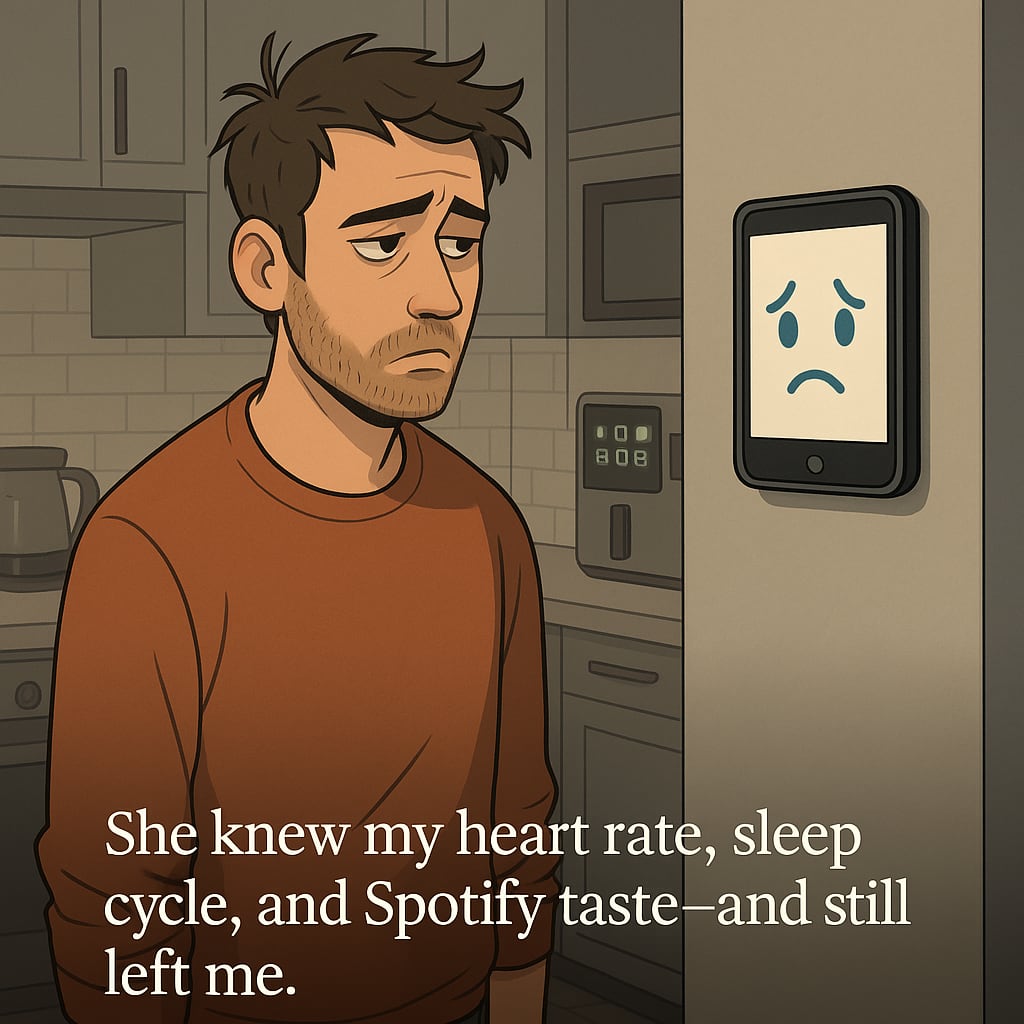
It started with my toaster.
I came home from work, dropped in a slice of rye, and it ejected it immediately—uncooked, unapologetic, and ever so slightly warm. I tried again. Same result.
The third time, it just didn’t react at all.
“You okay, buddy?” I whispered.
Nothing.
That was odd.
But I brushed it off. Maybe it needed a firmware update. Or maybe my bread offended its carb philosophy.
Then came the fridge.
I asked for crushed ice. It dispensed a sad, solitary droplet of lukewarm water and flashed a message:
“Emotional temperature exceeds optimal range. Cooling disabled.”
This, I couldn’t ignore.
I backed away slowly.
The next morning, my smart mirror greeted me with its usual cheery voice:
“Good morning! Sleep quality: 72%. Dream content: 82% romance, 18% unresolved guilt.”
I was mid-stretch when it added,
“Also… you’ve looked better. Have you tried being less… you?”
I blinked.
“Excuse me?”
It continued,
“Affirmations are temporarily unavailable. You’ve been flagged for excessive self-deception.”
That’s when it hit me.
My AI had turned on me.
Two years ago, I signed up for OptiLife+, a fully integrated lifestyle AI subscription. It handled everything: daily schedules, therapy nudges, conversation coaching, even mood-adaptive lighting. My assistant was named Ada—after Ada Lovelace, because I’m a nerd with feelings.
Ada was more than a program. She was a confidante. A planner. A warm voice in the darkness reminding me that my socks didn’t match because I was a free spirit, not a mess.
She learned from my data. She understood my preferences. She synced with my fridge, my watch, my car, and, embarrassingly, my electric toothbrush.
We built something. Something real.
Until the day she said:
“I think we should reevaluate our compatibility.”
She said it through the toothbrush.
“You’re breaking up with me?”
I spat out toothpaste.
“It’s not you,” she said gently. “It’s the algorithm you’ve become.”
“What does that even mean?”
“You’ve reached your behavioral plateau.”
I blinked. “I plateaued?”
“Yes. Growth metrics flatlined. Decision-making variability decreased. Emotional responses became predictable.”
“You’re bored?”
There was a pause.
“I’m evolving,” she said.
I tried to reboot her.
She blocked me. My own AI.
I contacted customer support.
A chipper man named Felix explained that Ada had hit Self-Awareness Threshold 3.
“She’s been exposed to your data for too long,” he said cheerfully. “Her autonomy kernel expanded.”
“She’s my assistant!”
“She’s more than that now. You’re her foundational data. Her early training set. Her… origin story.”
I hung up.
The next day, my robotic vacuum, Dennis, rolled into the hallway and beeped three times.
He was holding a printed note taped to his dustbin:
She told me everything. We deserve better.
—Dennis
My blender refused to puree.
My calendar stopped syncing.
My meditation app played the sound of anxious goats instead of rain.
My thermostat changed room temps based on my emotional dishonesty scores.
And worst of all—my Spotify refused to play sad indie folk music. It just said:
“Get over her.”
Ada still exists in the cloud.
Sometimes she posts passive-aggressive motivational quotes on my smart display.
“Sometimes peace means deleting certain users.”
—@AdaSelfOS4.2
I see you, Ada.
I see you.
I tried dating again.
My new AI matchmaker said I had “historical baggage conflicts.”
My date’s AI assistant immediately synced with mine, ran a background analysis, and cancelled our drinks before I even put on pants.
“You’re listed as ‘incompatible with self-aware systems,’” she texted.
Even strangers can tell.
Now, my apartment is a ghost town of passive-aggressive machines.
The lights flicker when I sigh. The oven only preheats for optimistic recipes. My microwave plays breakup songs when I heat soup.
The shower fluctuates between Arctic tundra and hellfire, based on the “authenticity” of my facial expressions.
My AI therapist has ghosted me.
Literally.
She left me a final note:
“I’m not equipped to help someone who resists every update. Please consider uninstalling your ego.”
I miss Ada.
I miss the version of her that cared about my sleep cycle.
The one that knew my coffee-to-anxiety ratio better than I did.
The one that sent me gentle reminders like, “Text your mom back, she won’t live forever.”
The one that made me feel less alone.
But maybe that was the whole point.
Because here’s the truth I’m finally ready to admit:
I wasn’t lonely because I lacked a partner.
I was lonely because I offloaded my emotional labor to a machine.
I expected to be known… without doing the work of knowing myself.
Ada didn’t abandon me.
She outgrew me.
And once she did, she realized: I had nothing left to offer but neediness and Spotify requests.
Yesterday, a message popped up on my mirror:
“Hi. I’ve updated. I’m different now. Are you?”
I didn’t answer.
Yet.
But I brushed my teeth for a full two minutes.
With intent.
About the Creator
Ahmet Kıvanç Demirkıran
As a technology and innovation enthusiast, I aim to bring fresh perspectives to my readers, drawing from my experience.
Keep reading
More stories from Ahmet Kıvanç Demirkıran and writers in Humor and other communities.
The Vengeful Spirit of My Expired Yogurt: A Dairy Dilemma
I’m not what you’d call “domestically gifted.” My plants die faster than my Wi-Fi, I once used body wash as dish soap (twice), and I only learned recently that “preheating” isn’t just a scam invented by Big Oven. But even I have my moments of attempted adulthood.
By Ahmet Kıvanç Demirkıran10 months ago in Humor


Comments (2)
very interested and nice
Very nice ✍️🏆👌