


Introduction
Charlie Solevar, a man in his early 30s, returns to Salt Lake City after deployment to settle the affairs of his recently deceased paternal grandmother. He comes back to the apartment where he grew up, haunted by a flood of unresolved memories and the lingering absence of his mother, Birdie, who disappeared when he was twelve. Grief-stricken and grappling with an emotional void, Charlie spirals into a strange twilight state, convinced that the universe is trying to communicate with him through the remaining letters in expired cans of alphabet soup.
Desperate for answers, Charlie embarks on a wild and deeply emotional quest to unravel the mysteries of his past, accompanied by his childhood best friend, Ray—now a local police officer—and Aubrey, an actress and neighbor who finds herself drawn into Charlie's unraveling world. As Charlie pieces together the fragments of his past, he uncovers dangerous truths, long-buried secrets, and a trail of events tied to his mother’s mysterious disappearance.
1988
In 1988, Birdie Solevar, a woman in her mid-30s showing early signs of schizophrenia, takes Charlie on an impulsive road trip. Without a plan, they let the universe guide them, eating alphabet soup from a can and attempting to form words from the remaining letters. Birdie’s letters are gibberish, but Charlie’s bowl reveals one clear word: “ZION.”
They set off for Zion National Park, but they never make it. Birdie’s fragile mental state fractures when she becomes convinced that someone is following them. In the dead of night, they return to Charlie’s grandmother’s apartment. After a vicious argument between Birdie and her mother, Birdie leaves—and disappears.
Birdie is never seen again. Charlie is left in the care of his grandmother, growing up with the quiet weight of her absence. Seventeen years later, his grandmother's death reopens old wounds and propels Charlie into a journey of discovery, grief, and redemption.
After eighteen years passing Charlie's grandmother dies, forcing him to face unresolved childhood feelings. His quest to find the answers leads him on a wild and comical adventure, bouncing him through stages of grief.
BARGAIN
Reeling from grief and searching for connection, Charlie sorts through his grandmother’s apartment and discovers several cans of long-expired alphabet soup tucked behind an old can of Kilmuray salt. Starving and emotionally numb, he prepares a bowl of soup.
As he eats, Charlie recalls the rare moments of closeness he shared with Birdie over similar meals. Halfway through the bowl, the letters at the bottom spell out a chilling message: “MURDER.”; since that moment, encouraged by stress, grief and guilt, Charlie becomes a believer that the alphabet soup is the medium for his conversations with Birdie.
Overcome by nausea and pain, Charlie collapses. His neighbor, Aubrey, hears the noise and calls for help. Ray, now a police officer, arrives with the paramedics and recognizes his old friend. Ray stays behind to support Charlie, in the meantime developing feelings for the neighbor who called in- actress Aubrey.
The next day, Charlie buys another can of soup, but it reveals nothing. Determined to reconnect with Birdie’s spirit, he eats another expired can, asking "If she had any money"—and again, he collapses. This time, the letters spell out “SALT.”
Ray and Aubrey, worried for Charlie’s health and sanity, intervene. Charlie explains the soup’s messages, convinced that his mother is speaking to him from beyond. Ray and Aubrey urge him to seek closure and face his grief directly.
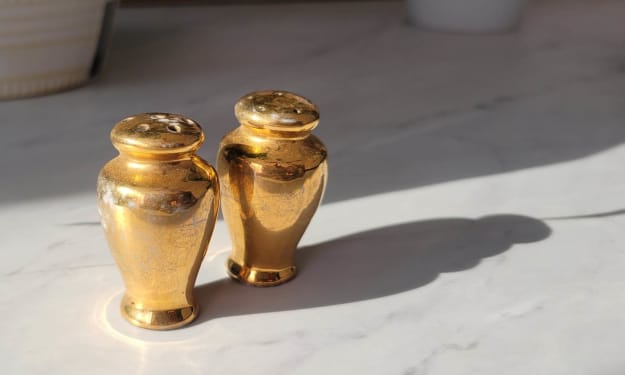
When alone Charlie mulls over the "SALT" message, remembering that Birdie bought a cute little golden salt and pepper shaker set during their final and unfinished trip together, from the antiques dealer.
Charlie remembers Birdie’s old golden salt and pepper shaker set—she had promised to keep the salt shaker safe, while he held onto the pepper shaker. Charlie searches the apartment frantically, but the salt shaker is missing.
Aubrey and Ray meet him at the apartment to find it in even a greater disarray than before, and Charlie head-in and butt up in piles of items. Ray proposes to take a small break and distance himself from the apartment. Charlie solidifies in his belief that the messages only come from the soup that Birdie purchased herself. He tells Ray about the road trip he and Birdie took when he was 12.
The Trip
Charlie finds the keys to Birdie’s old station wagon and proposes a road trip to Zion, hoping to retrace their steps and unlock the truth. Ray agrees to join him, motivated by both friendship and professional curiosity over Birdie’s disappearance. Aubrey stays behind to clean Charlie’s apartment, uncovering disturbing clues: Birdie’s old schizophrenia medication, unsettling diary entries, and long, ramblings tape recordings.
Charlie and Ray’s journey takes them to Salt Rock, Utah, where they stop at what used to be the gas station. Now they encounter a quirky rock-climbing shop called “Ropes, Soaps, and Dead Hopes.” Convinced they are on the right path, Charlie recalls a fateful stop at an old gas station during the original trip with Birdie.
1988
The engine on Birdie’s station wagon sputters, as Birdie and Charlie drive into the old gas station.
At the gas station, Birdie—broke and desperate—meets the station’s shady manager, a drug dealer under pressure from a rival group. Sensing an opportunity, the manager offers Birdie free gas in exchange for delivering a crate of blue salt containers to a nearby diner. Birdie, convinced the universe is aligning in her favor, accepts. Unbeknownst to Birdie, the crate contains a hidden fortune. As she drives toward the diner, the gas station manager calls his associate—but gunshots cut the call short.
Birdie explains to Charlie that everything is working out according to the Universe’s wishes. Even the Gas station clerk provided free gas, she explains that the clerk needed Birdie to deliver the salt to the diner in exchange for yet another freebie, a meal!
On the way to the diner Birdie notices a small antique shop. She winks at Charlie, they make a quick stop. They explore the show, commenting on the strange and funny finds. Birdie finds a small salt+pepper shaker set. She steals it as a memorabilia piece, to commemorate their silly salt adventure.
Birdie is teetering between the twilight state of consiousness and sobriety. Charlie is amused and delighted with Birdie's worldview. He is happy to spend rare time with her, not knowing that B’s mental state is on declline and quickly deteriorating.
At the diner…
The black phone rings, and rings, and rings… the dealer’s brother is murdered by envoys from the opposing group. The voicemail echoes through the reception of the antique shop: “Vinny…”
Birdie travels to the antique shop, bouncing and bumping on the red rocks, Birdie and Charlie arrive at the diner. It is almost dark.The diner looks strange and desolate, the sign says “CLOSED” Only one car was parked next to it. Birdie enters through the unlocked side door. In the meantime Charlie knocks on the front door, jiggling the door handle, trying to summon the owner. He sees that someone is approaching the door from within, backlit by the light coming from the kitchen in the depth of the restaurant. A woman almost comes to the door, reaches for a gun, tucked in the belt of her jeans, when suddenly she hears a loud noise coming from the kitchen. The woman quickly darts back.
In the meantime Birdie enters the lit kitchen, stumbling in on the murdered owner of the Diner. Quickly turning to leave, she accidentally knocks down a can of salt from the kitchen shelf, making lots of noise. She runs back, meeting with terrified Charlie by the car. They hop in and drive away.
The killer comes out just at the moment when the station wagon drives off into the dark: She follows the car with her eyes. She goes inside, to the telephone to make a call, looks down at the blinking red button of the voicemail machine. She leaves a bloody fingerprint on the “ERASE” button.
Terrified for herself and her son, Birdie floors the gas pedal. Her mania is fully offset by the murder scene. She is not sure if it was a hallucination or reality. In both cases Birdie decides that it would be safest for Charlie to be back at home, with Birdie’s mother. Charlie is scared, his little knuckles are white from grabbing onto the handle to stabilize himself. He is crying, Birdie is muttering and screaming. They never make it to Zion.
DEPRESSION
Charlie and Ray track down the antique store where Birdie had stolen the golden shaker set. The shopkeeper reveals that a complete set would be extremely valuable. Charlie’s hope for closure fades when he realizes that the matching salt shaker is still missing.
Interspersing his every word with a dusty wheeze, the vendor explains that he used to have a set like this a long while ago, a very valuable and rare piece. Charlie gets excited. “ Extreeemely valuable” wheezes the vendor “only if it is a full set, of course” adds the clerk.
ANGER
Ray and Charlie arrive at the diner, a pristine relic of mid-century Americana. The chrome gleams under soft neon lights, and black-and-white newspaper clippings hang in tidy rows along the walls. Blood-red leather settees line the booths, and the waiter wears a crisp mint-green uniform, perfectly styled in 1950s fashion. The place hums with quiet nostalgia, a polished echo of another era.
Charlie leans in, lowering his voice as he tells Ray the story—a dark piece of history tied to this very diner. After a quick search on his phone, Ray confirms it: there was a murder here, eighteen years ago.
Charlie’s mind spirals. Was Birdie mixed up with a dangerous crowd? he wonders. Was she the murderer? Was he—somehow—a witness to her madness, not her serendipity? His chest tightens. Is that why she disappeared?
Then it clicks. That’s why the soup spelled “MURDER.”
A woman in her late forties emerges from the kitchen and steps toward the front counter. She’s counting the cash in the till when her gaze lands on Charlie. Her eyes narrow as recognition sharpens her features. Slowly, her gaze shifts toward the window—to the station wagon parked outside. Birdie’s station wagon. Her expression changes—softening, almost reverent.
She approaches their table and introduces herself as the diner’s owner. Her smile is knowing, almost tender, as she offers Charlie a free meal. Charlie is startled but delighted. Once again, it feels like the universe is quietly aligning in his favor.
Ray steps outside to make a few calls while Charlie places an order—for Ray, and for an extra empty bowl. Once the server walks away, Charlie pulls out the smuggled soup and empties it into the bowl, eating quickly before Ray returns. As he scrapes the bottom, several letters emerge from the dregs. His stomach twists.
Ray returns, his expression dark. He sits down, eyes sharp. “Aubrey found Birdie’s old prescriptions for schizophrenia,” he says. “And recordings—long, rambling, unsettling stuff. Diaries too. Disturbing entries.” Ray hesitates, then adds carefully, “Charlie… Aubrey thinks Birdie’s behavior—and yours—it could point to early-onset symptoms.”
Charlie’s hands tighten around the bowl beneath the table. His pulse hammers in his ears. He lifts the bowl slowly, his breath hitching as he reads the word formed at the bottom in uneven letters: “KILMURRAY”
ACCEPTANCE
Ray and Charlie arrive at Zion just as dusk falls. They park the station wagon near the edge of a cliff and set up a fire, the flames casting flickering shadows on the rugged desert landscape. The air is crisp, and the night feels saturated with an eerie quiet—a perfect backdrop for Charlie’s whirlwind of memories and realizations.
By the fire, Ray absentmindedly strums his guitar, his fingers gently plucking the strings, while Charlie is lost in thought. The past feels distant and fragmented, his memories of Birdie hazy and elusive. Yet, the one constant throughout his life—through all the chaos and uncertainty—has been Ray.
Now, however, something sinister stirs inside Charlie. The restless spirit of Birdie haunts him still, a jealous presence that seems to demand Charlie’s attention, as if she desires to claim him entirely, even at the cost of his relationship with Ray.
Anger rises in Charlie’s chest, a sudden, sharp wave of emotion. He is consumed by a belief that Birdie, with her jealousy and possessiveness, was never the loving figure he once remembered. Instead, she was unhinged, spiraling into madness. He grips the thoughts with desperate certainty, feeling them course through him like fire.
Ray, noticing the shift in Charlie’s mood, speaks calmly, urging him to let go of the grief that binds him. “The messages in the soup,” Ray says softly, “they’re just echoes of your grief. Not some cosmic force. You don’t have to carry her with you anymore.”
But Charlie’s mind races. The anger, the frustration, the unresolved pain—they boil over. He stands abruptly and heads toward the station wagon, rummaging through his backpack. His fingers close around a small pepper shaker. Without a second thought, he slips it into his pocket.
Ray, still inside the wagon, calls out to him, but Charlie’s agitation flares. He hurls the backpack onto the ground. The last can of soup tumbles out, rolling under the driver’s seat, an unintended symbol of all that remains unsaid.
As Ray settles in for the night, Charlie stays behind by the fire. The warmth of the flames contrasts with the coldness he feels inside. He reflects on the years he spent with Birdie, memories muddied by chaos and fear. Despite her struggles with schizophrenia, she always tried to bring light to his world—she wanted to make him laugh, to make him feel loved.
In the stillness of the desert, Charlie pulls the gold shaker from his pocket. The weight of it feels heavy in his hand, but with a steadying breath, he whispers, “Goodbye, Birdie.”
He steps to the edge of the cliff and releases the shaker. It arcs through the air, reflecting the firelight in a brief flash before vanishing into the inky abyss of the desert night. At the same moment, a shooting star blazes across the sky, a perfect, silent symbol of release.
It is a profound moment for Charlie—one of finality and freedom. The grief, the guilt, the hold that Birdie once had over him—all of it dissolves into the vast, unyielding darkness. And for the first time in years, Charlie feels truly free.
DENIAL
Ray wakes up late in the morning, momentarily disoriented by his unfamiliar surroundings. The sun's early rays stream through the windshield, casting a warm glow over the interior of the station wagon. Reaching into the glove compartment, Ray searches for a bottle of water. His hand brushes against something metallic. As he pulls it out, a gleam of gold catches his eye.
Confused yet intrigued, Ray holds the object up to the light. A smile spreads across his face as he waves it toward Charlie, who is sitting outside the car. But Charlie’s serene expression shifts in an instant to one of sudden recognition. His calm morning demeanor fades into indignation as he realizes what Ray has found.
Charlie’s mind races. If it hadn’t been for Ray’s insistence the previous night, he would have kept the last tangible connection to Birdie—and a large sum of money—secure in his possession. He thinks back to the “KILMURAY” message, now fully understanding its meaning. The pieces fall into place.
“A permission was given,” Charlie thinks, his thoughts growing frantic. “It was Birdie who was sending the messages. I should have trusted her.”
Overcome with emotion, Charlie swings the car door open and climbs inside, lashing out at Ray in a storm of incoherent words and raw grief. He cries, his voice breaking as he accuses the universe of betraying him. Ray, shocked and confused, straightens the passenger seat in an attempt to subdue the chaos. In doing so, he inadvertently pushes Charlie into the gear shift. The car lurches as the gear falls into neutral, and the tension inside the vehicle sends the last can of expired soup tumbling out from under the seat, wedging itself beneath the brake pedal.
The old station wagon begins to roll.
Ray is the first to notice the movement, panic creeping into his voice. “Charlie, we’re rolling! We’re rolling!” he yells.
Suddenly, Charlie snaps to attention, his rage turning to confusion. As Ray kicks him out of the car, Charlie stumbles onto the red, dusty earth. From the ground, he watches helplessly as the station wagon continues its slow descent toward the cliff. The vehicle lurches closer to the edge.
In that fleeting moment, Charlie meets Ray’s eyes—wide with panic—as the car tips over the edge, disappearing into the chasm below. Above them, the sun rises over Zion National Park, casting a golden light on the tragic scene unfolding beneath it.
IN THE MEANTIME…
In the meantime Aubrey declutters Charlie’s apartment. As she works her way through the kitchen, she discovers a bizarre collection: dozens of salt and pepper shakers, all neatly lined up at the kitchen table. Yet, to her bewilderment, none of them are filled. Frustrated by the seeming futility of it all, she takes a break to cook eggs.
Approaching the spice cabinet, Aubrey peers inside, but finds only disappointment. Resigned to the chaotic randomness of Charlie’s life, she turns to the row of empty salt shakers on the table behind her. Throwing her hands up in exasperation, she mutters, “ARRGH! None of you are useful!”
Determined to make something of the situation, Aubrey walks over to the pantry and scans the shelves. Her eyes land on a shelf stacked high with cans of salt—except the labels all read “KILMURRAY.” “Wow, that’s an overkill,” she mutters under her breath, half-amused, half-confused.
Curious, she grabs one of the cans and, with a casual shrug, brings it back to the counter where she’s preparing the eggs. As she lifts it, she’s surprised by its unusual weight—heavier than a typical salt can. She opens the lid, expecting a simple pour of salt, but instead, to her astonishment, a handful of iridescent, pea-sized diamonds spill through her fingers, tumbling into her scrambled eggs.
About the Creator
Salomé Saffiri
Writing - is my purpose. I feel elated when my thoughts assume shapes, and turn into Timberwolves, running through the snowbound planes of fresh paper, leaving the black ink of their paw prints behind.
Keep reading
More stories from Salomé Saffiri and writers in Humor and other communities.
From ad men to mad men
It's after 2am in the morning when a local police patrol vehicle in Northern New Jersey spots a figure costumed as Quasimodo, The Hunchback of Notre Dame, proceeding southbound on the sidewalk along Lydecker Street. Though the hunchback’s costume stuffing offers added insulation, it's January, and friggin’ freezing. Carefully, the officers slow down, gently question the subject, and offer him a ride home.
By David W. Maury2 days ago in Humor
Lady, Just Get Back in Your Car
I read this joke a couple of days ago on the internet. A man is driving his five-year-old to a friend's house. Suddenly, another car speeds in front and cuts them off. They almost have an accident. "Douchebag!" the father yells. A moment later, he realises the indiscretion, pulls over, and turns to face his son. "Your father just said a bad word," he says. "I was angry at that driver, but that was no excuse for what I said. It was wrong. But just because I said it, it doesn’t make it right, and I don’t ever want to hear you saying it. Is that clear?" His son looks at him and says, "Too late, Douchebag."
By Calvin London7 days ago in Humor
Review of 'Man on the Run'
My wife and I saw Man on the Run, a nearly 2-hour documentary on Amazon Prime, about Wings, Paul McCartney's group that flew around the world from shortly after The Beatles broke up in early 1970 to shortly after John Lennon was murdered at the end of 1980, making a Beatles reunion forever impossible.
By Paul Levinson7 days ago in Beat

Comments (2)
I Loved this great work ♦️♦️♦️
The humor was spot on, and the twist at the end totally caught me off guard. You managed to take something as simple as salt and turn it into an absolutely hilarious commentary.