
ON THE DISCOVERY OF CANUS INSECTIVORUS
Its Brief Existence During the Pleistocene Era

This paper explores the recent discovery of fossils believed to be derived from a species known as Canus Insectivorus, colloquially known as Bug Wolves. These animals reportedly existed for approximately ten years during the Pleistocene Era around 16,000 B.C. The fossils were uncovered in the western portion of what is now the United States during a routine dig conducted by Prof. Magnus Trelviksson, a zooarcheologist. Trelviksson’s team was investigating human dwellings when they discovered small bones. “We found Canus Insectivorus bones in the general vicinity of early dwellings,” Trelviksson stated, adding that this was proof that they were domesticated.
This conclusion was met with disbelief by anthrozoologist Dr. Hesperia Jernoux, who adamantly insisted that Bug Wolves were never domesticated, given their brief existence. This disagreement between Trelviksson and Jernoux continued for years and became infamous, until Jernoux passed away in 1985. She had suffered from a condition known as “Fieldworker’s Decline,” which was thereafter referred to as Jernoux Fever. It was a little-known occupational hazard at that time for field archeologists.
Canus Insectivorus shared the grasslands and plains with large herds of bison. These bison were considerably larger than their present-day counterparts, each one weighing approximately 2,500 to 3,000 pounds. In contrast, Canus Insectivorus, or Bug Wolves, were generally eight inches tall from the ground to the top of their heads. They typically weighed from nine to eleven pounds. Bison were the only natural prey of Bug Wolves.
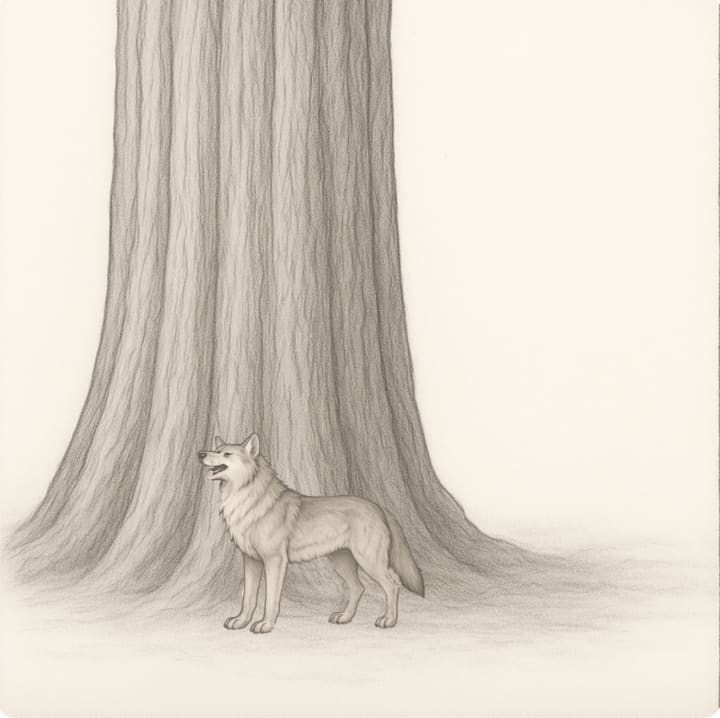
Canus Insectivorus got their name from their method of hunting for food. Because of their diminutive size, they were able to conceal themselves in the tall grasses where bison were grazing. They are thought to have gathered in coordinated hunting packs, yet it appears each individual launched a solitary attack on its chosen bison.
These undersized hunters would approach their prey and leap up and use their jaws to attach themselves to the bison’s neck, similar to the way a mosquito or biting fly will land on a human and attach itself to feed on blood. Given the Bug Wolves’ size and weight, and the heavily-furred and thick-skinned nature of the bison, the prey were often barely aware of a Bug Wolf hanging off their necks. Eventually the Bug Wolf’s jaws would tire and it would let go of the neck and fall to the ground. Occasionally this led to it being trampled underfoot as the bison moved to a new grazing area.
“It’s actually somewhat surprising that they lasted as long as they did, given their failure as hunters and their fear of domestication,” is a statement attributed to renown paleontologist Dr. Veylin Zorovic. This was rabidly debated by Prof. Darius Hueltenbach, who was firm in his opinion that it was not a fear of domestication that kept the Bug Wolves away from humans, but rather their behavior. When approached by a human, many of whom were attracted to their small size and were unafraid, the Bug Wolves would attempt to leap up to bite the human’s far-more-vulnerable necks (evidence of this was found on human remains). This led humans to erect short barricades to keep the Bug Wolves from entering their dwellings. Prof. Hueltenbach referred in his notes to the Anacrito Enclosures in New Mexico, a disputed dig site where stakes arranged in a line in front of dwelling entrances were thought to be placed to deter Bug Wolves.
The Anacrito Enclosures have been covered in detail by many researchers since the 1970’s. Branskewitz (1975) initially described the linear stake structures and associated fossils, noting the unusual presence of small canid teeth among the midden layers. Vatrond (1983) argued that the stakes themselves represented a deliberate attempt by humans to block small predators from cave entrances. Quistril (1994) viewed the remains and suggested that relating the stake evidence to the Bug Wolf may be closer to local folklore and cryptozoological fervor than scientific fact.
Researchers generally agree that Bug Wolves underwent extinction due to a failure to thrive, brought on by their inability to effectively secure food for their pack.
Canus Insectivorus did not occupy space on this planet for very long and we are only just now learning about them and their extinction. It does, however, appear that they may not have left us entirely. Just as modern birds are all that remain of dinosaurs, there is a variety of domesticated canine that occasionally exhibits Bug Wolf hunting tendencies, often masquerading as play. This canine variety is plentiful in the United States

In this way, the Bug Wolf may live on. Their story was lost to time until their remains were recently discovered. Now it appears that their story echoes in backyards and living rooms across the country.
About the Creator
Keep reading
More stories from writers in Humor and other communities.
Canada Conducts Massive Airstrikes on Minnesota to Aid Heroic Protesters Battling Authoritarian I.C.E. Regime
In an act of compassion, the Canadian Armed Forces have initiated massive airstrikes against key centers of oppression in Minneapolis, in an action dubbed "Operation De-Icing" that supports local protesters demanding an end to the brutal regime of U.S. Immigration and Customs Enforcement (I.C.E.).
By Scott Christenson🌴7 days ago in Humor
Worth the Wait: Puerto Viejo, Costa Rica
Beach bumming in a small Caribbean beach town sounded like a perfect way to end our 6-month trip through Mexico and Central America. Or so we thought. The foul, fishy stench of rotten seaweed hit our nostrils as we stepped from the cramped bus and looked out at a rather depressing, empty, and underwhelming black sand beach. It was pouring with rain, and we had to quickly fish out our ponchos. We thought, this couldn’t be it, could it?
By Sh*t Happens - Lost Girl Travel7 days ago in Wander




Comments