
Lift the Lid on Convenience Fud
Fear. Uncertainty. Doubt. What’s in your microwave meal?

Busy career? Not enough time on your hands to cook for you or your family?
It’s not hard to see why the national diet includes such a generous helping of convenience food.
As part of the Department of Social Scrutiny’s remit to introduce the British National Diet – an approved list of typical food and drink consumed in the UK that helps make Britain the great nation that it is – we provide here some information on convenience eating.
The British National Diet, or BND, makes it easier for the government to set out its policies on nutrition, snacks, liquid refreshment and related prandial affairs. It is hoped that the diet will re-establish the traditional British meal to the position it occupied before exotic foods like whole pineapples and other non-tinned produce were introduced.
Broadly speaking, the British National Diet aims to encapsulate just what it is that makes British cooking the art that it is. Boiling, deep-frying and roasting take precedence over subversive, foreign concepts such as “Mediterranean cuisine” and “flavour”.
To find out more about this:
Britons work the longest hours of any employees in Europe, and that’s something the Department of Social Scrutiny is tremendously proud of.
The only fly in the tub of soothing ointment we apply daily to the weeping sore of indolence, is the sometimes difficult matter of finding enough time to eat. Which is where convenience food comes in – simple to cook, quick to prepare, and very easy to eat, there’s no need to miss a moment of work ever again.
British convenience food comes in several varieties, from replica motorway service area meals to elaborate creamy pasta dishes that can either be eaten hot from a microwave or applied cold as a moisturiser.
The most important facet of convenience food is that it should be presented in a way that excites the busy diner. According to a recent study, saliva is good for you again, and modern foods take this into account with serving suggestions designed to make you salivate wildly on eye contact with the packaging.
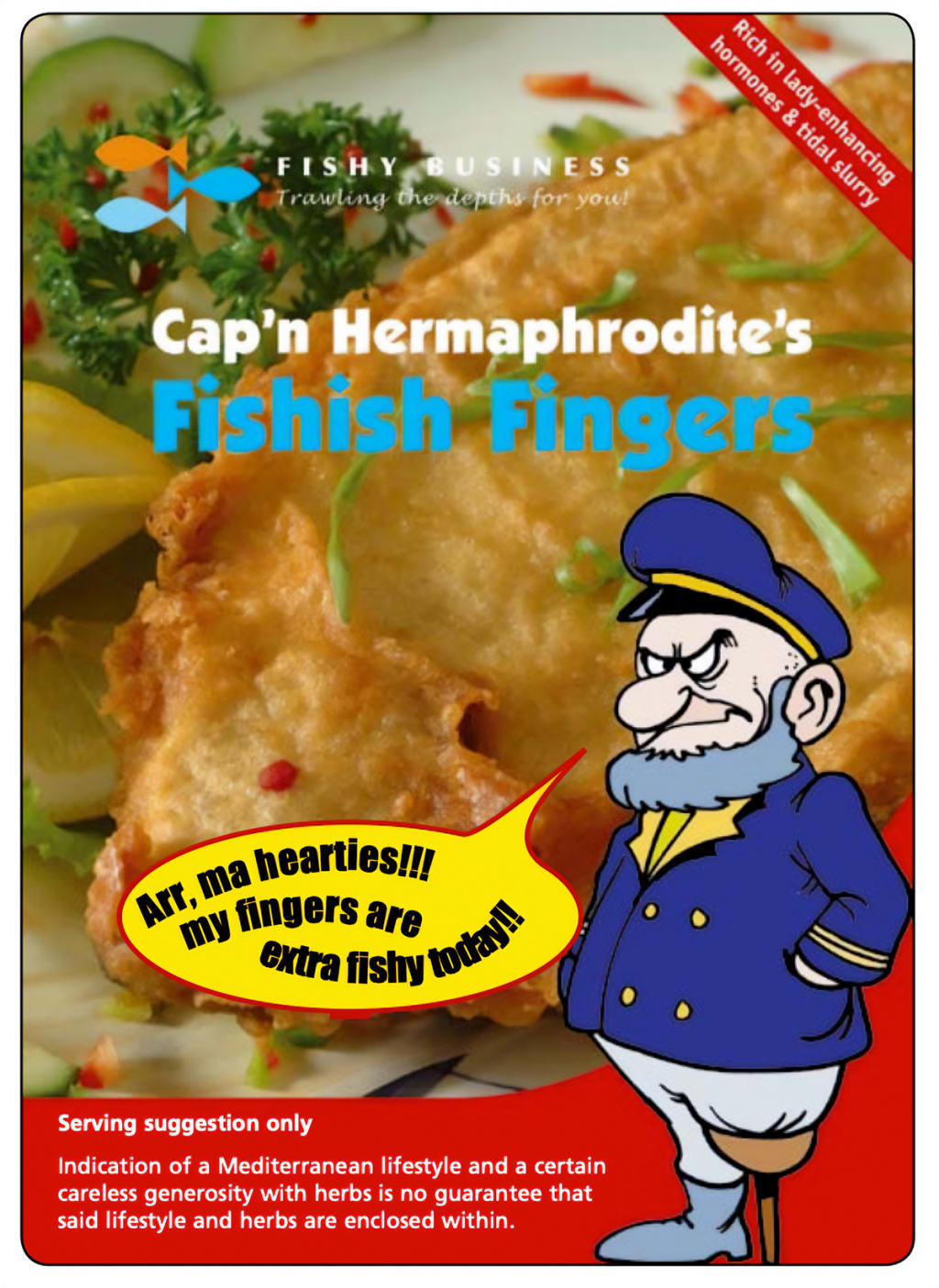
Cap’n Hermaphrodite’s Fishish Fingers (above) is a typical packet of convenience food aimed at the family market. It features bright, primary colours, an encouraging photograph to elicit the production of saliva, along with the added value of a slightly disturbing caricature that somehow communicates with the dark recesses of your child’s mind to pile on the pester pressure.
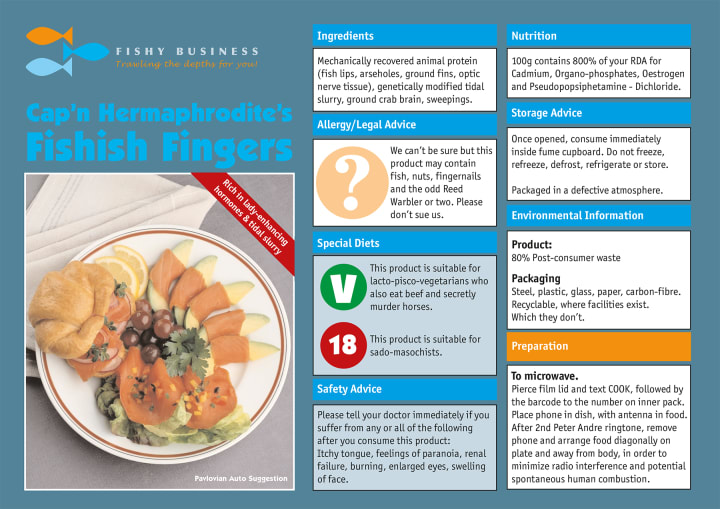
Cap’n Hermaphrodite’s Fishish Fingers.
With its easy to understand instructions and option of phone radiation cooking, this meal offers fantastic convenience with only a medium to high increased risk of immediate death.
Food on Your Lap
Type of food
Virtually instant convenience food manufactured from God-knows-what in a giant shed with no natural lighting in the vicinity of Birmingham.
Presentation
Bright and breezy packaging that holds some clues as to what all the pre-teenage children’s comic designers are up to these days.
Often features a friendly stereotypical animal character tastefully unrelated to the animal in the packet.
Adult versions of these meals are packaged in a subtler way, with lots of nice cursive lettering and panels printed in gold ink.
Sold principally to single, carefree, career-focussed individuals, packaging is designed to forestall any sense of disappointment right up to the moment that you consume it, heartbroken and alone, at your kitchen table.
From the Kindle ebook Britain: What a State, also available on Kindle Unlimited.
About the Creator
Ian Vince
Erstwhile non-fiction author, ghost & freelance writer for others, finally submitting work that floats my own boat, does my own thing. I'll deal with it if you can.
Top Writer in Humo(u)r.
The World Is on Fire, But My Freezer’s Been Stockpiling Since 2017
📦 Section 1: Frozen Time Capsules – A Love Letter to Foods That Shouldn't Be Alive There comes a moment in every adult’s life when you open your freezer, stare into the icy abyss, and realize you’ve been harboring culinary fugitives from the past.
By The Pompous Posta day ago in Humor




Comments (3)
We're coming in to winter here in Australia and my skin has been so dry, I need to get my hands on one of those creamy pastas. I recently had food poisoning from frozen fish, so I might skip the fishish fingers though.
This article about the British National Diet and convenience food is quite something. It's interesting how it ties in busy work hours with the need for convenience. I can relate to that struggle. But the idea of boiling, frying, and roasting being the essence of British cooking over more flavorful cuisines seems a bit narrow-minded. What do you think about that? And are there really no other aspects of British food culture that should be considered in this diet? Also, the part about using convenience food as a moisturizer is pretty funny! Wonder what they meant by that exactly.
You've managed to make British cuisine even more amusing!