
"Hayek’s Hangover: A Love Story Between Markets and Mayhem"
Neoliberalism Needs To Go

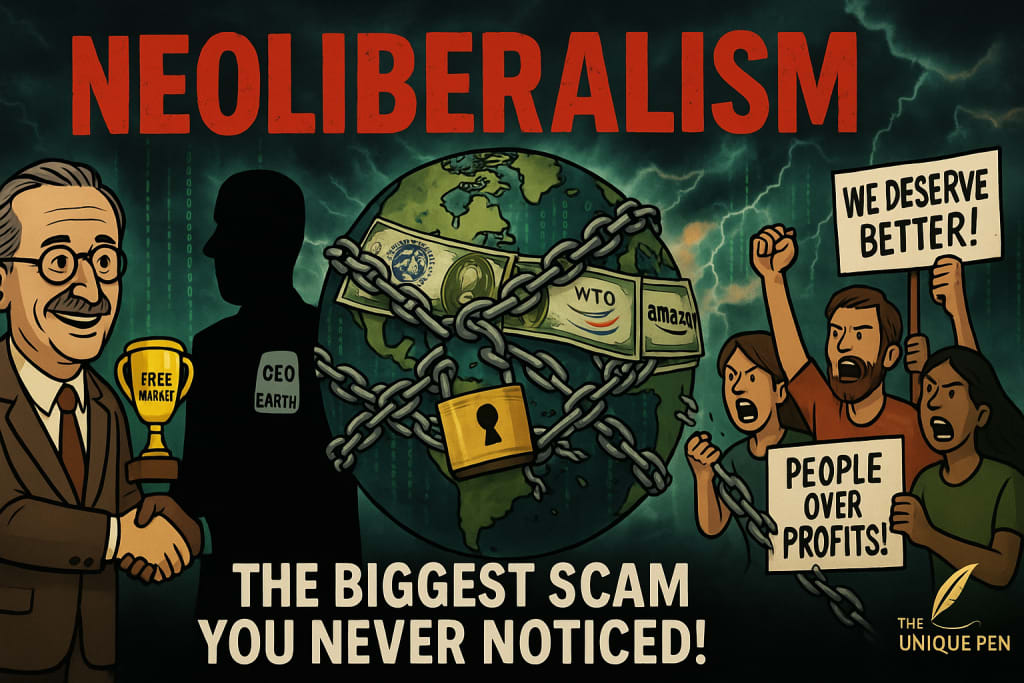
Once upon a time in a snowy Swiss chalet—not quite a James Bond hideout, but close—a bunch of intellectuals gathered with a dream. It was the 1940s, and the world was crawling out of the rubble of fascism and world war, trying to piece together what kind of future it wanted. In a resort town named Mont Pèlerin, a group of academics, economists, and political thinkers formed what would become the world’s most powerful secret club that no one had ever heard of: the Mont Pelerin Society.
At the center of this gathering was Friedrich von Hayek, a man who thought communism was a slippery slope to serfdom, socialism was just fascism with better PR, and that governments needed to chill. A lot. Hayek and his fellow thinkers wanted to protect capitalism—not just from bombs and bullets, but from an even greater threat: democracy.
See, in their eyes, the problem with democracy was that it let poor people vote. And when poor people vote, they tend to ask uncomfortable questions like:
“Why am I working 16 hours a day and still can’t afford bread?”
or
“Shouldn’t healthcare be, you know, a human right?”
To Hayek, this was unacceptable. The market, he believed, was a natural phenomenon—like gravity, or Beyoncé’s dominance of the charts. You don’t mess with it. You just obey.
So what did Hayek and his crew do? They started building an idea—a new “ism.” Not socialism, not fascism, not classic liberalism. This was something new. Something... neo. Welcome to neoliberalism.
Chapter 2: The Gospel According to Hayek
Neoliberalism said the market was holy. Government? Eh, not so much—unless it was used to protect the market from the people.
Think of neoliberalism as the ultimate reverse Uno card. Instead of the state helping the people, the state was now helping the market, so the market could help the rich, who would then help themselves.
The policies that followed were simple:
Privatize everything. If it moves, sell it. If it doesn’t, privatize the land under it.
Deregulate. Tear up the rulebooks. Let companies “innovate” without pesky things like safety or ethics.
Free Trade. Not for you, but for capital. Let money flow like a billionaire’s champagne tab.
And here’s the kicker: it wasn’t about shrinking the government. It was about remaking it—weaponizing the state to protect capital, suing any country that dared to dream of affordable medicine or local ownership of their own natural resources.
Chapter 3: The Rise of the Neoliberal Empire
Fast forward to the 1980s. Enter Ronald Reagan and Margaret Thatcher, neoliberalism’s prom king and queen. Reagan got handed a literal checklist by right-wing think tanks like the Heritage Foundation titled, “How to Neoliberal in 10 Days.”
And boy, did he follow through:
Unions were crushed.
Public housing was torched.
Wall Street was given a free pass to morph into a casino.
Meanwhile, across the Atlantic, Thatcher famously declared, “There is no such thing as society.” Just individuals and markets. Translation: “Good luck, peasants.”
But this wasn’t just an Anglophone affair. The IMF and World Bank became the missionaries of this new faith, spreading the neoliberal gospel to every corner of the globe.
If you were a newly decolonized country in the '70s or '80s, you weren’t really free unless you:
Sold off your industries,
Let foreign companies set the rules,
And agreed not to cry when they sued you for "interfering with the market."
Think of it like colonialism—but make it corporate chic.
Chapter 4: The Neoliberal Matrix
Under neoliberalism, the world became a giant Monopoly board—except all the hotels were owned by five people, and you weren’t allowed to pass “Go” unless you had a degree in hustling your own identity as a brand.
Even your own body, your skills, your vibe—became assets to be monetized. Suddenly, everyone was an entrepreneur. Not because they wanted to be. But because the safety nets had been set on fire.
Why do we have Uber instead of unions?
Why does The Rock’s Twitter bio say “Founder of Teremana, ZOA, XFL & Project Rock”?
Why does every job feel like a side hustle?
Neoliberalism. That’s why.
Chapter 5: Hayek’s Bastards and the Fightback
Here’s the twist. Neoliberalism never really “won” in the hearts of people.
It just wormed its way into the system so deep, it became the default.
But every system has a shelf life.
In Honduras, citizens rose up when Silicon Valley billionaires tried to set up a private libertarian island—complete with its own laws, courts, and probably avocado toast quotas.
When the new democratic government said “No, thanks,” those billionaires didn’t start a dialogue.
They sued Honduras for $10.8 billion under—you guessed it—neoliberal free trade laws.
That’s not a bug. That’s the program working as intended.
Epilogue: The End of the Road
Neoliberalism is cracking. The fantasy that markets can fix everything is fading.
The IMF, the WTO, the investment treaties—they’re all looking a bit shaky.
It turns out, you can’t run a planet like a hedge fund forever.
Eventually, the wires are stripped, the people get angry, and someone asks the forbidden question:
“What if we ran things differently?”
So here we are.
The age of Hayek is limping to a close.
Not with a bang—but with a billion microtransactions and a bunch of lawsuits.
And maybe, just maybe, something better is waiting on the other side.
About the Creator
The Unique Pen
"Behind every word, there's a story waiting to be told. I am The Unique Pen, a voice that challenges norms, ignites thought, and crafts narratives that leave a lasting imprint. If you seek writing that resonates, disrupts, and connects"
Keep reading
More stories from The Unique Pen and writers in Humor and other communities.
Two Grumpy Old Men Solve the Problem
Marty and Steve were two grumpy old men who lived together. They had known each other for years. Marty had been a bachelor all his life. Steve said it was because no one could stand to ever live with him. Marty’s standard reply was “Well, you are, so what sort of a moron does that make you!”
By Calvin London12 days ago in Humor
The World Is on Fire, But My Freezer’s Been Stockpiling Since 2017
📦 Section 1: Frozen Time Capsules – A Love Letter to Foods That Shouldn't Be Alive There comes a moment in every adult’s life when you open your freezer, stare into the icy abyss, and realize you’ve been harboring culinary fugitives from the past.
By The Pompous Post4 days ago in Humor
A Transparent Look at Vocal Challenges and Top Stories
Almost three years ago, we shared a resource article that served as a place for people to suggest new challenge prompts. We thought it would be a good idea to refresh that thread, and take the opportunity to answer a few common questions about top stories, how challenges are judged and how submissions are reviewed.
By Vocal Curation Team4 days ago in Resources


Comments
There are no comments for this story
Be the first to respond and start the conversation.