
You Don't Know Her
A post-pandemic subway ride with the stranger across from you

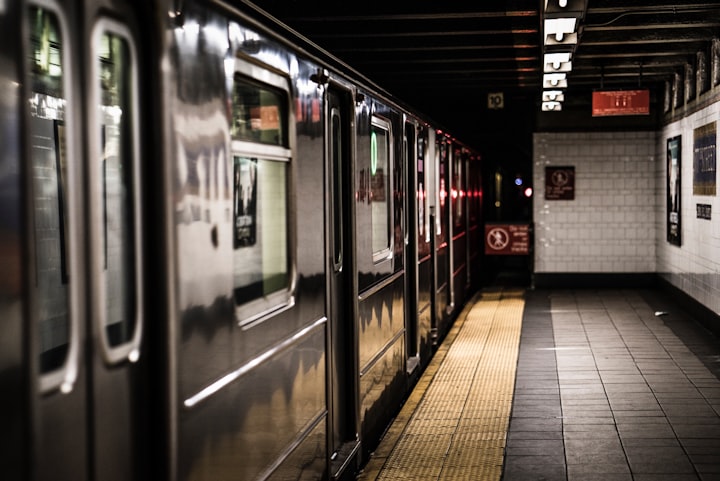
You don’t know her. You don’t even notice her. You’re staring at your phone, again. She’s been here before, maybe even riding the same train car as you.
Eventually, the city wears anyone down. You move there shiny and new, and in just one summer night, the steam on the tracks melts your mascara, frizzes your hair. The layer of grime permeates the air and dulls every inch of you. The trope is extremely overplayed, and quite frankly, worn down. A young woman moves to New York to chase a dream, or escape a past. Shortly after, she’s eating ramen on the floor of her closet-sized bedroom, crying because well, New York actually smells like piss, and no one smiles ever. She’s barely making it as a copywriter, a waitress, retailer, whatever. The details are semantics. The story is the same. The story is unoriginal. The story doesn’t matter. New York reminds you daily, as you’re splashed by a filth puddle when a cab swerves near you: you don’t matter.
But this morning, this woman, this story is slightly different. Or maybe it’s not. You can’t know how it ends. You’ll never really know, yet you hear stories like this. Still, those stories are hearsay, like the NYPost cover stuck to the floor of this very subway car. Everyone has their headphones in, their eyes glazed over. Is everyone feeling the same monotony, the same numbness? Have they become so subdued by the clacking of the tracks that the stutter into the station does not shake them alive anymore? Do they not remember their first ride, the way they braced their cores to fight the train’s force as it lurched to a stop? We’re all just subterranean surfers in a sea of suits.
What’s inside the bags clutched between everyone’s knees? Hers is a burgundy leather. Maybe vegan leather. She looks like she could live in Brooklyn, and this is an F train headed downtown.
She’s pensive, consumed. She’s scrawling notes in a tiny black Moleskine. You’re across from her, but even if you were cramped in the tush-imprint of the seat beside her, two peas in a very temporary pod, you wouldn’t dare peer over her shoulder.
She doesn’t have time to even consider whether you or anyone else sees the bead of sweat around her brow. New York has taught her to ignore everyone, so why would anyone notice her? Why would anyone know she has a thick stack of cash in her handbag? The handbag was a Christmas present from the man who was supposed to be her forever love, right before he shot himself in the driveway three years ago on St. Patrick’s Day. The pandemic had been bad (an understatement). For him. For her. For, well, everyone except the rich folks on Moderna’s, Pfizer’s, and Zoom’s boards.
He was in crisis. She knew it wasn’t her fault. She knew there was no stopping him, no going back, no fault or blame. In ending his life, he also ended theirs together. So, she pawned out the ring and moved to New York. She heard the city never sleeps. She thought that the steady hum of life could soften the isolation of her post-traumatic insomnia and her post-loss loneliness. That was 18 months ago.
Slowly, she had begun to sleep. Mostly, though, she had begun to sleep around. With men who fleetingly reminded her of him in some subliminal way. His beard, his jokes, the furrow of his brows, the tapping of his fingers on the tabletop at a jazz club. They were all a sliver of him, but none were an inch of the salvation she wanted. She fell into each of their arms, for a night or a dozen. But she never fell further. And every time, in the morning, somewhere between this placeholder man’s bed and her overpriced abode in Bedstuy, she always could be found, another human pill in the shuttering pillbox that is an F train car. And she always had her little black notebook, and she was always writing a letter to him about each temporary lover. Processing, searching, dreaming, seeking. It was cheaper than therapy. And quieter, too.
Today’s letter started the same, and so did the story. She had met last night’s bedmate during her shift at the whiskey bar in the Thompson Hotel lobby. Working there was fine. The tips were good and the drinks were neat. She wore all black because everyone south of Houston St wears all black, and it suited her perpetual state of mourning. He came in for a quick drink before some kind of business dinner each night, for months. His voice was quiet, his beard was salt and pepper, and his order was uncomplicated. He didn’t ask invasive questions or give flagrantly rude compliments. He shared her energy - a slow-marinating, palpable loneliness, a sadness that you’d blink and miss if you didn’t slow down. And people don’t come to New York to slow down.
He came every week, Tuesday to Thursday. She never fucked a customer - too cliché even for her taste,, but slowly, their brief exchanges had worn her down, melted to her core.
“It was the fourth night of the seventh week. I don’t know why I remember that. He left his room key with his signature on his nightly bill. The gesture was subtle, yet bold. That afternoon, the way his brow furrowed was exactly how your brow furrowed, right before you walked outside and shot yourself. And I thought, maybe I could unfurrow his, before it’s too late, before he might do what you did…,” she wrote. She trailed off. She sighed.
You only saw her sigh. You don’t know her. You don’t know what happened last night. Go back to your Instagram feed. This isn’t your story.
“I’ve now worked in the lobby bar for over a year, and had never once gone upstairs. And in the near-silence he and I had shared over the last seven weeks, I had come to trust him. He had unwittingly become my wordless confidant. My steady blue eyes at the bar, and a guaranteed good tip without a bother or false banter.”
And when I woke up, he was gone, and there was a traveler’s check for $20,000, and the hotel notepad simply said, ‘Thank you. For your kindness. This never happened. Thank you.’
But it happened. She was sure of it. But she hadn’t known him like she thought she had. She wanted to know him over and over again.
Now, you may have already forgotten that Biden’s UN envoy, Linda Thomas-Greenfield died last week because Morgan Freeman also died that day - and that was way sadder for the masses and way bigger news for the media. Why am I reminding you about Linda? It’s related, I promise. Linda’s vacancy means James Schofield will now be the American Ambassador to the United Nations. The bipartisan wonderchild, four-tour veteran, and descendant of a woman enslaved to a founding Father? He would now be the restorative face of America’s damaged global image, the catalyst for meaningful unity and change through diplomacy. No one else knew his drink order, though.
“I also forgot that she died. You know I don’t follow that stuff. Not sure I even knew who Linda was. But now, everyone knows Linda. AND now everyone knows his name and his face. Sort of. And they also know his gorgeous wife in her pressed suit. And his two beautiful all-American kids. It’s like everywhere I look today, I see his fucking face, and his fucking smile, and his fucking browlines that remind me of you.”
She was sure no one knew what his fingertips felt like untying her bathrobe, or how warm his breath had felt on her collarbone. No one knew that despite his enormous stature, he preferred to be the little spoon. And for her, it had felt oddly natural to hold him that way.
“I don’t care about all of that. Or, I guess I can’t. You were one end, he is another. I am still here. I am still me. I am ready to move forward, my love. I’ve filled up this notebook. Its blank pages are few. In the emptiness you left, I have poured out myself, my sadness, my aching. I am older, yet newer. And so should be my days in New York. This city is no home for me. I have written my first chapter without you, alone, slowly, begrudgingly, longingly.”
$20,000 was the perfect amount to get out of the city. Combined with the life insurance policy, she would have enough to get the bungalow outside Asheville, back home. To really start over.
“I am ready to feel you in the breeze and hear you in the stream. There will be extra sweet tea in the fridge. I’ll live up the road from my sister, and the boys will play in my yard. I’ll finally have the chicken coop and the wildflowers and someday, a porch swing and maybe, a banjo. I’ll get back to sewing, maybe. I’ll work at the diner. And I’ll move along. It’s time.”
When she cashed the check that day, she fluttered the bills. She’d never held that much cash. She only asked for the check in cash to see the teller’s reaction. She must’ve briefly forgotten it’s New York, and no one blinks at $20,000.
She felt the soft paper money brush her fingertips. In the folds of bills, she saw fields of tallgrass and a creek she could splash her toes in. She saw a life ahead. The grieving would never be over, but the color would return to her cheeks - and her wardrobe. She looked better in prints after all.
Or maybe she’s just going to work. Morning commute. Like everyone else. You wonder what her Starbucks order is as you walk up the steps to pick up yours. You don’t even like coffee, but New York changes people, they say.
About the Creator
Stef in Chicago
I work in healthcare tech, started a matchmaking business in quarantine. I write on mental health and dating for Glamour. The Artist's Way got me to try creative writing again.
Keep reading
More stories from writers in Humans and other communities.
Time to change your life.
Is it even possible for you to change your life? A lot of people, more than there should be, are unhappy with their lives. But what are they doing about it? Usually nothing. People talk about how shitty their lives are and want change, but are they not taking the actions to change?
By Jen Phillipsabout 15 hours ago in Humans
How Breakups Affect Mental Health And Emotional Healing Over Time
Separations with each other are accompanied by strong emotional responses that may be overwhelming at first. Grief, shock, anger, bewilderment, and loneliness are all feelings that are often triggered as people experience the grief of losing a close emotional attachment. Sudden loss of emotional contact interferes with everyday life and emotional stability and produces distress which impacts on sleep, appetite, and concentration. To most people, the separation causes instability, which causes their anxieties to increase or even lose their emotions as the mind tries to cope with the transformation.
By Robert Smith2 days ago in Humans


Comments
There are no comments for this story
Be the first to respond and start the conversation.