
Why South Korea is Going to be wiped out
South Korea Going to Extinct
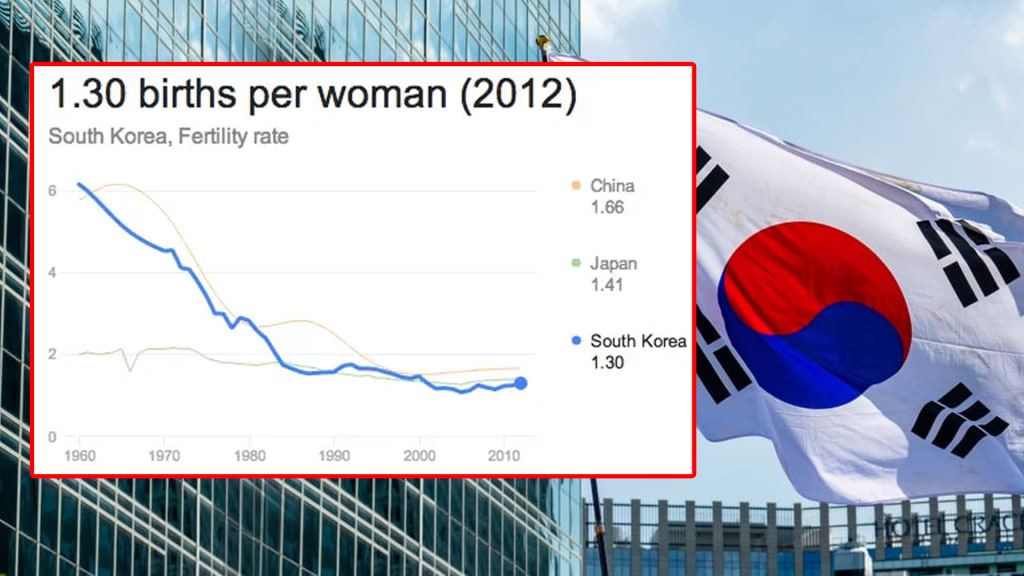
Something really phenomenal in mankind's set of experiences is all presently occurring right now in South Korea. For the past several years, South Korea's fertility rate—the number of children that each woman will give birth to during her lifetime—has consistently declined, many years to the point where not only today, in 2024, has it reached the lowest fertility rate in the world, but it has probably reached the lowest fertility rate ever measured by any society in all of mankind's history.
To keep a stable population within any society, the fertility rate needs to stay at an average of 2.1 children per woman. If the fertility rate is higher than 2.1, the population will be growing, and if the fertility rate is lower than 2.1, the population will shrink. The lower the fertility rate becomes, with no additional immigration from elsewhere, South Korea's fertility rate had already fallen below the 2.1 replacement level many years ago. Back in 1984, that was not particularly memorable or remarkable, but because many other developed countries like the US, Japan, Germany, Australia, and others had all seen their own fertility rates drop below the 2.1 replacement level years before the South Koreans did, it was noteworthy.
However, it was after South Korea's fertility rate fell below the replacement level that it became exceptional, as it just continued to sink, getting worse and worse over time. By 2013, South Korea's fertility rate had sunk low enough to become the lowest in the whole world, with the average South Korean woman having only 1.2 children during her lifetime. Then, defying almost everyone's expectations, it continued to sink even lower. By 2019, South Korea became the first country in recorded history to reach a fertility rate of less than one child per woman, when it sank to just 0.9. It continued to decrease year-over-year, setting new all-time civilizational low records. As of 2024, the fertility rate had sunk to just 0.68 children per woman nationwide—the lowest ever recorded in a large human culture since the dawn of time, excluding major conflicts or famines. This implies that, for every 100 young childbearing-age South Korean residents alive today, they will only produce around 34 children between them during their lifetimes. If the fertility rate stays where it is today, those 34 children will then have less than 12 children, and those 12 children will only have four children. This means that the population of young South Koreans three generations from now might be 4% of the size of the current population of young South Koreans today, which obviously represents a complete breakdown in South Korea's population. This decline will continue throughout the remainder of the 21st century as fewer and fewer children are born to replace the elderly who die from natural causes.
The sheer speed at which South Korea's fertility rate has declined is also something that is truly remarkable in mankind's history. For comparison, the fertility rate in the US back in 1800 was around six children per woman, and it took America around 170 years from that point for its fertility rate to consistently decline to below the 2.1 replacement level during the 1970s. In contrast, South Korea's fertility rate also stood at around six children per woman in 1960, but then it took only the next 60 years for the country's fertility rate to plummet from 6 down to 0.8 children per woman by 2020. In that same 60-year period, from 1960 to 2020, America's fertility rate declined more gradually from three children per woman to 1.7.
Therefore, South Korea's population undoubtedly peaked at an all-time historical high in 2020 at 51.84 million people. The following year, in 2021, South Korea recorded its first net population decline since the Korean War of the mid-1950s—57,187. Then another 123,000 were lost in 2022, and even more people will be lost each year to come. The country, for many years longer, by the mid-2070s and around a decade from this video's delivery date, is expected to see its total population shrink to about 36 million people, representing a total deficit of around 16 million people, or around 30% of the nation's peak population in 2020. This level of population decline is extraordinary in human history, excluding the plague that struck 14th-century Europe. It will only get worse from there. By the end of the century in 2100, South Korea’s population will likely have lost nearly half of its peak 2020 population, declining to just around 25.2 million people, essentially returning to the population it had back in the mid-1960s.
All of this, of course, assumes that the nation’s current fertility rate of 0.68 children per woman stops declining any further and remains steady at its current level. But the thing about South Korea’s exceptionally low fertility rate is that it is in completely uncharted territory with no prior precedent to truly understand where it might eventually settle. No part of this has ever occurred before in mankind's history to a society during peacetime, absent diseases and famines. No one is quite certain where the very bottom of the country's fertility rate could ultimately end up. Demographers have been regularly astonished as the South Korean fertility rate has declined lower than one child per woman in 2019 each year to the current value of 0.68, and it’s now even lower in many parts of the country. In the capital and largest city, Seoul, where around 20% of the South Korean population resides, the fertility rate has currently sunk to just 0.55 children per woman as of 2024—the lowest figure in the country. This means that a typical 100-childbearing-age cohort of residents in Seoul today will only produce around 27 children to replace them during their lifetimes.
What’s even more disturbing than South Korea's rapid population decline throughout the remainder of the 21st century will be the structure of the South Korean population as it ages. Since the beginnings of the Industrial Revolution, modern industrial societies have been supported by the idea that a much larger working-age population (aged 15 to 64) will contribute to the economy and support their much smaller dependent counterparts of retirement age (seniors aged 65 and up) and children aged 0 to 14. Children and the elderly don't contribute much to the economy and are net economic drains since they draw resources from the economy without contributing back. However, this has always been acceptable as long as the productive working-age population in between them is typically larger in population. Throughout all of mankind's history, since the Industrial Revolution, this has remained true for every society around the world, including South Korea.
In 2024, South Korea's working-age population is around 36.7 million individuals, while the country’s retirement-age population is around 9 million individuals, meaning that for each South Korean of retirement age today drawing resources from the economy without contributing, there are about four South Koreans of working age still working and contributing to the economy to support them, which is a fairly good ratio and about the same as the US currently has. However, as more and more South Koreans age with fewer children being born to replace them, this ratio will continue to become more and more unbalanced as the middle-aged South Korean population continues to age.
For many years, throughout the 1950s, 60s, and 70s, when South Korea ranked among the poorest and least developed countries in the world, back when it was much worse off than North Korea, South Korea had one of the youngest populations in the world. The median age of South Koreans did not exceed 18 years until 1972, when the median age in the US at that time was already 28 years. Since then, however, the median age of South Koreans has risen significantly faster than it has in the US. Their median age reached a tipping point in 2011 when their typical residents were around 37 years old. Since then, the median age in the US has only increased by a single year to 38 years old in 2024, while in South Korea, the median age has soared by an additional eight years to 45 years old today, which is already the eleventh highest among large countries in the world and will clearly worsen with time. By the 2060s, the median age in South Korea will soar to over 61 years old, which is also completely unprecedented in human history. Never before has there been a large human society where the majority of residents are older than 60 years of age. To put this into perspective, the oldest major country in the world today is Japan, with a median age of 49.5 years old. Even Monaco, a small microstate largely populated by elderly wealthy individuals, has a median age of 56.2 years today, which is still younger than what South Korea is projected to be in just slightly more than a decade from now due to the rising age in the country caused by the declining fertility rate.
South Korea’s population of seniors aged 65 and older is already projected to reach 37% of the country’s total population by 2045, surpassing Japan's level of elderly individuals at 36.7% of their population by that time. This implies that South Korea will likely surpass Japan as the world’s oldest society by then. By the mid-2070s, almost half of South Korea’s remaining population will be of retirement age (65 and older), around 17.3 million senior citizens out of a country of just 36.7 million.
About the Creator
Keep reading
More stories from writers in Humans and other communities.
Time to change your life.
Is it even possible for you to change your life? A lot of people, more than there should be, are unhappy with their lives. But what are they doing about it? Usually nothing. People talk about how shitty their lives are and want change, but are they not taking the actions to change?
By Jen Phillipsa day ago in Humans
Instructions Included Challenge Winners
For the Instructions Included challenge, we asked writers to tell a story through instructions and to trust the form to carry what could not be said outright. Across the top entries, that trust paid off in many different ways.
By Vocal Curation Team5 days ago in Resources




Comments (1)
Thanks for sharing