
Why Saying “I’m Sorry” Is So Hard
How three simple words carry the weight of pride, fear, and love

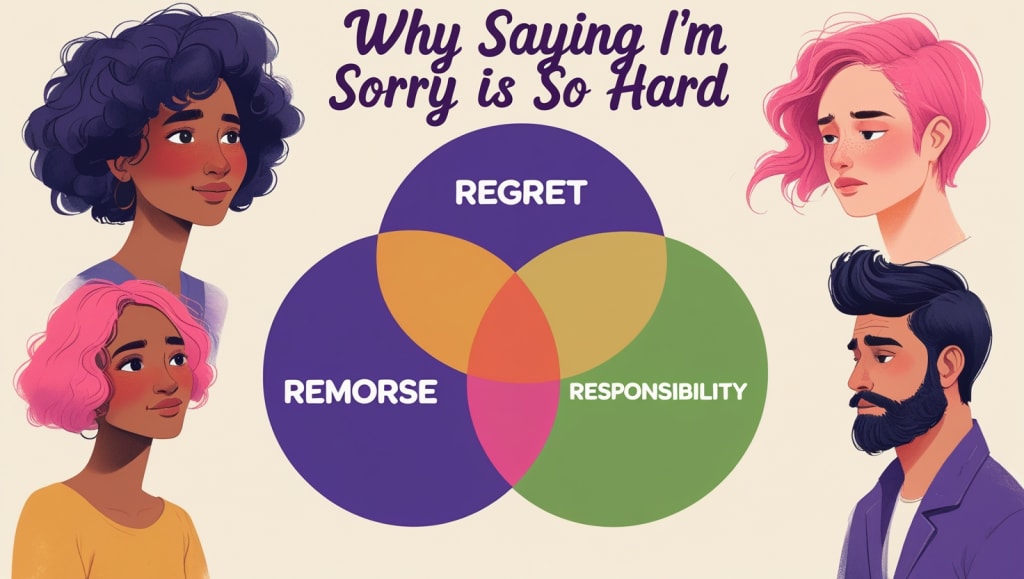
It’s only two words. Just six letters.
And yet, for many of us, “I’m sorry” feels like trying to push a boulder uphill.
We know it’s the right thing to say. We know it could heal wounds, bridge distances, and ease tension. But when the moment comes, our lips tighten, our throat closes, and the words get stuck somewhere between our mind and our mouth.
Why is something so simple… so hard?
The Weight Behind the Words
An apology is never just an apology.
It’s a quiet confession — a way of saying:
• I hurt you.
• I was wrong.
• I could have done better.
And sometimes, that feels like too much to admit. Pride stands in the way, whispering, If you say it, you’ll look weak.
Fear joins in, warning, What if they don’t forgive you? What if it changes how they see you?
Apologies require us to look in the mirror and confront the parts of ourselves we’d rather hide.
The Myth of Weakness
Many people grow up believing that apologizing is a sign of weakness — a way of giving up power.
But here’s the truth: saying “I’m sorry” is an act of strength.
It means you value the relationship more than your ego.
It means you’re willing to put down your shield and show your humanity.
And that’s not weakness — that’s courage.
When Ego Gets in the Way
Pride is often the biggest roadblock to an apology.
We tell ourselves things like:
• It wasn’t entirely my fault.
• They should apologize first.
• They’re overreacting anyway.
This mental negotiation helps us avoid discomfort in the short term — but it leaves cracks in our relationships that grow wider over time.
Ego keeps us “safe” in the moment but lonely in the long run.
The Fear of Consequences
Another reason “I’m sorry” feels heavy is because we don’t know what will happen next.
Will the other person reject us?
Will they still be hurt?
Will they forgive, but never forget?
Apologizing means taking a risk. It means stepping into a space where you have no control over the outcome. That uncertainty can be terrifying.
But here’s the thing: silence rarely makes things better. If anything, it lets resentment grow roots.
Learning to Apologize Well
A good apology isn’t just about saying the words — it’s about meaning them.
Here’s what makes an apology truly healing:
1. Acknowledge the hurt – Say exactly what you’re sorry for.
Example: “I’m sorry I snapped at you yesterday when you were just trying to help.”
2. Take responsibility – Avoid “if” or “but” statements.
Not: “I’m sorry if I hurt you, but…”
Instead: “I realize I hurt you, and I take full responsibility.”
3. Show you understand – Let them know you get why it mattered.
4. Offer to make it right – Ask if there’s something you can do to repair the damage.
5. Give space – Let them process. Forgiveness doesn’t always happen instantly.
When “I’m Sorry” Isn’t Enough
Sometimes, words alone won’t fix the harm.
In those cases, actions speak louder:
• Changing the behavior that caused the hurt.
• Showing consistency over time.
• Proving that your apology wasn’t just an empty gesture.
A genuine apology isn’t just a one-time statement — it’s a commitment to do better.
The Gift of Vulnerability
Apologizing is more than a repair tool. It’s a way of saying: I care about you. I value us. I don’t want to let this hurt be the last thing between us.
When we choose vulnerability over pride, we open the door to deeper connection.
We remind each other that we’re all human — flawed, imperfect, but capable of love that grows stronger after the storm.

================
Thank you for reading
Best regards: Habib
About the Creator
Habib king
Hello, everyone! I'm Habib King — welcome here.
Every setback has a story, and every story holds a lesson. I'm here to share mine, and maybe help you find strength in yours. Let’s grow together.
Keep reading
More stories from Habib king and writers in Humans and other communities.
Flower Bloom 369
FLOWER Bloom 2/25/26 Wednesday By Mariann Carroll Karen had been with Tony for 7 years. Tony started acting strangely after her surgery. He would mow the lawn in the rain and be on his cellphone. He started pushing Karen away. Tony came clean about seeing someone. Karen moved out two months later. Karen moved in with a friend. She felt betrayed.
By Mariann Carroll3 days ago in Fiction




Comments
There are no comments for this story
Be the first to respond and start the conversation.