
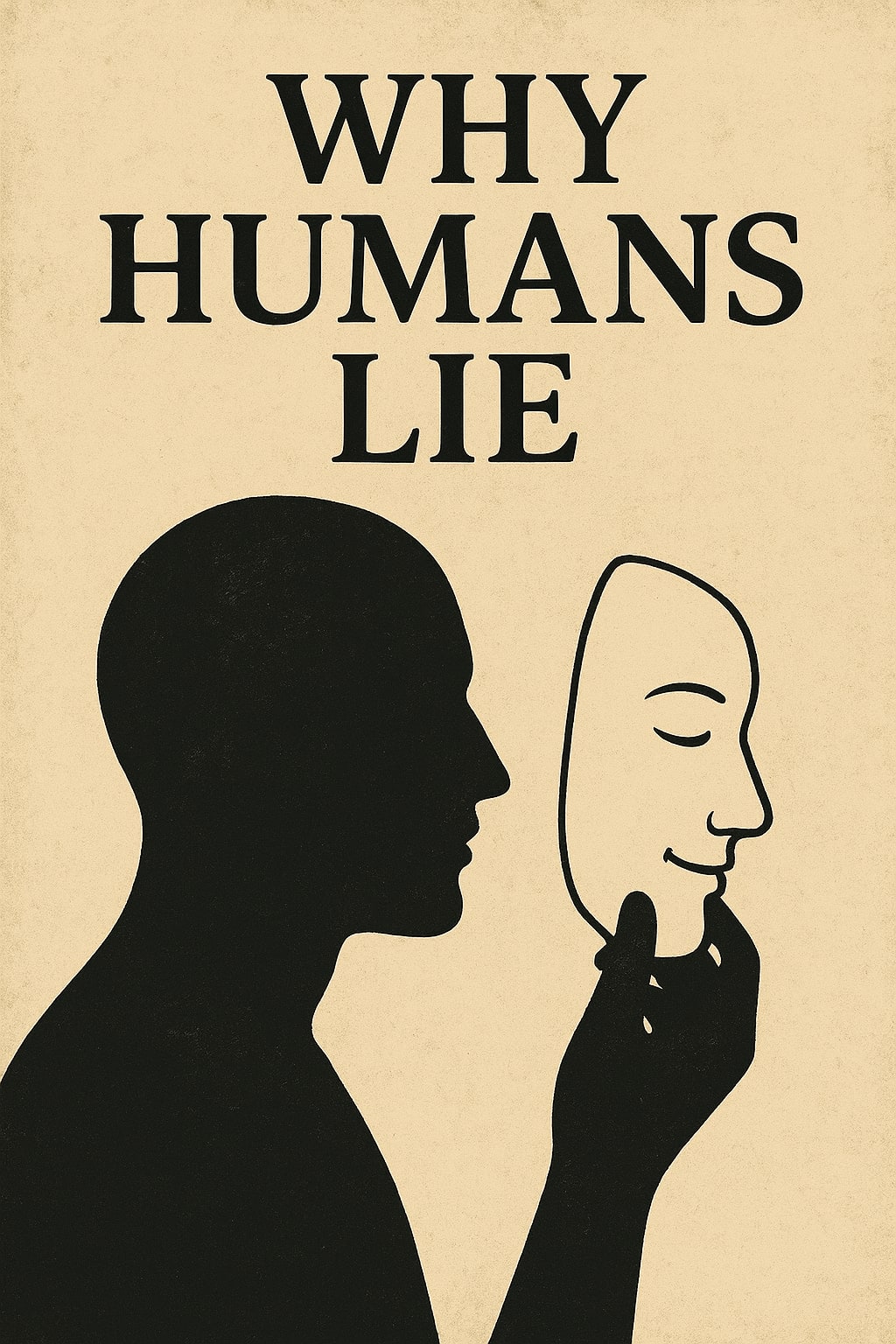
Why Humans Lie
Subtitle: The Truth Behind Our Deceptions
The rain fell softly on the glass windows of the small café, blurring the city lights into streaks of gold and silver. Inside, a man sat alone at a corner table, his coffee untouched, his eyes fixed on the steam rising from the cup. His name was Daniel Hart, a psychologist who had spent twenty years studying human behavior — but that night, he wasn’t thinking as a scientist. He was thinking as a man who had just told the biggest lie of his life.
Earlier that evening, he had looked into his wife’s eyes and said, “I’m fine.”
He wasn’t.
It wasn’t a grand deception or a malicious falsehood — just a small, simple lie. Yet it carried a familiar weight, the kind that presses on the chest and tightens the throat. He had said it to protect her, or maybe to protect himself. After all, what was the point of burdening her with his sleepless nights, his fading passion, and the growing void he felt inside?
He took a sip of his cold coffee and opened his notebook — a habit he had kept since his university days. On the top of the page, he had written:
“Why do humans lie?”
It was the question he had been asked earlier that week during a lecture. One of his students, a quiet girl in the back row, had raised her hand and said, “If lying is wrong, then why do we all do it — even good people?”
Daniel had smiled then, offering the textbook answer — “Lying is a defense mechanism. It protects the self from harm, rejection, or guilt.”
But deep down, he knew that wasn’t the full truth.
Later that night, Daniel decided to find his answer the way he always had — by observing others. He left the café and walked through the city, where the stories of human lies unfolded in every glowing window.
At the flower shop, he saw a man buying roses with trembling hands. His phone buzzed, and the man quickly silenced it. He smiled as he told the florist, “They’re for my wife — it’s our anniversary.”
Daniel could tell from his voice that the man wasn’t married. The lie was clumsy but tender, an offering to someone else, or maybe a memory of someone lost. We lie to love, Daniel wrote in his notebook.
Farther down the street, he passed a group of teenagers huddled near a bus stop, laughing too loudly, pretending not to be cold or scared. One boy, no older than sixteen, shouted, “My dad’s sending me to college abroad!” The others cheered, but Daniel caught the flicker of shame in the boy’s eyes. We lie to belong, he wrote.
At the hospital across the street, he saw a nurse tell a pale woman in bed, “You’re going to get better soon.”
Daniel knew the look in the nurse’s eyes — he had seen it before in hospice wards. It was a lie, but a merciful one. We lie to comfort.
By the time Daniel returned home, his notebook was full of fragments — snippets of overheard truths wrapped in falsehoods. But one thought kept returning:
If everyone lies, is honesty still sacred?
The house was quiet when he entered. His wife, Emily, was sitting by the fireplace, reading a book. She looked up and smiled. “You’re late again.”
“Lecture ran long,” he said automatically — another small lie. He set down his notebook and coat, then sat across from her.
She studied him for a moment. “You’re not fine, are you?”
Daniel froze. He had spent his life studying deception, but he had forgotten that love has its own kind of intelligence — the kind that sees through silence.
“No,” he admitted finally. “I’m not.”
The words came out heavier than he expected, trembling like something long caged. “I don’t know what I’m doing anymore, Em. I spend my days studying the mind, teaching people about truth — but I can’t even be honest with myself. I feel like I’m disappearing behind my own masks.”
Emily set her book aside and took his hand. “You’re not disappearing,” she said softly. “You’re just tired of pretending.”
They sat in silence for a long time, the kind of silence that heals. For the first time in months, Daniel felt something lift — not completely, but enough to breathe again.
Later that night, as Emily slept beside him, Daniel returned to his notebook. He crossed out the words “Why do humans lie?” and wrote something new beneath it:
“Because the truth is heavier than most hearts can carry.”
He realized then that lying wasn’t always an act of evil — sometimes it was an act of mercy, of survival, of fear, or even love. People lie not only to deceive others, but to protect what little light they have left. Lies, in their twisted way, are proof that we still care — about others, about ourselves, about the fragile worlds we build to feel safe.
Daniel closed his notebook and turned off the lamp. The rain had stopped, and outside, the wind whispered through the trees — gentle, forgiving.
For once, he didn’t listen for truth or illusion in its sound.
He simply listened — and let it carry him to sleep.
About the Creator
Keep reading
More stories from abdul qadir and writers in Humans and other communities.
Tales of Humanity
In a quiet town nestled between rolling hills and sparkling rivers, life moved at its own gentle pace. People went about their daily routines, often wrapped in their own worries, rarely noticing the invisible threads that connected everyone. These threads were not magical in the ordinary sense; they were made of empathy, kindness, and shared experience. The oldest resident of the town, a wise woman named Amina, often told children, “Every act of goodness is a seed that blooms in someone else’s life.” Most of them nodded politely but never quite understood the depth of her words—until one spring morning changed everything.
By abdul qadir3 months ago in Humans
How Astrology Affects Twin Flame Attraction and Separation Cycles.
Twin flame attraction feels instant and consuming. Separation feels confusing and painful. Astrology explains why these cycles repeat. Planetary movements influence timing, emotional intensity, and personal growth. You experience pull and distance through energetic patterns reflected in birth charts and transits.
By Wilson Igbasia day ago in Humans



Comments
There are no comments for this story
Be the first to respond and start the conversation.