
Whispers of the Last Train
A midnight train, a fleeting love, and a goodbye that lasts forever.

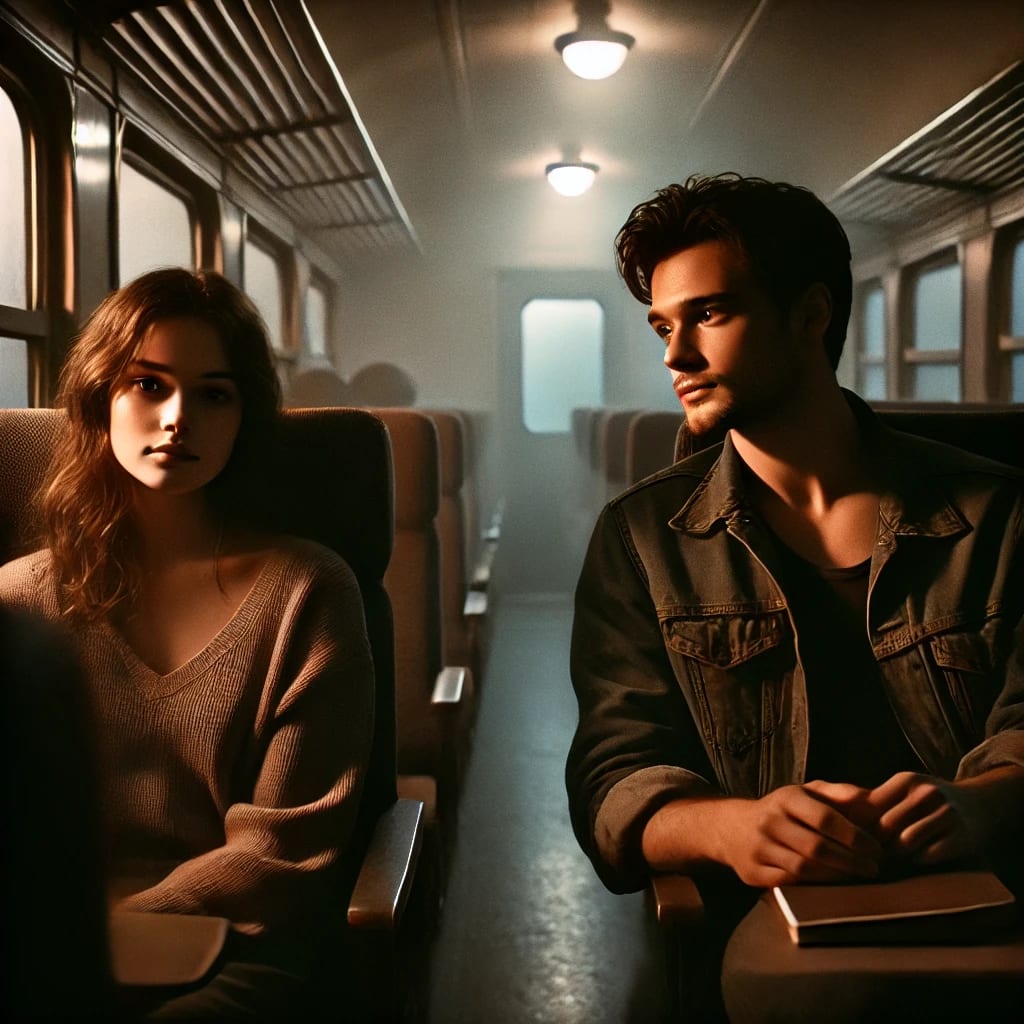
The clock at the old railway station struck 10:15 PM as the final train of the night screeched onto the platform. A cold December breeze blew through the rusted beams, carrying the faint scent of damp earth and diesel. Amid the scattered passengers rushing to board, 23-year-old Maya sat quietly on a wooden bench, her chin resting on her palm, eyes lost in thought. She wasn’t waiting for anyone; she wasn’t even sure where she wanted to go. The train station had become her escape—a place where movement never ceased, even when her life had come to a sudden halt.
Maya had once been full of dreams—an artist by heart, painting for galleries in hopes of recognition. But after the passing of her father and a series of failed exhibitions, life had stripped away the colors. The world, for her, now existed only in greys.
“Ticket?” a deep voice interrupted her trance.
She looked up to see a tall man, disheveled but not unkempt, standing before her. His eyes—soft yet piercing—held her gaze a little too long. “You’ll miss the train if you’re not careful,” he added, holding up a ticket.
“I don’t have anywhere to go,” Maya replied flatly.
The man chuckled as if her response amused him. “I don’t have anywhere to go either, but the train moves anyway.” He tilted his head toward the waiting carriages. “Come on. Sometimes, you just need to move to feel alive.”
Something about his words stirred her. She didn’t know why she stood up, didn’t know why she followed him to the train. It wasn’t like her to trust strangers, but tonight, her instincts told her this was different.
The man bought her a ticket before she could protest. As they boarded, she finally asked, “Who are you?”
“Arjun,” he said, leading her to a window seat. “And you?”
“Maya.”
“Nice to meet you, Maya.” Arjun settled into the seat across from her.
The train lurched forward, cutting through the darkness, and the faint chatter of passengers filled the silence. Arjun was peculiar—not pushy, not loud, just comfortable to be around. He didn’t ask intrusive questions but spoke in a way that made her want to listen. He talked about small things—a novel he loved, his backpacking adventures, how trains reminded him of freedom.
“What about you? Where were you headed tonight?” Arjun finally asked.
Maya hesitated. “Nowhere, really.”
“No one travels to nowhere, Maya. Maybe you just haven’t figured out where yet.”
His words hung between them. For the first time in years, she felt seen—like someone understood the hollowness she’d been carrying.
As the hours passed, Maya found herself opening up to him. She told him about her father, about how his death had left her adrift. She described her love for painting, how every brushstroke felt like breathing, and how losing hope in her art felt like suffocation. Arjun listened, his face kind and unjudging.
“I used to believe the world wanted to see my art,” she confessed. “But no one came to the last exhibition. It’s like I’m invisible.”
Arjun leaned back, watching her thoughtfully. “Do you think a tree stops growing if no one sees it? Does the sun rise only if people watch?”
Maya blinked, surprised. “No.”
“Exactly. You’re an artist because you have something to say. It doesn’t matter who listens. You create because it keeps you alive, not because the world demands it.”
The sincerity in his voice struck her. For the first time, someone had reminded her that her passion was hers, not for validation but for existence.
Hours slipped by. The train was emptying out as it stopped at smaller towns. The dim lights flickered, casting shadows on the walls. Maya leaned her head against the cold window, watching Arjun stare at the passing trees.
“Why are you here?” she finally asked. “Where are you going?”
Arjun smiled faintly but didn’t answer right away. “Sometimes we take trains not because we want to arrive, but because we need to leave.”
“That’s not really an answer.”
“Maybe it is.”
There was a sadness in his voice that Maya hadn’t noticed before.
By the time the first hint of dawn appeared on the horizon, the train had thinned out to almost no one but them. Arjun pulled out an old notebook and handed it to her.
“What’s this?”
“Something to remember tonight by,” he said.
Inside were pages of poetry, sketches, and musings. Maya flipped through, finding fragments of thoughts that felt like they belonged to her.
“We’re all passengers on a train we don’t control, hoping the next stop will feel like home.”
“It’s beautiful,” she whispered.
“It’s yours now. Maybe it’ll inspire you to paint again.”
“But why give this to me?”
“Because you’re the only one I’ve met who’ll understand it.”
The train came to a slow halt at an unnamed station—a quiet place bathed in the soft glow of dawn. Arjun stood up and slung his bag over his shoulder. “This is my stop.”
Maya’s heart sank inexplicably. “Wait. Where are you going?”
He didn’t answer immediately. “It doesn’t matter, Maya. You have your path, and I have mine.”
“No, don’t just disappear,” she said, standing to follow him. “Arjun, wait.”
He turned, smiling that faint, wistful smile. “Live, Maya. Create. Even if no one’s watching.”
And with that, he stepped off the train and into the fog.
Maya sat back down, holding the notebook tightly. She waited for the train to move, hoping he’d return. But as the minutes ticked by, reality sank in. He was gone.
Two days later, Maya found herself painting again. For the first time, the canvas welcomed her emotions freely—colors spilling like water, forming shapes and lines she couldn’t explain. Arjun’s notebook sat open next to her.
But something gnawed at her. She couldn’t let go of the sadness in his eyes that night.
On impulse, she searched local news reports from the area where he had left the train. Her breath caught when she found it—an article about a young man named Arjun.
“Arjun Kumar, 27, passed away last night after a prolonged illness. Known for his love of travel and art, he often wrote poetry and sketched during his final days.”
Maya’s chest tightened. The article said he’d been diagnosed with an incurable condition, one that left him with months to live. He’d chosen to travel, to meet strangers, to leave pieces of himself behind before the inevitable end.
Tears blurred her vision as she looked down at the notebook. Arjun hadn’t just given her poetry; he’d given her a part of himself.
Months later, Maya’s art made waves across galleries again. But this time, she didn’t paint for applause. She painted to tell stories—to express what words never could. And in every exhibition, a small corner displayed Arjun’s notebook, opened to his words:
“Even if no one’s watching, create. Because it’s how we stay alive.”
Maya never boarded a train without thinking of him again. In her heart, Arjun remained a whisper—a fleeting presence who reminded her that life isn’t measured by its length but by the beauty left behind.
And just like that, she kept moving.
End
About the Creator
B Pily
Thank you for landing over here! 🙏
Transitioning Realms: How 4D Serves as the Gateway to Higher Awareness.
The concept of dimensional consciousness has captivated spiritual seekers, quantum enthusiasts, and philosophers alike for decades. While much attention has been given to the shift from 3D to 5D reality—as discussed in various metaphysical teachings—the 4D consciousness often emerges as the crucial "bridge" in this evolutionary journey. But what exactly is 4D consciousness, and how does it function as a connector between the dense, material world of 3D and the unified, love-centered expanse of 5D? This exploration delves into the nature of 4D, its role as a transitional state, the signs of inhabiting it, and practical ways to navigate this bridge toward higher dimensions.
By Wilson Igbasi3 days ago in Humans


Comments
There are no comments for this story
Be the first to respond and start the conversation.