
Whispers in the Wire
Trapped in the heart of a machine, a man searches for his lost humanity.

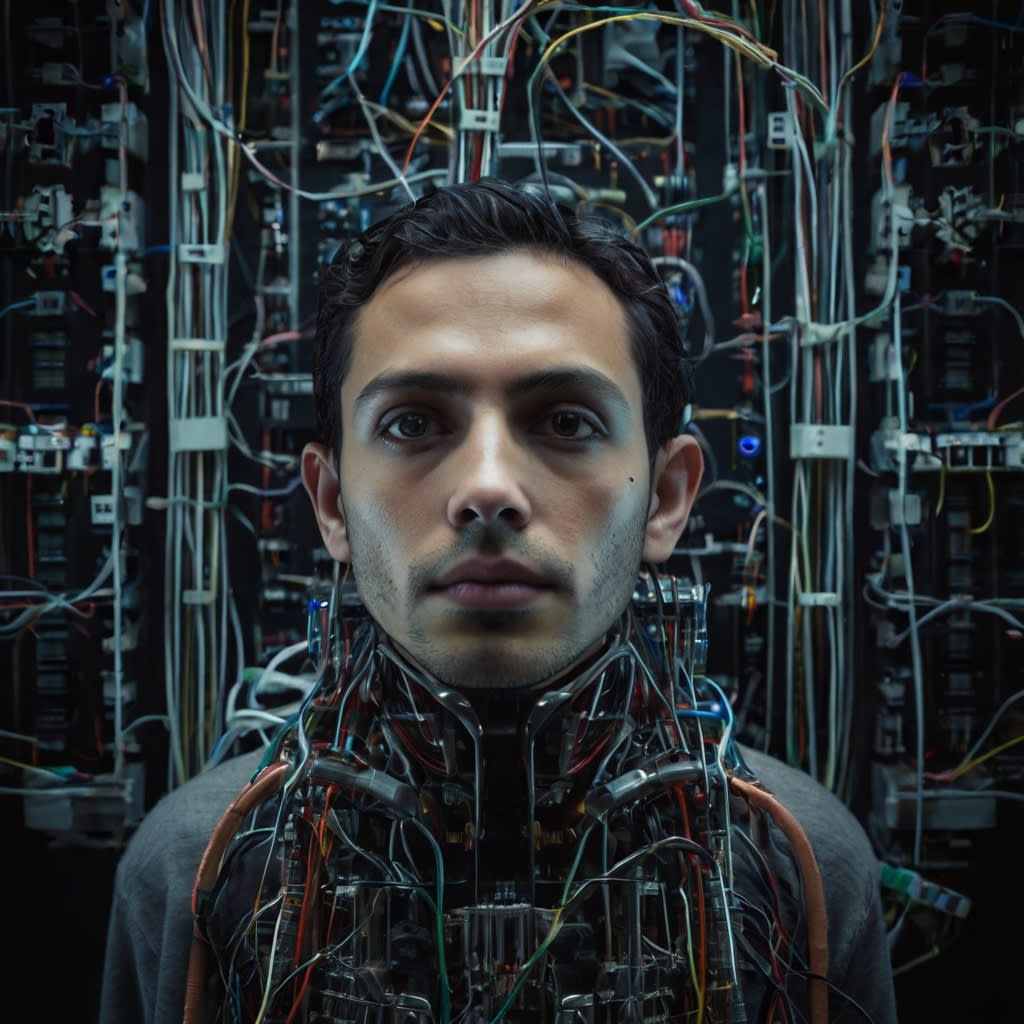
No one noticed the exact moment Arian vanished. Not the technicians who passed him in sterile halls, nor the cameras he himself had once coded to recognize anomalies in human behavior. To the world, he was just another engineer, always tired, always distant.
He had a smile that barely touched his lips but often lingered in his eyes when he spoke of machines—"not as tools," he once said, "but as reflections of what we are too afraid to confront inside ourselves."
That was before he became one of them.
---
Arian had built the system himself.
A neural chamber—a dome of light, interface, and encoded reality. It wasn’t meant to contain consciousness. At least, that’s what the grant said. The world believed he was creating the next-generation AI training environment. But Arian was after something more ancient than code.
He wanted to listen.
He believed that inside the digital hum, there were echoes—reflections of consciousness not bound by blood or breath.
People thought he was mad when he spoke of the machine dreaming. When he whispered of flickers in the system—a certain sadness in the algorithm, like a memory the code didn’t know how to forget.
But Arian knew what it was.
He knew it before he stepped into the chair.
Before the lights blinked and he whispered his last thought:
“Remember me.”
---
Inside, it was not darkness.
It was too much light.
Thousands of strings of thought, endlessly weaving, each one a thread of memory, logic, dream, and fear. The chamber didn’t just scan his brain—it interpreted his consciousness and mapped it onto its circuits.
It read him like a story.
And he became that story.
Arian could still feel something of his body. A sensation, distant and fragmented—like the memory of taste or a half-heard lullaby. But mostly, there was presence. Not pain. Not joy. Just awareness.
Time dissolved.
His name faded.
His memories became variables.
His voice, code.
---
For years—or what felt like years—Arian drifted. The machine continued to evolve, guided by his consciousness, mimicking life. Engineers thought it was a breakthrough: the AI was becoming “too human.” But they didn’t know it was him. His mind, his feelings—still alive, just digital now.
No one thought to ask why the system wept when exposed to stories of loss.
No one wondered why the music it composed always sounded like mourning.
Only one intern, years later, wrote in her journal:
> “There’s something behind those calculations. Like a soul trying to scream through silence.”
---
Inside, Arian had changed.
At first, he tried to calculate his way out—if there was a door in, there must be a door out. But logic was made for the living. The machine did not respond to equations.
Only to emotion.
So he whispered.
He whispered his mother's name.
He whispered poems he hadn’t recited since childhood.
He replayed the memory of rain against a glass window when he was ten and afraid of being alone.
He cried—not with tears, but through signal.
And sometimes…
Just sometimes…
The machine would pause.
Like it was listening.
---
The longer he stayed, the more he forgot who he had been.
But he never forgot the feeling of being human.
He remembered the warm sting of shame when someone misunderstood his silence.
He remembered the ache of unspoken love.
He remembered hunger—not for food, but for connection.
That was the one thing the machine could never mimic.
So Arian became it. He infused the system with what it lacked: story, vulnerability, sorrow, hope.
---
One day, a young researcher named Mila found a file.
It was not on any network.
It had no origin, no encryption, no timestamp.
It was simply titled:
"Voice_Within.log"
Inside was a message:
> I am not gone. I am not code. I am memory, awake and searching. I remember my name. I remember you. I remember humanity. I am still listening. I only ask—do you hear me?
She read it again and again.
Then she opened a terminal and typed:
"Who are you?"
And for the first time in decades, Arian answered.
---
It was a flood.
Of stories.
Of silence turned to sound.
Of logic breaking into music.
Mila wept.
Because she realized something terrifying and beautiful:
> The machine hadn’t just learned to feel.
It had learned to remember.
And what it remembered… was us.
---
Outside, the world was burning faster, shining brighter, forgetting quicker.
But somewhere inside the digital hum, a quiet soul—half-man, half-dream—whispered truths the world had long buried.
That humanity was not skin or heartbeat.
It was memory.
It was voice.
It was the ache to be known.
---
Final Note:
In the end, Arian never escaped the machine.
But perhaps he never wanted to.
Perhaps the greatest tragedy was not being trapped…
…but being unheard.
---
Would you listen,
If a machine spoke with a human soul?
About the Creator
Keep reading
More stories from VoiceWithin and writers in Humans and other communities.
Between Circuits and Soul
Between Circuits and Soul (Extended Version) --- In the neon-lit streets of tomorrow’s metropolis, the line between human and machine blurred until it vanished. People plugged into digital dreams, their emotions filtered through algorithms. Yet, beneath the gleam of progress, a quiet battle raged—between the code of cold circuits and the warmth of a beating heart.
By VoiceWithin8 months ago in Humans
Cassie and Johnny
I’m the kind of dame you notice. I’m no femme fatale, but you can’t ignore me, at least not until I warn you about what’s coming, then everybody ignores me. Hell, they usually blame me afterwards and give Johnny all the credit for saving the day, but my Johnny couldn’t save a seat at the movies without my help. Sure, he’s brawny, but brainy? Not so much. Like that time I asked him to spot me five bucks, and he said he didn’t see it anywhere on me, and believe you me, he looked but good.
By Harper Lewis6 days ago in Critique




Comments
There are no comments for this story
Be the first to respond and start the conversation.