
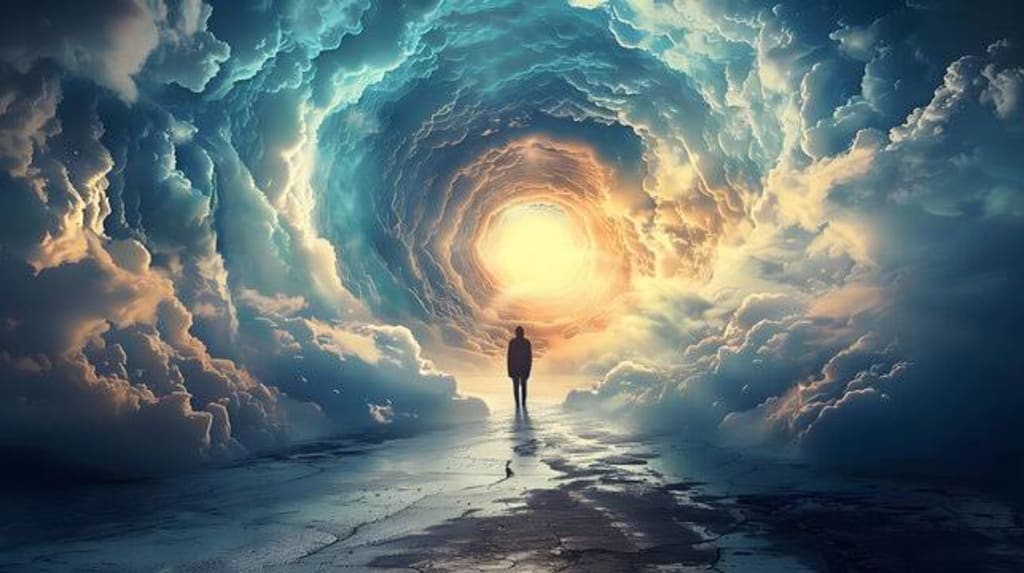
The question of what happens after death has captivated humanity for centuries. Philosophers, scientists, theologians, and countless cultures have all attempted to address this profound mystery, each offering different insights and explanations. The range of beliefs about the afterlife reflects humanity's diverse experiences and values. While no definitive answer has emerged, various perspectives offer interesting and meaningful explanations that help individuals and societies find meaning in life and death.
1. Religious Perspectives on the Afterlife
Different religions have their unique understandings of what happens after death, each with its concept of a spiritual journey, reincarnation, or eternal existence.
Christianity teaches that the soul ascends to Heaven, descends to Hell, or awaits resurrection depending on one's faith and deeds. The concept of an afterlife is central to Christian doctrine, with Heaven described as a state of eternal union with God, while Hell is seen as a place of separation and suffering. Some Christian denominations also believe in Purgatory, a transitional state for the purification of souls before entering Heaven.
Islam holds that after death, individuals face a Day of Judgment where their deeds determine their fate in either Paradise (Jannah) or Hell (Jahannam). The soul experiences the intermediate state, Barzakh, where it awaits the final judgment. This belief reinforces the importance of living a righteous life and following the teachings of Islam to achieve eternal reward.
Hinduism and Buddhism both embrace the idea of reincarnation, where the soul or consciousness is reborn in a new form based on karma—the accumulated actions from past lives. In Hinduism, the cycle of birth, death, and rebirth (samsara) continues until one attains moksha, or liberation, through self-realization and detachment from worldly desires. Buddhism similarly teaches that reaching enlightenment (nirvana) liberates one from the cycle of suffering and rebirth.
Judaism is less explicit about the afterlife, focusing more on moral and ethical living in the present. However, some Jewish teachings include beliefs in the World to Come (Olam Ha-Ba) or the resurrection of the dead in the Messianic Age, where the righteous are rewarded. The diversity of beliefs within Judaism highlights the emphasis on human action and ethics in the here and now.
Each of these religions provides frameworks that address not only life after death but also the purpose of life itself. Through their teachings, they offer comfort, moral guidance, and a sense of justice or cosmic order.
2. Philosophical Views on the Afterlife
Beyond religious beliefs, philosophical perspectives explore the question of the afterlife in broader, often secular terms. Some philosophers propose the idea of the soul’s immortality, suggesting that our consciousness continues in some form. Plato, for example, argued that the soul is separate from the body and persists after death, entering a realm of pure forms and truth. On the other hand, Epicureanism contends that death is simply the end of consciousness, implying that fearing death is irrational since, once dead, we cease to experience anything.
Existentialist philosophers, such as Jean-Paul Sartre, argue that the absence of an afterlife places greater significance on our choices in the present. According to existentialism, death underscores the freedom and responsibility we have to create meaning within our lives, as life has no inherent purpose beyond what we make of it. Existentialism shifts the focus away from an afterlife and toward the meaning of individual actions and relationships.
3. Scientific Perspectives on Death and Consciousness
The scientific view of death is generally rooted in physicalism, which asserts that consciousness is a product of the brain’s physical processes. From this standpoint, when brain activity ceases, so does consciousness, making death the end of subjective experience. Neuroscientific research suggests that consciousness is tightly linked to brain function, which deteriorates irreversibly when biological death occurs. Studies on near-death experiences (NDEs) provide fascinating insights, though science generally explains these experiences as hallucinations caused by chemical changes in a dying brain rather than evidence of an afterlife.
Quantum physics introduces interesting perspectives, though many interpretations remain speculative. For example, some interpretations of quantum mechanics suggest that consciousness could be interconnected with the fabric of reality, leading some physicists and philosophers to ponder whether consciousness persists in some non-physical form. Theories such as biocentrism propose that life and consciousness are fundamental to the universe, potentially opening the door to possibilities beyond the traditional scientific understanding of death.
4. Psychological and Cultural Views on Death and Afterlife Beliefs
Cultural and psychological perspectives emphasize how beliefs about the afterlife help individuals cope with mortality. Fear of death is a universal human experience, and many psychologists suggest that belief in an afterlife serves as a powerful coping mechanism. The Terror Management Theory posits that awareness of mortality influences behavior, encouraging individuals to find self-esteem and meaning by adhering to cultural beliefs and values, which often include afterlife concepts.
Different cultures offer varying narratives that shape how people understand death and the afterlife. For example, in many Indigenous cultures, the afterlife is viewed as a continuation of one’s spiritual journey, where ancestors watch over the living. These beliefs highlight the enduring connections between generations and emphasize that death is not the end but part of a larger cycle of existence. Such views foster a sense of continuity and respect for the past and future generations.
5. Personal Interpretations and the Mystery of Death
Finally, personal beliefs about the afterlife are as diverse as individuals themselves. Some may blend religious, scientific, and philosophical ideas into a unique understanding. For some, the afterlife may not necessarily involve a continuation of individual consciousness but a return to a greater collective existence. Others find peace in the idea of an afterlife as an unknown mystery, one that we may never fully comprehend within our earthly existence.
In sum, whether we view the afterlife through religious, philosophical, scientific, or personal lenses, each perspective reflects a unique attempt to make sense of life and its inevitable end. While we may not have a definitive answer, contemplating what happens after death can encourage us to reflect on the kind of life we want to lead. For many, these questions about the afterlife provide a foundation for values, ethics, and the pursuit of meaning, allowing us to live with greater purpose, compassion, and appreciation for the time we have.
About the Creator
Whiskey At Dusk
Guess the whiskey was more important to you in the end, wasn’t it? It was more than the well-being of your friends; more vital than showing up to the places you promised you would and could come to; more critical of a matter than fulfilling your damn responsibilities and getting the press off your back.
By Snarky Lisa3 days ago in Humans


Comments (1)
Super