
When Survival Becomes a Daily Act of Courage
Please Don’t Forget Somalia
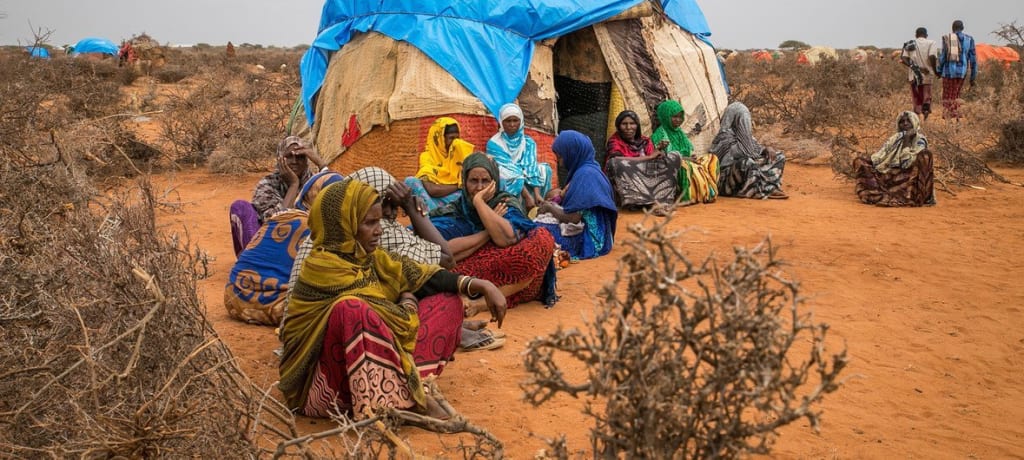
This is what drought looks like when it reaches women and children.They sit on dry, unforgiving land where nothing grows anymore. The earth beneath them is cracked, dusty, and exhausted—much like their bodies. Behind them stands a fragile shelter made from scraps: old fabric, sacks, and a blue plastic sheet barely holding together. It offers little shade, little protection, and no promise of tomorrow.
This is what drought looks like when it reaches human lives.
In Somalia, drought is not just the absence of rain. It is the slow disappearance of dignity, safety, and choice. It pushes families from their homes, strips livelihoods away, and leaves women and children carrying the heaviest weight. When livestock die, when crops fail, when water sources dry up, it is women who walk farther, wait longer, and sacrifice more. It is children who learn hunger before they learn hope.
I live here. I see this reality beyond photographs.
Every few minutes, there are checkpoints. Movement is restricted. Safety is uncertain. The sun is relentless, and trees are rare. Women sell tea in reused plastic bottles under extreme heat, just to earn enough for the day. Others sit like the women in this image—displaced, exhausted, and invisible to the world.
What strikes me most is not only the hardship, but the silence around it.
These women are not screaming. They are not protesting. They are enduring. Some rest their faces in their hands, others stare into the distance, and some hold children who do not fully understand why food is scarce or why home is now a temporary shelter on dry land. This quiet endurance is both powerful and heartbreaking.
Women in crisis zones often become shock absorbers for society. They stretch limited food, manage trauma, protect children, and keep families together—even when their own needs are unmet. Yet they are the least heard and the last supported.
Children growing up in such conditions face more than hunger. They face interrupted education, long-term health issues, and psychological scars. A childhood shaped by displacement and uncertainty steals more than comfort—it steals potential.
But this story is not only about suffering.
It is also about resilience.
Despite everything, these women remain. They hold onto community. They sit together. They survive another day. There is strength in their presence, even when the world looks away. There is dignity in their patience, even when help is slow or absent.
What is missing is not courage—it is support.
Supporting women and children in drought-affected areas means more than emergency aid. It means access to clean water, safe shelter, healthcare, education, and livelihoods that restore independence. It means listening to local voices, respecting cultural realities, and investing in long-term solutions rather than temporary relief.
This image should not be just something we scroll past.
It should make us pause.
Because somewhere right now, a woman is sitting on dry land, waiting—not for sympathy, but for a chance to live with safety, dignity, and hope.
I am not writing this as a distant observer. I live among these realities. I have seen women wake before sunrise to search for water that may not exist, carrying empty containers under a burning sun. I have watched mothers measure food carefully, deciding who eats now and who must wait. Children ask questions adults cannot answer—When will it rain? When will we go home? Sometimes there is no home left to return to. Safety is never guaranteed, movement is cautious, and silence often feels safer than being seen. Yet even here, women continue to hold families together with remarkable strength. They share what little they have, comfort children through hunger, and face each day with patience the world rarely acknowledges. Living here has taught me that resilience is not loud. It is quiet, heavy, and constant—and it deserves more than our pity. It deserves action.
This is not someone else’s crisis. It is a shared human responsibility, and ignoring it only deepens the cost for generations to come.
About the Creator
Keep reading
More stories from Khadija Ali and writers in Humans and other communities.
Frankincense (Luban): Somalia’s Ancient Resin with Modern Export Potential
When people think of Somalia’s exports, livestock often comes to mind first. Yet for centuries, Somalia has been supplying the world with something even more precious: frankincense, locally known as luban. Long before modern trade routes, Somali frankincense traveled across the Red Sea, the Arabian Peninsula, and into Europe and Asia. Today, this ancient resin is quietly regaining global attention — and it holds strong potential for small and medium-scale exporters.
By Khadija Aliabout a month ago in Motivation
Signs of a Fake Long Distance Relationship You Keep Excusing
Long distance relationships can feel intense, emotional, and deeply personal. When they are real, they create trust, consistency, and shared growth across miles. When they are deceptive, they sap energy, time, and emotional safety. Many people realize something is wrong but try rationalizing it away. We frequently forgive behavior that would never be considered acceptable in a real-world relationship.
By Relationship Guide7 days ago in Humans



Comments
There are no comments for this story
Be the first to respond and start the conversation.