
When I Cut Into the World, I Speak Back
Collaging through change
As a youth, mixing globs of paint with a paintbrush allowed me to create the palette of color I needed to imitate the world of color around me. My kindergartener's point of view worried about getting it right- I needed the correct hues for the tops of trees, the stems of flowers, and importantly, reptile skin (to make sure a friend could do justice to the new crime-fighting, pizza- devouring, sewer-living, teen-age mutant ninja turtles t-shirt he had convinced his parent’s to buy him over the weekend).
Carmine, periwinkle, or the numerous shades of green I needed to paint trees or flowers or to help out a friend nail his self-portrait were so, so ambitious; my tiny arsenal consisted only of yellow, red, and blue. But soon I made a discovery. When these building blocks made contact on the butcher paper, magical things happened. If I took my paintbrush and swirled together red and blue, I could have grape or royal. When I took yellow to blue, I made moss or kelly. Michael Angelo came alive. The paintbrush had given me so much, but there was more.
Many years later, I realized that as wonderful as it was to know how to recreate the world in some faithful manner, it was also very important to know how to tease it apart. To know how to rebel, to cut out some or most parts, to rescue the shreds and create anew through art. I had to find a new tool.
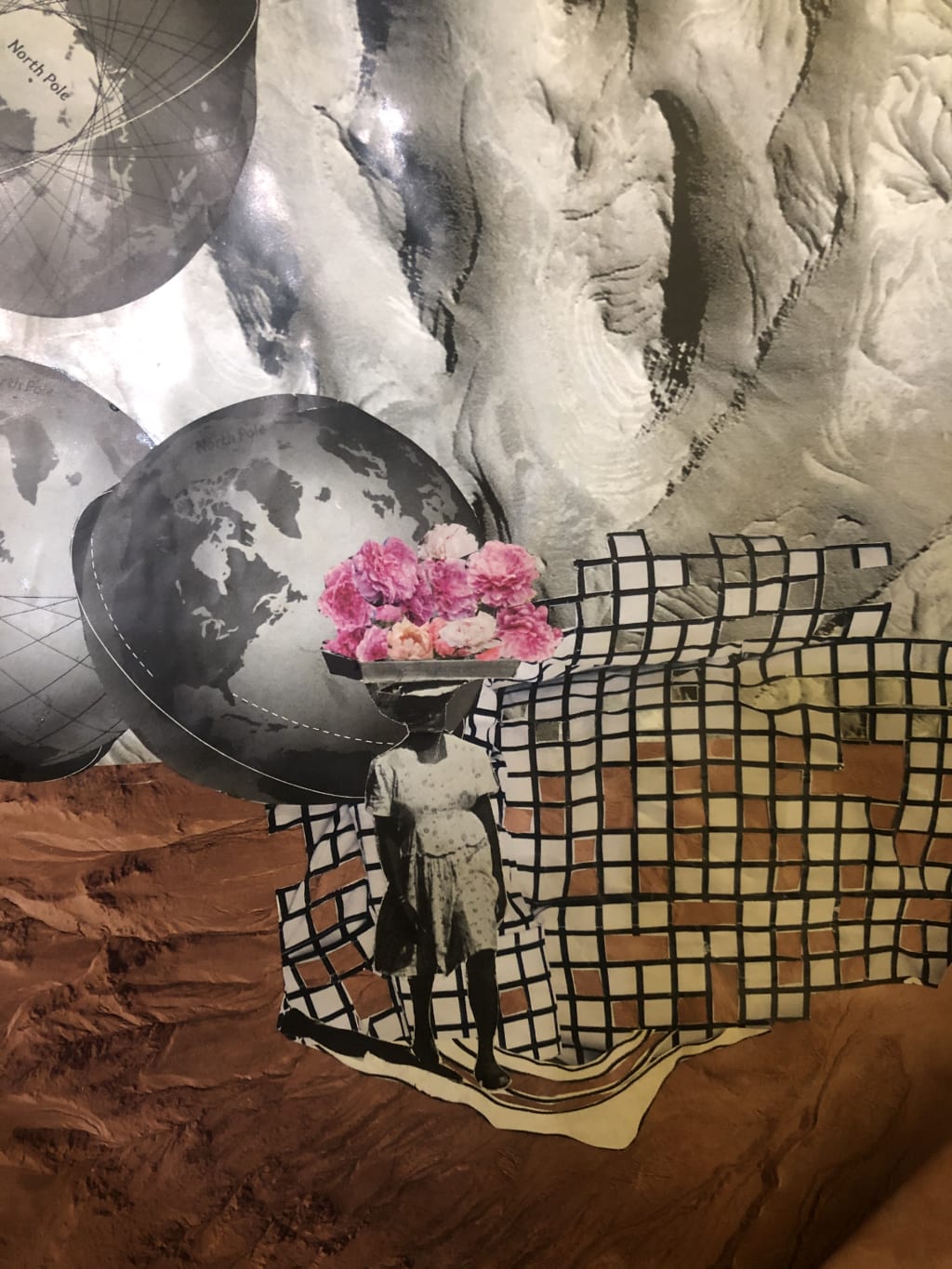
I was hunched over a pile of magazines on the floor of an old friend’s room some years ago as I cut apart an old sexist advert for kitchen appliances with a detail knife (my first time using one!!) when it came to me. The idea that intervening in the world certainly means many things and that unmooring a photo from its original context to disarm it of antiquated, harmful meanings and make it say something different can be one of them. A man ogling a provocatively dressed woman as she looks back at him while sitting on a barstool next to a stacked microwave/ self-cleaning oven combo with the words “stacked for convenience” over the top is rendered comical if this objectifying man is cut out and replaced with a stack of pancakes. Quite literally, one can cut into the world (and it’s stories!) with a pair of scissors.
Filmmaker John Akomfrah, who applies the philosophy of montage in his art, explains that this approach is focused on the third meaning- what meaning can emerge from cutting into discrete elements and putting them together in a different way. He explains that “when things collide, two opposites collide...some sort of synthesis is engineeded or brought about, and in that, a new form, a new meaning, or a new way emerges”. New roads can be made from old blocks, but they must first be slashed through, carved up, cut out.
On trips to the scrap art stores in my area, I’m always on the hunt for a story to cut into, an image that is the missing puzzle to an almost-finished project at home. I’m always searching because I have a suspicion that through these collages, these re-worked images that I can share with others, I might be able to clearly and honestly communicate. And there is so much to communicate- the ways in which I see how the world could be more and better than it is, or how we can take note of and celebrate what is wonderful, because so much of it is. Collaging is also a way to share dreams of the future, of courage, of strength, of hope. The suspicion that there are many stories to tell and retell is deep, so my blade is sharp and always ready.
About the Creator
Keep reading
More stories from writers in Humans and other communities.
Wild Card Weekend Recap: What Happens Now?
I think I figured out why I love Wild Card Weekend so much. It's because it's the first playoff anything of the calendar year. The NFL season starts in the fall, and once upon a time, the champion was crowned either on or slightly before New Year's. The evolution of the NFL schedule has resulted in the playoffs starting just into the New Year, and currently, the final week of the season falls on the first weekend of the New Year, with Wild Card Weekend coming a week after that. So yes, chronologically, the NFL's Wild Card Weekend serves as the first playoff anything of the calendar year.
By Clyde E. Dawkins5 days ago in Unbalanced




Comments
There are no comments for this story
Be the first to respond and start the conversation.