
"When Hearts Speak Different Languages"
"A Journey of Love Beyond Borders, Time, and Tradition"

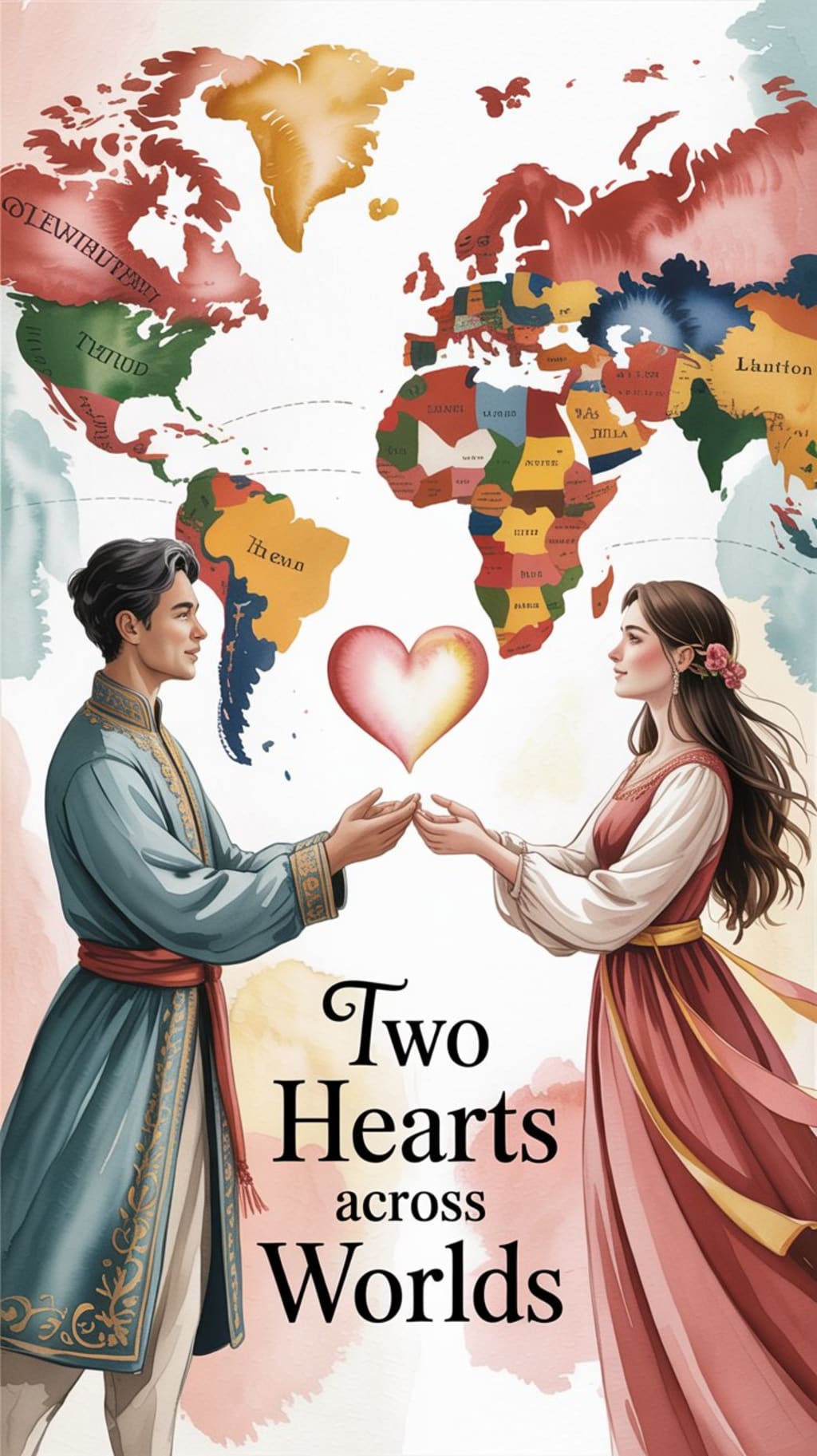
In the quiet corners of Istanbul’s Grand Bazaar, where the scent of spices mingled with the sound of ancient footsteps, a young Turkish calligrapher named Elif ran her father’s little art shop. Her hands moved like poetry, painting verses from Rumi and Quranic ayahs onto parchment. She believed in the beauty of words — written, spoken, whispered.
Half a world away, in the busy pulse of New York City, Alex, an architecture student, lived in blueprints and steel. He was logical, organized, and didn’t believe in fate — until he met Elif.
Their worlds collided on a spring day when Alex arrived in Istanbul to research Ottoman structures for his final thesis. He wandered into Elif’s shop looking for a gift, but found himself drawn not to the framed verses, but to the woman hunched over her desk, ink on her fingers and soul in her eyes.
“Do you speak English?” he asked, unsure.
Elif looked up. Her English was broken, but her smile was fluent. “Little,” she said, laughing.
He pointed to a framed line in Arabic. “What does that mean?”
She read it aloud in Turkish, then paused, trying to find the English: “Love… is the bridge between you and everything.”
“Rumi,” Alex said with a smile.
Her eyes lit up. “You know Rumi?”
“I’m trying to,” he replied.
And that was the beginning.
Alex returned every day. At first, to learn about the verses. Then, for tea. Then, just to sit in her presence. Their conversations were simple, full of hand gestures, shared glances, and the universal language of laughter.
Elif would write Turkish words on his notebook and teach him to pronounce them. Alex would bring her English books and point to phrases like, "You are beautiful" or "I miss you", and she would blush.
One evening, as the city was bathed in the orange hue of call to prayer, Elif handed Alex a piece of parchment. On it was written:
"Bazı duygular dilden güçlüdür."
(“Some feelings are stronger than language.”)
He didn’t need translation. He understood.
But love across oceans isn't simple. When his research ended, Alex had to return to New York. They stood outside the shop in silence, neither knowing how to say goodbye.
“You stay?” she whispered, hope trembling in her voice.
“I want to,” he said, heart breaking. “But I can’t. Not yet.”
She gave him the parchment — the same quote. Below it, in soft ink, she had added:
“Hearts… they always understand.”
He kissed her hand — a gesture not taught, but felt.
Back in New York, Alex carried her words like a compass. He emailed her poems, sent her voice notes mispronouncing Turkish phrases, and once, even mailed her a blueprint of a mosque design inspired by her shop.
Elif replied with voice notes of laughter, new verses, and one day, a picture of her holding a sign:
“Come back. No translation needed.”
It took two years. Two years of learning her language, saving money, finishing his degree — and never forgetting the calligraphy of her love on his soul.
He returned one morning, standing outside the same shop, now painted anew but still smelling of saffron and rose.
She saw him through the window.
Words failed. She didn’t need them. She ran to him, wrapped her arms around him, and whispered in his ear:
“Sen geldin… kalbim şimdi tamam.”
(“You came… now my heart is complete.”)
Epilogue:
Years later, in that same shop now named "Two Tongues, One Heart", tourists would find handmade art that carried messages in two languages — Turkish and English. Every piece told a story. Not just of culture or calligraphy, but of love that needed no translation.
Because some hearts…
speak louder than any language.
About the Creator
Keep reading
More stories from syed waqar ahmed and writers in Humans and other communities.
The CEO of Everything
They say "jack of all trades, master of none," but they forgot to mention the part where the jack of all trades is also the camera woman, the makeup artist, and the person currently yelling at a tangled Wii microphone cable in a her own bathroom while recording herself singing and trying to make it look realistic and professional. (As professional as you can make it with nothing but a cell phone camera and a mic that doesn't work)
By Sara Wilson4 days ago in Humans
The Girl Who Blinked: How a Sixteen-Year-Old Stopped a Massacre by Trusting the Knot in Her Stomach
The true story of Emily Carson, the Colorado high school student who prevented a school shooting by noticing a subtle detail and reporting it, highlighting the power of situational awareness.
By Frank Massey 7 days ago in Humans
Affection and Healing for Yourself
During the night of the last quarter moon, I gathered my ritual supplies. I carefully handled the chunk of black tourmaline that would protect me from your overall negative and narcissistic energy. I carefully walked the house with my stick of selenite in hand, asking the universe to cleanse our working space.
By Alisha Wilkins ✒️🦋🖋️2 days ago in Fiction


Comments
There are no comments for this story
Be the first to respond and start the conversation.