
What the Super Bowl Halftime Show Reveals About America
Hope, Friction, and Unity

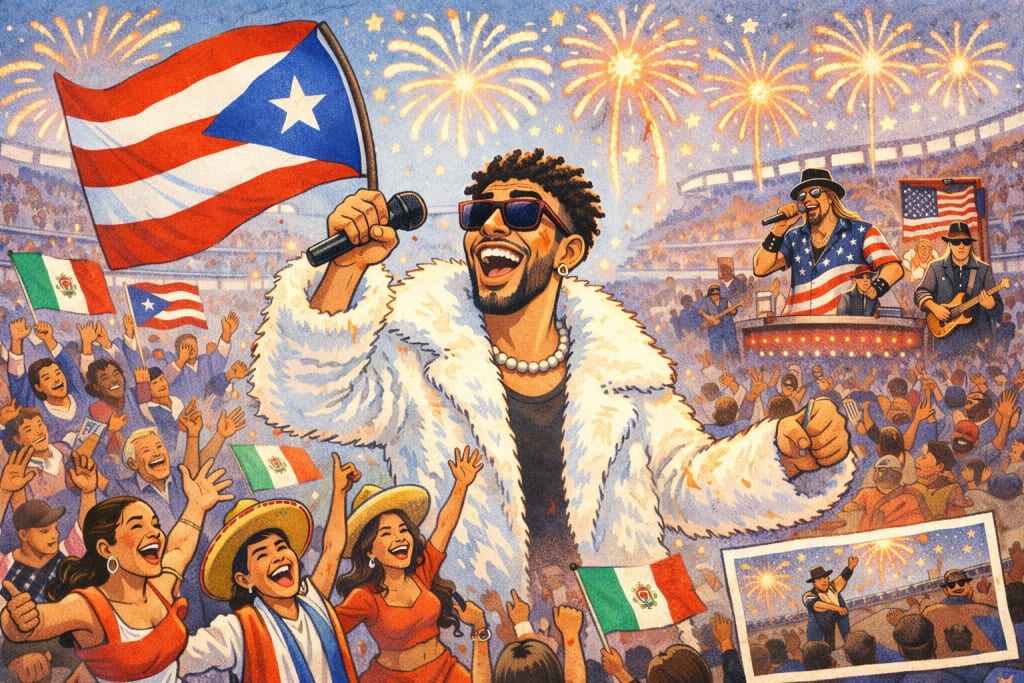
Systems are supposed to promise order. They organize behavior, distribute power, and offer the comfort of predictability. When they fail, the failure is often quiet at first and often experienced as friction. We feel it as unease rather than outrage, as a sense that something is slightly off but difficult to name. Few moments expose that friction more clearly than a Super Bowl halftime show, a cultural ritual designed to unite the largest possible audience for fifteen minutes of shared attention. When that stage becomes contested terrain, it reveals not just disagreement over music but also misalignment in the social system that is meant to hold a pluralistic nation together.
The imagined contrast between the Super Bowl halftime-show headlined by Bad Bunny and an alternative halftime show featuring Kid Rock captured this tension with unusual clarity. On its surface, it appears to be a dispute over taste, genre, or generational preference. Sadly, it reflected a deeper system failure: a country that symbolically celebrates diversity while struggling to reconcile it substantively. Super Bowl 60 halftime show was a mirror, reflecting both aspiration and anxiety, unity and fragmentation, and hope and despair. Inviting Bad Bunny onto America’s biggest stage carried undeniable symbolic weight. He represents not only a global musical phenomenon but also the cultural confidence of a Spanish-speaking America that is no longer peripheral. His presence suggested openness, inclusion, and a willingness to acknowledge the lived reality of millions of Hispanic Americans. Yet this symbolic embrace unfolded alongside policies and practices that result in mass deportations, family separations, and political rhetoric that often frames immigrants as threats rather than contributors. The system speaks in two voices at once: celebration and exclusion, applause and expulsion. That contradiction is not incidental; it is structural.
The alternative halftime show, featuring Kid Rock, functioned as the countersignal. It was framed as resistance to cultural displacement and as a defense of a version of America that some perceive as overlooked or mocked by elite institutions. For many, this alternative is not about hate but about recognition, about insisting that their values and identities still belong in the national story. The system, however, tends to present these expressions as mutually exclusive, as if one voice must come at the expense of another. In doing so, it misaligns cultural expression with civic belonging.
What makes this moment both hopeful and despairing is that both impulses are deeply American. Bad Bunny’s message, grounded in the idea that love can overcome hate, echoes the aspirational American ideal that pluralism is a strength. The alternative show’s insistence that all voices deserve space echoes a constitutional tradition of free expression and dissent. The despair arises not from the existence of these voices, but from a system that frames their coexistence as conflict rather than complementarity.
The Super Bowl itself is designed as a unifying spectacle, a rare event where demographic silos briefly dissolve. When that platform becomes a battleground, it suggests a deeper malfunction in how cultural systems process difference. Instead of allowing multiple narratives to coexist, the system amplifies antagonism, rewarding outrage with attention and turning symbolic gestures into zero-sum statements. The result is a population trained to recognize one group's recognition as the erasure of another.
Yet within this misalignment lies genuine hope. The fact that these debates occur on stage means that the conversation remains collective. People are still arguing about what America is and should be, rather than retreating entirely into separate cultural worlds. That argument, however uncomfortable, is evidence of a system under strain but not yet broken beyond repair.
The United States calls itself united not because it is uniform, but because it aspires to hold contradiction without collapse. The challenge is that many of our cultural systems, from media to entertainment to politics, are poorly designed for that task. They are optimized for engagement, not understanding; for signaling, not synthesis. As a result, they exaggerate division even when the underlying values are less incompatible than they appear.
The Super Bowl halftime debate asks us to sit with that discomfort rather than resolve it prematurely. It reminds us that attention itself is a form of power, and that who is seen, heard, and celebrated matters deeply. It also reminds us that inclusion without structural consistency feels hollow, while resistance without empathy hardens into grievance.
The quiet lesson is this: a healthy system does not require agreement, but it does require the capacity to coexist without fear. To celebrate Bad Bunny without treating alternative voices as threats. To make room for Kid Rock without interpreting that space as a rejection of multicultural reality. The hope is not that one side wins the stage, but that the stage itself becomes large enough to hold the whole, complicated chorus of America.
Attention is enough for now. Naming the misalignment is a first step toward recognizing that unity is not the absence of difference, but the willingness to remain in relationship despite it. As a proud Hispanic American, I hope that no one forgets that this is the promise embedded in the name United States, and the challenge we should all continue to struggle to live up to.
About the Creator
Anthony Chan
Chan Economics LLC, Public Speaker
Chief Global Economist & Public Speaker JPM Chase ('94-'19).
Senior Economist Barclays ('91-'94)
Economist, NY Federal Reserve ('89-'91)
Econ. Prof. (Univ. of Dayton, '86-'89)
Ph.D. Economics
Keep reading
More stories from Anthony Chan and writers in Humans and other communities.
Fleeting Leaves
Autumn leaves drift down, Beauty fades as time rushes Life, too, feels so brief.
By Anthony ChanExclusive • 5 months ago
The Angry Man in Your House
"If you grow up with an angry man in your house, there will always be an angry man in your house" This statement has caused plenty of controversy online, people say its a statement that blames victims while also undermining those who break traumatic cycles to form health relationships... but if I'm honest now that I'm in my 30s it makes more sense to me than ever, and I'd argue that its not just about fathers and uncles.
By S. A. Crawford2 days ago in Humans



Comments
There are no comments for this story
Be the first to respond and start the conversation.