
What Shiva and Parvati Teach Us About Sacred Love: A Divine Blueprint for Human Relationships
Shiva is wild, fierce, and free. He wears ashes, dances the Tandava, and lives in cremation grounds. Parvati is composed, nurturing, and rooted in family values. Yet, they accept each other as they are.

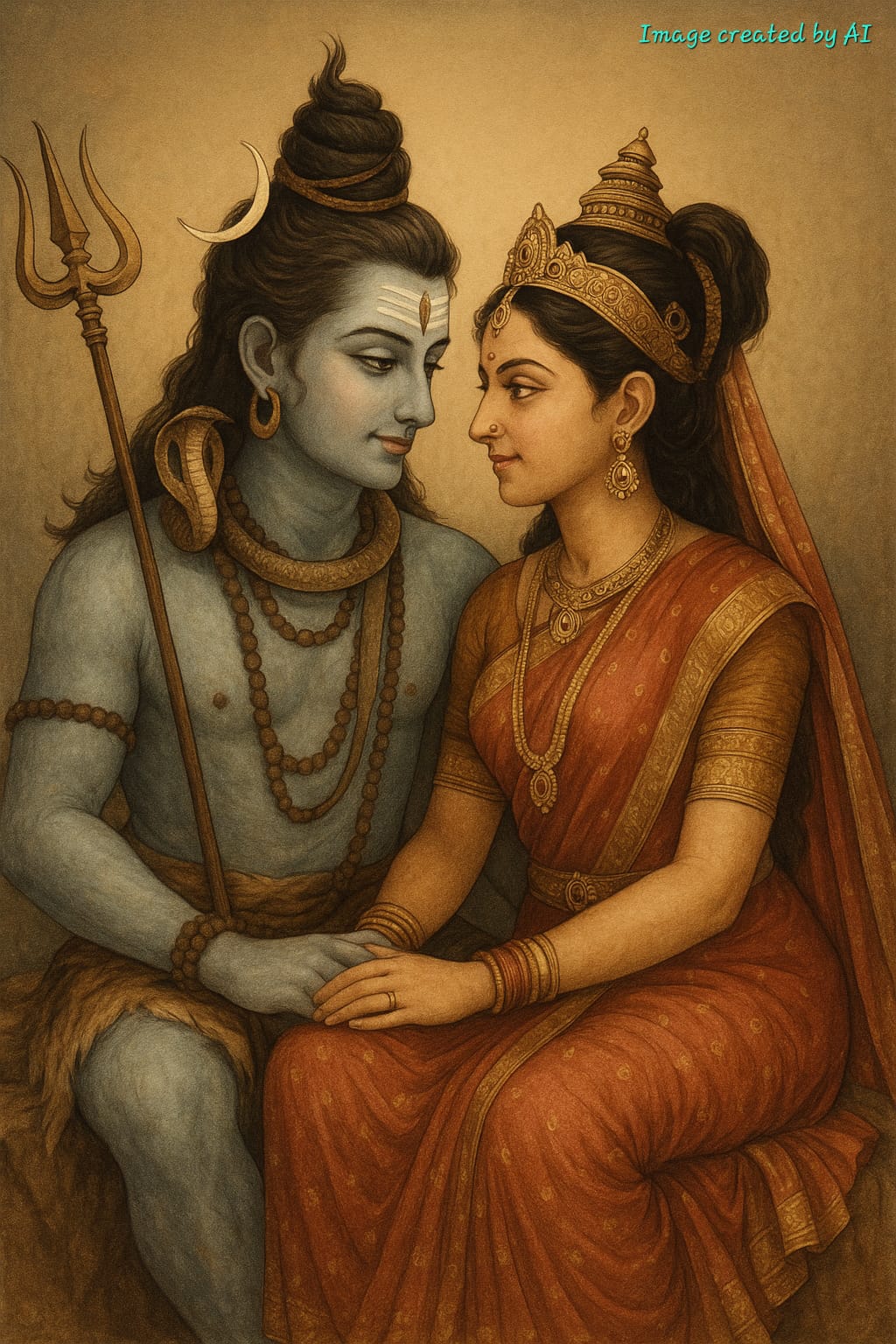
"In a world chasing temporary thrills and transactional love, the eternal bond of Shiva and Parvati reminds us that real love is not found—it is built, layer by layer, through devotion, acceptance, and transformation."
I’m writing this not as a scholar of mythology, but as someone trying to understand what it truly means to love and be loved.
As I reflected on Shiva and Parvati—the divine couple whose union is not just spiritual but profoundly human—I found lessons that go far beyond religious symbolism. Their story holds a mirror to our own relationships, showing us what sacred love actually looks like when stripped of illusions.
Let me explain it simply, with heartfelt reasoning and grounded insights.
1. Love Begins with Self-Realisation
Before Parvati and Shiva unite, they both undergo deep personal journeys.
Shiva is in tapasya (deep meditation), detached from the world. Parvati, born as the daughter of the mountain king Himavan, grows up hearing about Shiva and feels a deep spiritual pull toward him. But she doesn’t chase blindly.
Instead, she chooses to meditate and become spiritually evolved herself.
Lesson: You must find wholeness in yourself before you can unite meaningfully with someone else. Sacred love is not about completing each other—it’s about two complete souls choosing to walk together.
In today's relationships, we often seek someone to "fix" us. But Shiva and Parvati teach us to build inner stability first. This is the root of self-respect and emotional maturity.
2. True Love Requires Patience and Perseverance
Parvati doesn’t win Shiva’s heart in a day.
Despite being the incarnation of Sati (Shiva’s first wife), she faces Shiva’s resistance. She undergoes rigorous penance, known as Tapasya, to prove not just her devotion, but her strength and independence.
Lesson: Love is not instant. It requires resilience and time. Parvati’s patience is not weakness—it is strength guided by purpose.
This is especially relevant in today’s culture of swipes and speed dating. Real connection isn’t a click away. It demands emotional effort, trust-building, and enduring each other’s shadows.
3. Acceptance of Each Other's Light and Darkness
Shiva is wild, fierce, and free.
He wears ashes, dances the Tandava, and lives in cremation grounds. Parvati is composed, nurturing, and rooted in family values. Yet, they accept each other as they are. There’s no “fixing” or trying to change the other into a more "civilised" or "perfect" version.
Instead, there is a radical acceptance of the other’s totality.
Lesson: Sacred love is not about changing your partner—it’s about embracing their completeness, including the parts that are hard to understand.
In modern life, couples often fall apart trying to mould each other. Shiva and Parvati show us that unity thrives in diversity—when opposites are honoured, not erased.
4. Love is a Spiritual Journey
Their union is not just romantic; it is cosmic.
When Shiva and Parvati come together, their energy (Shiva as consciousness, Parvati as energy/Shakti) creates balance in the universe.
This is the principle of Ardhanarishvara—half Shiva, half Parvati—a symbol of oneness beyond gender, ego, or individuality.
Lesson: Love, at its highest level, is a path to spiritual awakening. The right partner doesn’t just hold your hand—they elevate your soul.
When couples support each other’s higher selves, love becomes more than emotional—it becomes transformational.
5. Conflict Exists—But So Does Resolution
Even in their divine marriage, conflict arises.
In the story of Daksha Yajna, Kartikeya’s upbringing, or Parvati’s anger as Kali, they often disagree, challenge, and hurt each other.
But what’s powerful is how they always return to harmony, not by ego, but by understanding.
Lesson: Even the purest love goes through storms. What matters is how you navigate them.
We are taught to idealise "perfect" love with no flaws. But Shiva and Parvati show that love is a process, full of messiness, forgiveness, and renewed commitments.
6. Sacred Love is a Balance of Power and Surrender
In one tale, Parvati playfully blocks Shiva’s third eye, leading to temporary chaos.
In another, Shiva bows to Parvati as Annapurna—the goddess who nourishes him. Their love is dynamic. Sometimes one leads, sometimes the other.
It’s a balance of power and surrender.
Lesson: Sacred love is not dominance—it’s dance. Sometimes we lead, sometimes we follow. And both roles are equally divine.
A Love Rooted in Patience, Power, and Presence
If I were to define sacred love in one line, I would say this: It’s the kind of bond that doesn’t just survive time—it sanctifies it.
Shiva and Parvati teach us that love isn’t just about passion or compatibility. It’s about devotion, acceptance, transformation, and above all, choosing each other again and again—even after knowing the imperfections. As someone who has questioned the meaning of love many times, their story gives me comfort. It reminds me that sacred love is not far away—it begins with how we choose to love ourselves and others, deeply and wisely. Let us not chase the illusion of a perfect person.
Let us build the reality of a sacred bond—one rooted in mutual growth, divine patience, and soulful partnership.
At the end of the day, I’m telling you this from the heart - If this touched you, reflect on this:
Are you seeking love to fill a void or to share your fullness?
Because real love—the kind Shiva and Parvati model—is not about finding someone to complete you. It’s about finding someone to evolve with.
Written by: Soumen Sasmal
About the Creator
Soumen Sasmal
Soumen Sasmal is a versatile writer & storyteller, crafting deep, emotional, and insightful narratives to inspire personal growth and transformation.
Keep reading
More stories from Soumen Sasmal and writers in Humans and other communities.
The Girl Who Blinked: How a Sixteen-Year-Old Stopped a Massacre by Trusting the Knot in Her Stomach
The true story of Emily Carson, the Colorado high school student who prevented a school shooting by noticing a subtle detail and reporting it, highlighting the power of situational awareness.
By Frank Massey 4 days ago in Humans


Comments
There are no comments for this story
Be the first to respond and start the conversation.