
What is Dating With an Autoimmune Disorder:
Real Life Chewing Gum

Growing up I never dated. I’d like to say that my lack of dating comes from my disease but it doesn’t, not entirely. Let me explain. In Chewing Gum, the miniseries on Netflix, Tracy, a 24-year-old virgin is on a quest for sex. She’s lived her life in a strict Christian household, growing up not knowing basic terms or pickups for casual sex. As she seeks to gain more knowledge, she fumbles, hard. Watching her you cringe because you know she’s really trying her best. I was like Tracy but more extreme. I was single until I was 25.
I am the first child of two God-fearing Caribbean immigrants. They had the odds against them. Both of them had difficult family backgrounds, had had to fend for themselves from an early age. They fiercely believed in God through it all and impressed that same love upon me. To me, He knew everything that ever was and would be. It was a comforting thought and a nerve-wracking one, especially to a child.
For a long time, I lived repressed by the thought of God watching. I chastised myself for every little lie, didn’t even say a curse word until the eighth grade. If God was watching He wouldn’t want me to say those words and so that’s how I lived. In my school, there were other Christians, those that seemed to love him less fearfully. They wore demure clothing, cross necklaces. Their smiles were soft and even though I believed in the Lord the same as they, I knew we were different. I was having impure thoughts about my body, about other people’s bodies. I didn’t have anyone to tell these thoughts. I didn’t understand what was happening and when I tried to ask it came out all wrong. I found out the hard way that asking a girl whether or not she was on her period is taboo. I could barely grasp that two people had to have sex to reproduce. I remember asking my science teacher if she was sure about her information because all I could think about were my straight-laced parents. Yet, I probably wanted the same thing most girls did, a boyfriend. I guess this notion came about in second grade. A young Corbin Bleu mini was what struck me over the head with cupid's arrow. I thought about what it entailed, having a boyfriend. Afterward, I decided that the risk had not been worth it. He had guessed I liked him and had told me I looked like a monster. It had hurt, being surrounded by the other kids laughing, along with my feelings of shame.
-------
Monster is a little harsh, girl with frizzy hair and baggy clothes was more the truth. By middle school, I didn’t want people to notice my body. It seemed like a hideous amalgamation of limbs and height. Sure, my family was quick to tell me how beautiful I was but who believes family? I could see the pattern of curves and naughty behavior that enticed boys and I was the opposite of that. I was a bookworm. I was a reed-thin, flat-chested nerd girl with gap-toothed front teeth. I carried books with me everywhere, I never looked up. I cracked jokes and was always helpful. I never made waves, never got mad, aka doormat/target.
My belief was that over time I would become more attractive. It was what all the books said, anyway. I thought that would happen or that someone would notice me. I thought that someone was another nerd in my seventh-grade class. I had the worst timing, y’all. During this year, I contracted lupus and I went through a major personality shift. As my body deteriorated I began to care less and less about self-image. I retreated from friends, tried to will myself to disappear. When I told this kid I liked him, it was when I at my lowest point. I was being bullied, I was sick and ostracized. He was a great person, clever and artistic but probably the only reason I cared so much was that he was the only one I could talk to about lupus. His mother had Lyme disease, a condition very similar to mine. The pain I was in wasn’t awkward to him because he saw it every day.

-------
Lupus widened the dating parameters of cute and smart, to also include dependability and understanding. When it came to what I wanted in a relationship I understood, quickly, that any successful relationship required my honesty. Any sane boy would wonder about my weird moods, the bruises in the crooks of my arms. What I saw in that boy from seventh grade was empathy. He was the only one that didn’t treat me like glass or worse, pretend that everything was fine. He was a barrier between the sad faces at home and the ignorant ones at school. When he moved away to another city that year, it left me deeply hurt for months. I wanted to stay in contact of course, but lack of sufficient technology had gotten in the way. To put it in terms of what I was dealing with, AOL was still alive and well.
When I entered high school, to my disappointment, I did not get “prettier". Instead, I had started to notice the effects of prednisone on my body, hair loss, acne, and weight gain. All of it was beginning to culminate into one large mass of ugly, as far as I was concerned. I hid this with humor and intelligence, but the thing about small-town schools is that your bullies tend to age with you. In fact, they spawned new bullies if they stuck to it long enough.
Finding myself took awhile and dating never took off in high school. I kept falling for the sensitive types and sad to say the sensitive types I was attracted to were gay men. The sensitive types were transgender women that were into men. The sensitive types were moving to another county. I also had yet to understand my pansexuality, yet to understand that being big did not mean undesirable. Yet, even back then I knew size wasn’t the issue because there were girls bigger than I, with boyfriends. When I finished high school, I chalked up boys' disinterest to the fact that all of the one hundred people in my graduating class knew me. They knew the nerd, the clown, the chubby girl with big hair and they did not need to know more. I had somehow made myself undateable through being too innocent and too kind.
-------
College for most is where the magic happens. Feelings are unleashed, experimenting begins and people can potentially become serious romantic partners. I knew the levels of commitment I needed were with an older crowd, what I did not account for was the weirdness. I didn’t account for the multitude of sexual colloquialisms, initiations, and orientations that I wasn’t aware of. I didn’t account for the fact that people my age knew a great deal more than I did, that they had already asked these questions years ago.
My first attempt at a boyfriend was not my finest moment. It was a coworker that had been particularly nice to me. He was single, had a lip ring, a beanstalk of a man. He listened to bands with several words for a band name, that sang in dulcet tones. When he initiated the ritual of “asking me out “, he made it explicitly clear that it wasn’t us dating. It was friends with benefits. In my head, I understood but my heart ran away with me. I mistook kind actions for affection, let him use me when he saw fit. I felt powerless to sever the connection until I saw how little I actually mattered to him. I understood what I was when he introduced me to my replacement. She was the one he ended up marrying and starting a family with. She was the one that got him to change his status on Facebook. I also never knew if it was a race thing either, the fact that she became family, that they were both white, that I, being black, had to walk to his house and leave quietly in the morning.
There is another desperate moment in Chewing Gum that further binds Tracy and I. After her many failed attempts at seducing her boyfriend, she finds someone willing to sleep with her. While mine was not a sixteen-year-old I mistook for an adult, mine was not a great choice either. Understand, after all these dating attempts shot down, after being called ugly nearly my entire life, I began to believe I didn’t deserve love. I fell into the same trap that so many women do, the belief that their worth is tied to their romantic relationships. I picked someone I didn’t really know very well and didn’t even like, to be my first time. I didn’t enjoy it, honestly, it was boring. It was this action that made me finally understand what I wanted from a relationship. It was this devastating moment in my life where I understood I’d rather be by myself than hurting in someone else’s company. I could make myself happy.
I wish I had had that conversation with someone beforehand. Parents always say you’ll meet “someone special" but we never really know what that means! How many of us struggle to identify who we are as teenagers? How many of us are confused about our feelings toward certain genders with no one to turn to for answers? This idea that there is a perfect person out there for everyone is a falsehood. There are many who are capable of producing their own valuable joy. I add the word valuable because often it seems single people are construed as time-wasters or lonely. People that don’t want children are seen as unusual and not in the avante garde type of way. Someone’s ideal coupling might be an army of one, or three, or five but each of these people have to meet you on the level of love you want and deserve. What passions you enjoy, what disgusts you, all matter when it comes to finding the person(s) you want. Don’t settle for less.
-------
I remember finding the right person and the promise I made in my heart. I gave myself the freedom to love me and be okay with that. I know God isn’t always the answer in other people’s hearts but knowing that you don’t have to be anything for anyone but who you want to be for yourself, is still a comforting thought. I believe I was made to be sensitive, nerdy, loud and creative. I believed this finally, at age twenty-five.
My first boyfriend saw me at my worst both mentally and physically. I was in and out of the hospital, my skin had turned into a blistery, puss-filled massacre. I hated everything about myself. I put on a brave face for my family but he and my mother were the only ones that I let see all the weakness I felt. My body forgot how to walk, how to be outdoors, how to feel the sunlight. I couldn’t open doors or stand for too long, I wore heavy clothing to protect me, gloves to cover my hands. The skin on my face was shredded, my lips raw and open. We couldn’t kiss or hold hands for the first two years of our relationship. The way that my partner took care of me during this time and continues to care for me now amazes me. A crash course, in wound care, the sleepless nights, the many, many tears, he loved me patiently through all of it. He learned how to accommodate my needs and did so without making me feel awkward about it.

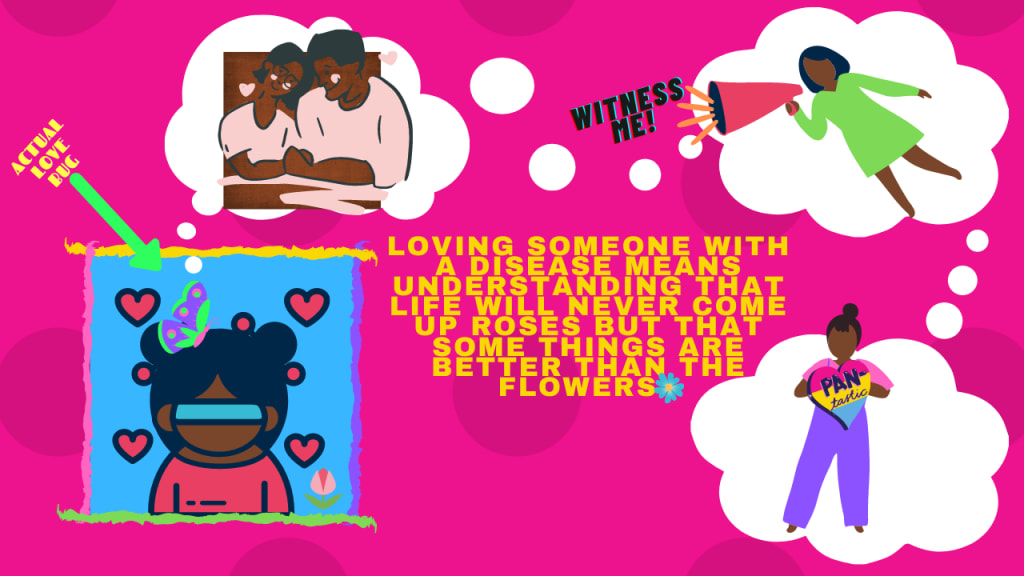
I kept asking him to leave. I told him, he didn’t want to deal with someone like me. I gave him every reason to turn the other way but he didn’t. He was there through all of it. After putting aside all the parts of a relationship that don’t really matter, I found what mattered the most. I realized that the best parts of me are on the inside and that a person worth loving will invest in that hidden beauty. Loving someone with a disease means understanding that life will never come up roses but that some things are better than the flowers. It means being afraid all the time but braving past it. It means accepting new challenges and adapting to crazy living situations. Loving me means, wondering about where our children will come from, wondering about my life expectancy and how much shorter than my partner it will be. Loving someone with a disease means being prepared for the worst but living like you don’t. You remind this person that there are other parts to themselves besides their disease, you don’t let them feel sorry for themselves.
I know that at the end of the day, my life, my partner are blessings. People with disabilities often struggle to maintain relationships because of the amount of care and patience that is required. Often, we are experiencing a plethora of emotions, ranging from mania, depression, to rage. Our bodies and minds are constantly fighting a silent war and leaving little energy for us to be reliable. Not only that, in the United States, being married can hinder one’s disability status and medical benefits afforded by the government. A partner may have to be willing to go unmarried in order to remain together. Also, a healthier or more financially stable partner may have to bear most of the financial or physical burdens of the household.
Being disabled comes with lawful romantic challenges as well. Our disability can sometimes ruin any chance of becoming a legally married couple. “Supplemental Security Income (SSI), a federal program meant for Americans with disabilities with limited resources or over age 65, is only available to couples with $3,000 or less in assets. This cap has remained in place since 1989 — although the equivalent of $3,000 then would be more than $6,000 in 2019. And for a couple with disabilities, monthly SSI cash benefits are reduced by 25 percent upon marriage to account for the efficiency of shared expenses like housing, according to the Office of the Chief Actuary…Individuals who qualify for the Disabled Adult Child program, which is linked to their parents’ work history, lose benefits upon marriage.” Taking this into account, it seems fitting to say that the United States government directly hinders a disabled person’s ability to love and prosper. When my partner and I decided to be together, we gradually had to accept these changes to our lives. I wasn’t always so incapacitated that I needed government assistance, it used to be that I could manage well enough with work and school on my own. When becoming afflicted with the resurgence of my disease’s symptoms in 2014, my partner and I were both flung into a new world. Chewing Gum’s Tracy didn’t learn her lesson about giving herself to someone worthy. She needed to feel validated right away and it didn’t matter who her partner was. When you have a disability you don’t always have that luxury. You need a ride-or-die partner, someone who values you in the lows as well as the highs of your life.
I made terrible choices with my love as well, wasting it after people that didn’t truly see me. Lupus showed me who would actually be there for me when the chips are down, it showed me friends’ and lovers’ true faces. I can’t say any of these discoveries were easy. It’s hard to say no to someone feeding you positive emotions. Just be aware of what they want and what you want. Make sure these desires align. If you’re living with a disease, make sure they know the real you. If they can’t accept all of you, they are the ones not worthy, not the other way round. So keep your head up, know that you’re beautiful (every single inch of you) and that real love is possible and worth fighting for.
Reference
Stern, C. (2020, March 04). Forced to Divorce: Americans With Disabilities Must Pick Marriage or Health Care. Retrieved November 18, 2020, from https://www.ozy.com/the-new-and-the-next/forced-to-divorce-americans-with-disabilities-must-pick-marriage-or-health-care/92284/
About the Creator
L Sophystra
Writer, singer, painter, dancer and spoken word artist. Come into the world of the Lady. Diversify what you know, living with lupus since age 12, this unique artist offers perspective that will change your heart and mind.
Keep reading
More stories from L Sophystra and writers in Humans and other communities.
Lifestyle Habits That Support Healthy Boundaries In Relationships
Healthy boundaries are built on self awareness. It is hard to communicate your emotional needs, values, and limits, without knowing them. Psychologist Carl Rogers also stressed that self concept and authenticity were important in the establishment of meaningful relationships. When people find time to think about their emotions and responses, they get to understand what is helpful and what is overwhelming. The awareness does not allow resentment to be built under the carpet.
By Kellee Bernier6 days ago in Humans
Silken Chains
Silhouettes of the female form were given flesh and bone. Silken skin glistened under the spotlight. Dry ice rose around our Icons as they danced atop their podiums in the Square. Heralded for their beauty, their movements were slight, powerful, and sensual.
By Paul Stewart3 days ago in Fiction


Comments
There are no comments for this story
Be the first to respond and start the conversation.