
I will say at the outset that, in certain circumstances, I am more than content with not showering for over a week. To be clear, the circumstances I’m referring to in this instance are climbing Mount Kilimanjaro, but I’m sure I could be swayed to do so in less extreme situations, too.
So, although showering wasn’t an option, we did, however, have ‘washi washi’ (Swahili for ‘wash wash’) available to us every morning; a small bucket of warm water was placed outside our tents each morning to enable us to bathe, but in the sub-zero temperature it seemed an absolute farce to remove skin-tight thermals in order to wash a few dead skin cells off, only to put those very same thermals back on. The things I was most impressed by when I looked around at my climbing group had nothing to do with their skincare regime, and everything to do with their perseverance and stamina, and we all had a bit of a stench by the halfway point, so really, what did it matter? I compensated with a ‘wet-wipe-washi-washi’ for the essential areas and called it a day.
I will say, though, it’s an odd sensation, facing the world each day when you’ve not even seen your own face. Good or bad, I think we’ve grown somewhat accustomed to presenting ourselves to the world in the way that we wish to be seen. In almost every aspect of life, it feels as if there is an opportunity to cultivate or curate an image of ourselves, regardless of how accurate the image is. On the mountain, there was no such opportunity. My bag contained no makeup, no mirror, no phone; I relied on muscle memory to smooth the parts of my hair that were prone to frizz, to feel for blemishes that were aching to be attacked, to scrape the sleep from the corners of my eyes. And as the days wore on, these things mattered less and less. It sounds as if perspective is the only thing at play here: how can pimples matter when you have to focus on climbing a mountain? It’s true that it is partially a matter of perspective, but, more so, it goes back to a deep-seated sense of knowing. An intuitive awareness of being enough, and that is something that neither time, nor place, nor circumstance can control. It’s a feeling that inhabits you so fully that, for the briefest moment in time, you become aware of a known truth: that we truly are one with the universe. I think it might be a feeling we are born with, but most of us lose it along the way. For some, this is a feeling that is easy to get back. For others - like me - not so.
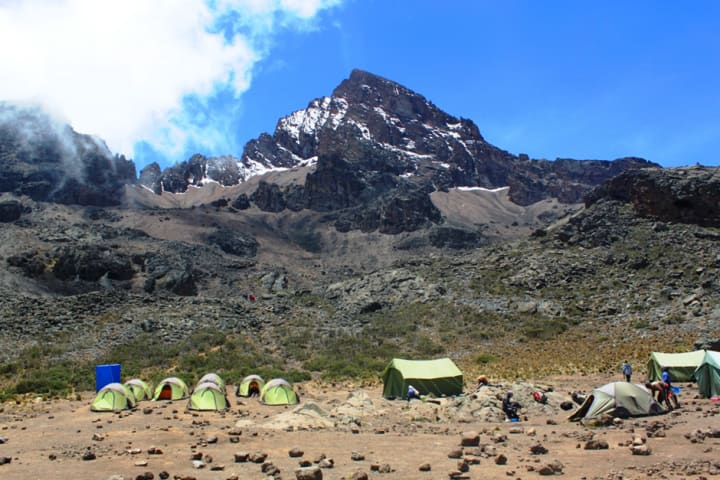
Having been a nail-biter since the age of seven, I experienced anxiety long before I knew what anxiety actually was, and I spent the better part of two decades biting my nails to the quick in an attempt to bring quiet to a painfully noisy world. So, when I look back at the photo below, I am taken aback, not by the immensity of the boulders, nor by the dust that seems to permeate every crevice and, to this day, remains firmly embedded in the laces of my hiking shoes. Nor am I surprised when everyone confuses me for my brother; we’ve always looked somewhat alike and, though my memory fails me now, I’m sure it’s his old cap that I’m wearing. The thing that I am most surprised by are my fingernails. My brows furrow in confusion and awe looking at this, seeing nails so healthy, so long, so completely unbitten. Absolutely impractical for the task of mountain climbing, and yet, there they are. When I think back at this time, riddled with so much fear and doubt, it strikes me as curious that my lifelong coping mechanism not only wasn’t used, but wasn’t required. I read back on my journal entries from the climb and the words that jump out most frequently are: elated, happy, strong, and amazed. We walked for six, eight, or sometimes 13 hours a day, and due to an unfortunate combination of cold and uncertainty, I slept for only about two hours per night. I wasn’t fit, I hadn’t trained, and my period arrived a few days into the climb, and yet, the overwhelming feeling was one of immeasurable joy.

It was then with great shock, that after a week of climbing and with only 200 metres to the summit, I was ready to give up.
After a six-hour climbing session, commencing from midnight the night before, we were preparing to make our way to the summit. It was still dark when we reached Gillman’s Point, which is about 5681 metres above sea-level, and only another 200 metres to the very top, Uhuru Point. We paused to rest, and I felt fantastic. I had quite literally danced my way up, and I recall someone asked me how I was feeling, to which I responded that I felt like I could run a marathon.
And yet, when we commenced the final leg, I was shattered. It was by no means a difficult walk, it wasn’t steep or gravelly, and even though it was another two hours, that was nothing compared to the endlessly long days we had done prior. Perhaps the true exhaustion of not having slept properly night after night had finally set in, coupled with my expectation that we had only a few more minutes until summit, as opposed to a few more hours. Whatever the reason, I hit the most tremendous low, and the mental annihilation that followed was, in a word, torturous.
I would catch my shadow in the corner of my eye at times as we marched along like a procession, and I could see my whole body almost folded over, head hanging down, eyes barely open, just shuffling along hoping that each step would bring me closer to the end.
I recall that my nose was either runny or blocked the entire climb, and my lips were deeply cracked from the blaring sun. While I had previously observed these ailments with wry amusement, now, in the final stretch, they seemed like the most unbearable burden. Every step became a chore. Everything seemed like the worst thing. The weight of the joy of the previous days that had carried me with such strength and grace, now paled by comparison.
On and on I went.
I had noticed earlier in the climb that by keeping my head down, I was able to trick myself into believing it was an easier feat than it actually was. Whenever I looked up and I would see how steep the incline was, I would think to myself that there is no way a human can possibly scale this mountain on foot, and once I started having those thoughts, I knew I’d soon be defeated. So, instead, I focused on the feet in front of me and continued shuffling along, completely unperturbed by the incline ahead.
In the final stretch, there was no option but to look down, my neck simply refused to do anything else.

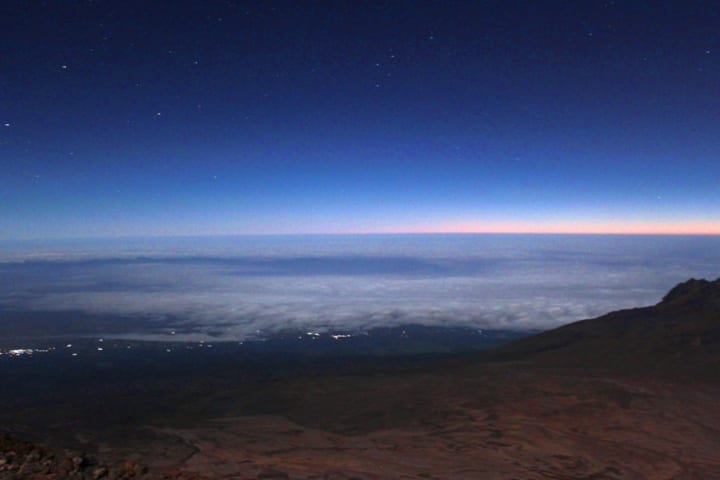
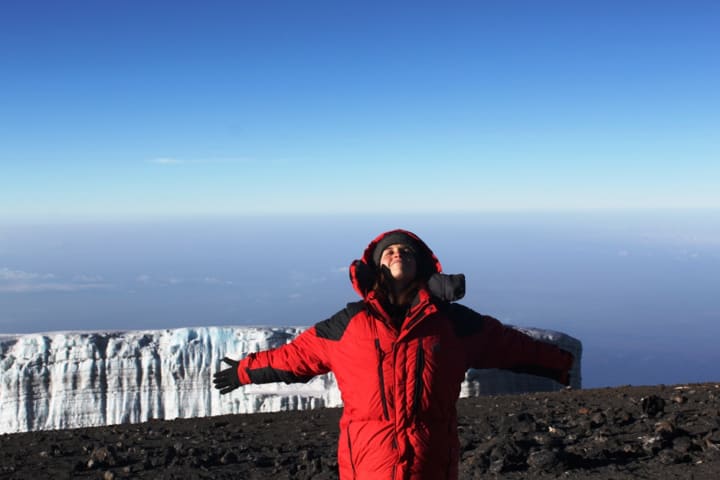
The sun began making its way to the horizon as we neared the summit, and when we finally made it to the top while the sun peeked out from what seemed like the edge of the earth, I dropped my bag and collapsed to the ground. With my eyes closed and my face to the sky, I cried. Not a big bellowing cry, just quiet tears that rolled down my cheeks and into the ground below. The guides immediately rushed over with concern, and I tried to explain that it was a controlled collapse and I was still in possession of all my faculties, but the fear of altitude sickness and the like brings with it a distinct sense of unease. So, I was ushered to my feet, proceeded with the formalities of congratulating one another and thanking our guides, and after 10 – 15 minutes on the top of Africa, we began our descent.
In thinking back on that time, and various other points in life, it strikes me that the true self seems to appear in a paradox of environments: during the deepest of adversity, and in environments so firmly surrounded by support.
For me, Kilimanjaro was both.
The mountain is filled with challenge and uncertainty, and were it not for the invaluable support of the porters and the guides, Kilimanjaro would continue to be a mere dream. Unbeknownst to me at the time, but their kindness, wisdom, and fortitude facilitated the realisation that the goal of reaching the summit became almost entirely irrelevant. The supportive environment they had created left us with only one thing to focus on: dredging up our insides to see what’s there.
And so, when I think back to the final walk, I realise it was one not filled with ego or artifice, nor with a sense of needing to conquer the mountain or myself. Certainly, there was an underlying element of grit and spirit, but more than that, there was the peaceful neutrality of simply continuing. And I think that, whether through bravery or necessity, the ability to surrender to the elements - both within and around us - and to keep going, is a truly remarkable thing.


Comments
There are no comments for this story
Be the first to respond and start the conversation.