
Was Martin Luther King Jr. an INFJ? The Personality Type of a Civil Rights Icon
"Injustice anywhere is a threat to justice everywhere." – Martin Luther King Jr.

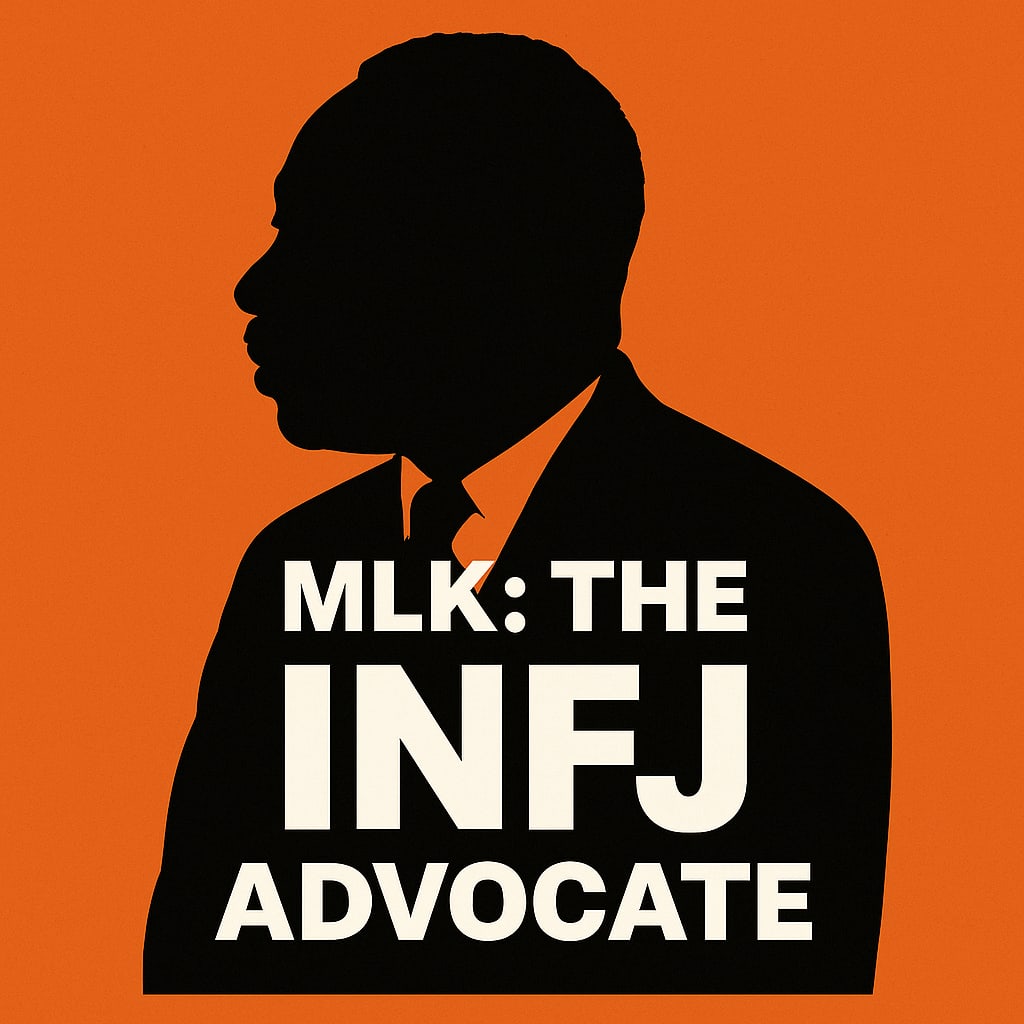
What made Martin Luther King Jr. one of the most uniquely powerful leaders of the 20th century? Was it the eloquence of his speeches, the strategy of his campaigns, or something deeper within his psychological makeup? While history often focuses on King’s role in the Civil Rights Movement, examining his personality through the lens of the Myers-Briggs Type Indicator (MBTI)—a system derived from Carl Jung’s theories of psychological types—provides a fascinating perspective.
In particular, many scholars and enthusiasts have proposed that Martin Luther King Jr. exemplifies the INFJ type, also known as the Advocate. By exploring King’s vision, empathy, strategy, and charisma, we can better understand how his leadership aligned with the characteristic strengths of the INFJ archetype.
The Visionary Idealist: Introverted Intuition (Ni)
Carl Jung described intuition as the ability to perceive patterns, possibilities, and the “unseen essence” of things (Jung, Psychological Types, 1921). For INFJs, their dominant function—Introverted Intuition (Ni)—allows them to see connections that others miss and to envision long-term outcomes with remarkable clarity.
This was perhaps King’s greatest gift. His “I Have a Dream” speech is not simply political rhetoric; it is the articulation of an inner vision that had been synthesized through deep reflection. The dream he presented on the steps of the Lincoln Memorial was both spiritual and prophetic, demonstrating Ni’s unique capacity to unite disparate threads—biblical imagery, constitutional ideals, and moral philosophy—into a coherent and inspiring vision of justice.
The Compassionate Advocate: Extraverted Feeling (Fe)
INFJs are equally defined by their auxiliary function: Extraverted Feeling (Fe), which drives them to seek harmony and to champion collective values. Jung himself described feeling as a rational function, oriented toward valuation and empathy.
King’s commitment to nonviolent activism and his insistence on the primacy of love reflect Fe in its highest form. He famously declared, “Darkness cannot drive out darkness; only light can do that. Hate cannot drive out hate; only love can do that.” His ability to connect empathetically across racial, religious, and class divides was not simply rhetorical—it was grounded in the INFJ’s deep concern for the welfare of humanity as a whole.
The Strategist: Introverted Thinking (Ti) and Judging (J)
Although INFJs are often idealists, they are not impractical dreamers. Their tertiary Introverted Thinking (Ti) and Judging (J) preference give them the ability to structure, analyze, and act decisively on their visions. Jung noted that even intuitive types, when matured, balance imagination with “discriminating reflection” (Psychological Types).
King’s work as a strategist and organizer demonstrates this balance. Campaigns such as the Montgomery Bus Boycott and the March on Washington were not spontaneous outbursts of emotion—they were meticulously planned acts of civil disobedience, designed to provoke both awareness and policy change. His “Letter from a Birmingham Jail” illustrates INFJ Ti at work: a carefully reasoned moral argument for civil disobedience that draws upon theology, philosophy, and law to dismantle counterarguments with precision.
The “Extravert” Question: INFJ Charisma in Public Life
A natural counterpoint arises: how could an introvert like King have been such a charismatic public speaker? Jung’s theory clarifies this paradox. Introversion and extraversion do not describe social ability but where one derives energy. INFJs, when speaking on behalf of their deepest convictions, draw energy from purpose rather than social interaction.
Thus, King’s public persona was not evidence of extraversion but the outward expression of INFJ conviction. When aligned with their vision, INFJs can be extraordinarily persuasive and compelling communicators.
Conclusion: A Legacy of Vision and Purpose
Understanding Martin Luther King Jr. as an INFJ provides a richer appreciation for the psychological foundations of his leadership. His dominant intuition enabled him to dream of a future others could not yet see. His extraverted feeling fueled his commitment to love and justice. His introverted thinking and judging preference allowed him to articulate that vision with clarity and to execute it with discipline.
Carl Jung wrote that “the intuitive mind is a sacred gift and the rational mind is a faithful servant.” King embodied this balance: a visionary idealist whose intuitive insights were grounded in moral reasoning and strategic action.
By reflecting on King through the lens of the INFJ type, we not only honor his legacy but also invite readers to consider how their own unique personality traits—intuition, empathy, logic, or otherwise—can be harnessed to pursue justice and inspire change.
References
Jung, C. G. Psychological Types. Princeton University Press, 1921/1971.
King, Martin Luther Jr. I Have a Dream. Speech delivered August 28, 1963.
King, Martin Luther Jr. Letter from a Birmingham Jail. April 16, 1963.
✨ Read more from the Vocal community on the intersection of art and activism
#MartinLutherKingJrINFJ #MLKPersonalityType #INFJPersonalityTraits #CivilRightsLeader #IHavaADreamSpeechAnalysis #NonviolentActivism #LeadershipPersonality #SpiritualLeadership #MyersBriggsFamousPeople #CivilRights #Activism #Leadership #History #Psychology #IHaveADream #Human
.
About the Creator
Keep reading
More stories from Sunshine Firecracker and writers in Humans and other communities.
Slumerican:
Slumerican is a brand with deep roots in American hip-hop culture, closely associated with the renowned artist Yelawolf. To truly understand the essence and significance of Slumerican, one must explore its origins, cultural relevance, merchandise offerings, and its role in shaping a unique narrative within the broader hip-hop community.
By Sunshine Firecracker2 years ago in Humans
The Longest Night: The Construction Worker, The Ledge, and the Nine-Hour Vigil
The true story of Michael O'Rourke, a construction worker who spent nine hours on a Brooklyn rooftop talking a suicidal woman down from a ledge, proving the power of simple human presence.
By Frank Massey about 11 hours ago in Humans
Ludacris and Nelly draw backlash over bookings at MAGA-coded music festival
Ludacris and Nelly headlining a mostly right-wing event is good for them. It’s also great for the genre of hip hop. The two rap veterans have showcased their talents on other stages. Why can’t they perform for mostly MAGA folks and grab that bag?
By Skyler Saunders4 days ago in Beat




Comments
There are no comments for this story
Be the first to respond and start the conversation.