
Urban Life and The Natural World
Urban Life and The Natural World — In the Station of Metro by Ezra Pound


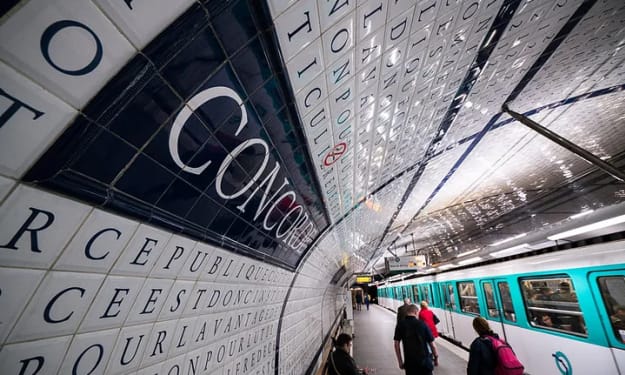
Pound was a champion of a technique called “imagism,” which is more concerned with conveying images in clear, vivid prose than with following any particular poetic form. As such, part of the “point,” as it were, of a poem like “In a Station of the Metro” is simply to paint a picture for the reader. Much of the wonder of this particular poem is the way in which the two images presented contrast with and complement each other, helping the reader “see” these very different objects — a subway station and a wet tree branch — in a new or different way.
Taken on a symbolic level, the poem seems to be juxtaposing two normally opposing realms: that of urban life and that of the natural world. This might be highlighting just how different the human-made world is from the natural world by putting them in such close proximity, or it might be highlighting each’s (somewhat unintuitive) similarity. Of course, the poem could also be doing both!
The word “apparition” is especially important in assessing the similarity or difference between the images in the first and second lines. On one hand, this word could suggest a distraction. The “apparition,” or the ghostly, blurred appearance of many people in a crowd, might be so dull and homogenous an image that the speaker’s brain turns instead to petals. In other words, all the people rush by so quickly that their faces become indistinguishable from one another, and the speaker becomes distracted, thinking instead of the loveliness of nature.
Indeed, this depiction of a relatively peaceful and elegant part of the natural world would seem a welcoming change from a noisy, crowded metro station. The speaker could also be suggesting that nature is worth prioritizing, or at least thinking about, in a world increasingly consumed by technology. Perhaps the speaker is thinking about how the metro station has displaced what might have once been a forest, swapping out trees for a hurried mass of people and the loud, dirty trains.
Of course, the poem is just as likely doing the opposite: implying that the world of human beings isn’t all that distant from nature, and is in fact an extension of the natural world. Note that “apparition” also implies a kind of visual dissolving of one image into another. Under this interpretation, the ghostly faces in a metro station, lining up on either side of a track, dissolve in the speaker’s mind into the image of petals hanging on either side of a branch.
In this reading, the city itself could be thought of as a tree, with each metro station representing different “boughs” of that tree and people representing the tree’s leaves. The metro nourishes various parts of the city — allowing transportation of people and goods — just as a tree’s branches carry water to its many leaves.
What’s more, both images convey a sense of temporality, since neither is static. In the first, people are traveling from one destination to the next; whatever “faces” appear in the crowd will be replaced by new commuters soon enough. In the second, the tree is wet — likely from rain — and will ostensibly dry, while its petals will eventually fall and be replaced by new ones. In a way, then, this pair of images could suggest everything from the fleeting quality of the moment to the cyclicality of life itself.
Pound may thus be suggesting that despite their obvious differences, urban life and the natural world follow the same universal laws. Or, to go a step further, perhaps urban life, being relatively modern, cannot help but mimic the older, established form of nature.
About the Creator
Shams Says
I am a writer passionate about crafting engaging stories that connect with readers. Through vivid storytelling and thought-provoking themes, they aim to inspire and entertain.
Keep reading
More stories from Shams Says and writers in Humans and other communities.
Perception, Imagination and Reality
“In a Station of the Metro” is concerned above all with imagery: the speaker sees a bunch of people in a subway station and this prompts the speaker to envision petals on a tree branch. This shift is remarkably sudden: in just two lines — a fleeting instant — the speaker sees both petals and a crowd of faces, and manages to vividly convey both images to the reader.
By Shams Saysabout a year ago in Humans



Comments
There are no comments for this story
Be the first to respond and start the conversation.