
Perception, Imagination and Reality
Perception, Imagination and Reality — In a Station of Metro by Ezra Pound

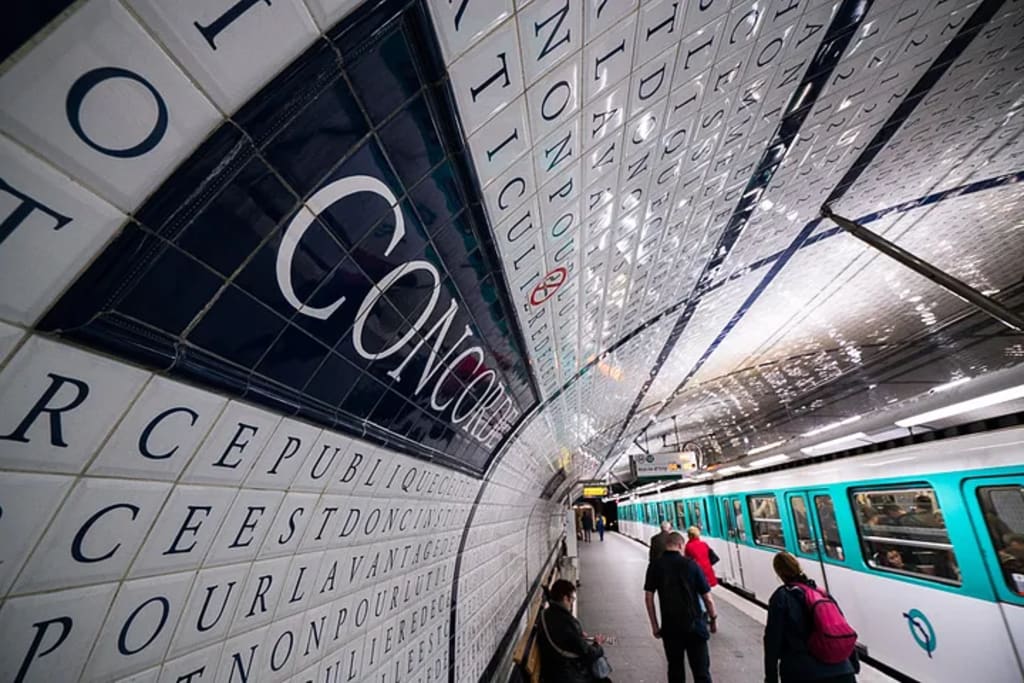
“In a Station of the Metro” is concerned above all with imagery: the speaker sees a bunch of people in a subway station and this prompts the speaker to envision petals on a tree branch. This shift is remarkably sudden: in just two lines — a fleeting instant — the speaker sees both petals and a crowd of faces, and manages to vividly convey both images to the reader.
The poem’s brief form allows it to combine both forms of perception (one happening before the speaker’s eyes, and one happening in their mind), creating a new, blended reality from the speaker’s point of view. Overall, then, the poem might be thought of as an attempt to capture the connection between sight and imagination — revealing how these two processes together shape people’s perception of the world around them.
Pound strips the poem of all superfluous language. Including the title, the poem uses just 20 words — meaning there is nothing to focus on besides the pair of images and how they relate to each other. The poem’s structure thus allows for a clear association between the what the speaker sees (“faces in the crowd”) and what the speaker imagines in response (“petals on a wet, black bough”).
The poem also notably doesn’t use any verbs. Instead, it is isolated to the rawest, most basic descriptions of images, which contribute to the spontaneity of the speaker’s visual association. In other words, the poem seems to catch the speaker in the act of visually processing a connection between “faces” and “petals” before the speaker even has time to form a complete thought! This verbless quickening creates a mingling between the two images as though the speaker sees “faces” and “petals” at the same time, or perhaps in oscillation.
A close reading of the poem’s language further reveals how the “apparition of these faces in the crowd” could indeed look like “petals on a wet, black, bough.” The word “apparition” could simply suggest the act of appearing, or it could denote something “ghostly.” The “faces” are certainly appearing before the speaker, but there is also a ghostly — or at least blurry — quality to a big crowd of people standing in a dimly-lit metro station. Readers can imagine, then, how the blurred, partially-obscured “faces” might have led the speaker to see something else.
“Faces” in a “crowd” may be different from “petals” on a “bough,” but the poem suggests that they are each visual fixtures of similar spaces. In a metro station, crowds line up on either side of a long train track just as petals stem from either side of a branch. The words “crowd” and “bough” even share assonance, which invites such a visual comparison between their shapes.
Furthermore, the adjectives modifying “bough” (“wet” and “black”) could also describe the metro station itself: “black” may be appropriate given the station’s dark, underground setting, while “wet” could describe the shimmering metal of the train and its tracks, or even leftover rain on pedestrians’ jackets.
Although readers are left to wonder why the speaker draws a visual link between “faces” and “petals,” the poem is not concerned with explaining anything about the speaker or their circumstances. Rather, it is a poem that portrays the instantaneous connection between eye and brain as an association sparks from an image, perhaps celebrating the sudden artistry of this imaginative process.
About the Creator
Shams Says
I am a writer passionate about crafting engaging stories that connect with readers. Through vivid storytelling and thought-provoking themes, they aim to inspire and entertain.
Keep reading
More stories from Shams Says and writers in Humans and other communities.
Faith and Faithlessness
On its surface, “The Hollow Men” is not a religious poem. Throughout, however, the speaker makes a series of subtle religious references and allusions. These references suggest that the “hollow men” have lost their connection to God. The speaker thus suggests that they might be restored — become fully human again — if they could regain their faith. At the same time, he also suggests that such renewed faith is impossible for the “hollow men.”
By Shams Saysabout a year ago in Humans
A Historic Declaration
We the People of the Husbands of the United States of America, in Order to form a more perfect Union, and I mean you...with me...establish Justice, insure domestic Tranquility, provide for the common defence, promote the general Welfare, and secure the Blessings of Liberty to ourselves, after Puberty, do ordain and establish this Declaration of Co-Dependence.
By Gerard DiLeo6 days ago in Humans
Top 10 PayPig Websites and Apps That Actually Work in 2026
When exploring the modern landscape of financial domination, finding reliable PayPig Websites and Apps is the absolute most critical step for your overall success. The digital era has completely transformed how financial dominants and submissives connect, creating specialized environments designed specifically for this unique power dynamic. In the past, individuals had to rely on mainstream platforms that often misunderstood or actively discouraged financial domination connections. Today, the industry has matured significantly, offering dedicated spaces that prioritize safety, consent, and seamless transactions. Understanding which platforms currently dominate the market can save you countless hours of frustration and help you build a sustainable, lucrative presence in the community.
By Mark Hipster7 days ago in Humans



Comments
There are no comments for this story
Be the first to respond and start the conversation.