
Uncovering the mysteries and deeper understanding within the Vedic texts of India.
Exploring the Hidden Meanings and Spiritual Teachings of the Ancient Vedas


The Vedas are a collection of ancient texts that are considered to be the oldest sacred texts of Hinduism. They are believed to have been written in Sanskrit between 1700 and 1100 BCE. The word "veda" means "knowledge" in Sanskrit, and the texts contain a wealth of knowledge on a wide range of topics, including religion, philosophy, science, and culture. The Vedas are considered to be the foundation of Hinduism and have had a profound impact on the development of Indian culture and spirituality. They have been passed down through the generations and are still studied and revered today.
However, the Vedas also contain many hidden meanings and secrets that have been obscured over time. These secrets can only be unlocked through careful study and contemplation, and they provide deeper insights into the spiritual truths of Hinduism. They offer a glimpse into the ancient wisdom of India and the powerful spiritual practices that have been used for thousands of years to achieve spiritual realization and union with the divine. In this blog post, we will explore some of the hidden secrets found within the Vedas, and how they can be used to deepen our understanding of India's rich spiritual heritage.

The Vedas are full of rich symbols and metaphors that are used to convey spiritual truths. These symbols have deep meanings that are often hidden and can only be understood through careful study and contemplation. For example, the symbol of the lotus is commonly found in the Vedas and is used to represent the spiritual journey of the soul. The lotus is rooted in the muddy waters of the physical world but rises up to bloom in the sunlight of spiritual realization. This symbol represents the idea that even though the soul may be rooted in the material world, it has the potential to transcend it and achieve spiritual enlightenment.
Another commonly used symbol in the Vedas is the Om. It is considered to be the most sacred symbol of Hinduism and is believed to be the sound of the universe. It is often used as a mantra during meditation and is believed to represent the ultimate reality, Brahman.
Symbols in the Vedas often have multiple levels of meaning, and can convey different things to different people. They are often used to convey complex spiritual ideas in a way that is easy to understand, and they are an integral part of Vedic culture. The symbolism in the Vedas is not only limited to visual representation but also in the use of poetry, mythology, and stories.
In addition to symbols, the Vedas also contains hymns, mantras and other literary forms. These literary forms are also rich in symbolism and metaphor which used to convey spiritual truth. The use of symbolism and metaphor in the Vedas is an effective way of conveying the spiritual truth, it's complex and abstract nature, and make it more accessible to a wide range of people. Understanding the symbols and literary forms in the Vedas can provide a deeper understanding of the spiritual teachings and practices of Hinduism, and can aid in our own spiritual growth.
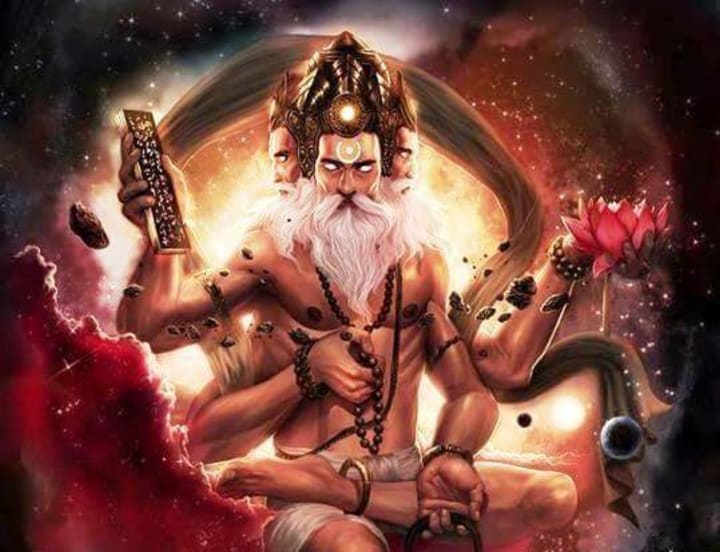
The concept of Brahman is the ultimate reality in Hinduism. It is the ultimate source of all things and the supreme consciousness that pervades the entire universe. It is the ultimate goal of spiritual realization and is considered to be the highest form of consciousness. In the Vedas, Brahman is described as the unchanging, eternal, infinite, and all-pervading reality that is the foundation of all things. It is the ultimate reality that is beyond time, space, and causation.
Brahman is described in many ways in the Vedas. It is often described as the ultimate source of all things, the source of all consciousness, and the ultimate goal of spiritual realization. It is also described as the ultimate form of existence, the ultimate reality that is beyond all dualities, and the ultimate reality that is beyond the reach of the mind and words.
The relationship between Brahman and the individual self is a central concept in the Vedas. The ultimate goal of spiritual realization is to achieve union with Brahman. This is often referred to as the attainment of Moksha, which is the release from the cycle of birth and death and the attainment of spiritual liberation. The individual self is believed to be a manifestation of Brahman and is considered to be part of the ultimate reality. The ultimate goal is to realize that the individual self and Brahman are one and the same.
In many ways, the Vedas describe that the true nature of the self is the same as the ultimate reality, Brahman. This ultimate goal can be reached by following the path of spiritual practice such as yoga, meditation, self-study, and devotion to God. The vedas also mentions that these practices can lead to the realization of the ultimate truth of the oneness of self and the ultimate reality, and the attainment of spiritual liberation.
The concept of Brahman and the relationship between the individual self and Brahman is a central theme in the Vedas and is essential to understanding the spiritual teachings and practices of Hinduism. The ultimate goal of spiritual realization is to achieve union with Brahman, and to understand the relationship between the individual self and Brahman is key to one's spiritual growth.

The Vedas contain a wealth of knowledge on the spiritual practices of meditation and yoga. These practices are considered to be essential to achieving spiritual realization and union with Brahman. The Vedas describe various methods of meditation and yoga that can be used to achieve this goal.
One of the most commonly discussed forms of meditation in the Vedas is Japa meditation, which involves the repetition of a sacred word or phrase, such as Om. This practice is believed to help focus the mind and still the thoughts, allowing the practitioner to enter into a deeper state of consciousness and achieve union with Brahman.
Another form of meditation that is discussed in the Vedas is Trataka, which involves gazing at a single point, such as a candle flame, to still the mind and achieve a state of concentration.
Yoga, on the other hand, is a spiritual discipline that has its roots in the Vedas, it's an ancient practice that originated in India. It's not only physical postures, but it also includes meditation, self-study, and devotion to God. The goal of Yoga is the same as meditation, which is to still the mind and achieve union with Brahman. The Vedas describes various forms of yoga such as Raja yoga, Bhakti yoga, Karma yoga, Jnana yoga.
The role of meditation and yoga in Vedic culture is central, they are considered to be essential practices for achieving spiritual realization and union with Brahman. These practices have been passed down through the generations and are still an integral part of Hindu spiritual life. Many spiritual traditions, such as Advaita Vedanta, and many other sects within Hinduism have developed over the centuries, which are based on the teachings and practices of the Vedas. They have been passed down through the generations by spiritual teachers, and many of these practices are still used today by spiritual seekers.
Overall, the Vedas contain a wealth of knowledge on the spiritual practices of meditation and yoga and describe various methods that can be used to achieve spiritual realization and union with Brahman. These practices have played an essential role in Vedic culture and have been passed down through the generations, they are still an important part of many spiritual traditions today.

In conclusion, the Vedas are a rich source of spiritual wisdom that have played an important role in the development of Indian culture and spirituality. They contain hidden secrets and deeper meanings that can only be understood through careful study and contemplation. The symbols, hymns, mantras, poetry, mythology and stories in the Vedas are used to convey complex spiritual ideas, which is still valid today.
The concepts of Brahman, the ultimate reality and the relationship between the individual self and Brahman are central to understanding the spiritual teachings of the Vedas. The practices of meditation and yoga, as described in the Vedas, are essential to achieving spiritual realization and union with Brahman. These practices have been passed down through the generations and are still an important part of many spiritual traditions today.
Understanding the Vedas can provide a deeper understanding of India's rich spiritual heritage and can aid in our own spiritual growth. It can be a valuable tool for anyone who is looking to explore their own spiritual path and discover the hidden spiritual truths of India. It is encouraged that readers to learn more about the Vedas and explore the ancient wisdom that they contain. There are many resources available, such as translations, commentaries, and teachings from traditional scholars, that can help deepen our understanding of the Vedas. Reading these texts and contemplating their meanings can open a door to an ancient wisdom that can help us navigate the complexities of our lives and journey towards spiritual realization.
About the Creator
Keep reading
More stories from writers in Humans and other communities.
Whiskey At Dusk
Guess the whiskey was more important to you in the end, wasn’t it? It was more than the well-being of your friends; more vital than showing up to the places you promised you would and could come to; more critical of a matter than fulfilling your damn responsibilities and getting the press off your back.
By Snarky Lisa5 days ago in Humans
Quarrel or Love
Idrees Ahmed and Lateef are two brothers. Idrees Ahmed is three years younger than Lateef and two grades behind him in school. Lateef studies in the seventh grade. Although they are brothers, their personalities are completely different. Despite being younger, Lateef prefers solitude and speaks very little, while Idrees Ahmed is so mischievous that the entire household is often exhausted by his pranks.
By Sudais Zakwan4 days ago in Humans
The Duelist
The rays of a dying red sun flashed against the onrushing blade. The grey beards say the key to dueling lies in size, speed, reach, righteous fury, whatever the person in front of them pays them to say. Matteo knew better than any it was none of these and had an undefeated record on these sands to prove it.
By Matthew J. Fromm4 days ago in Fiction




Comments
There are no comments for this story
Be the first to respond and start the conversation.