
Transforming Healthcare through AI.
Revolutionizing Medical Imaging, Diagnosis, Drug Discovery, Personalized Medicine, and Patient Monitoring.

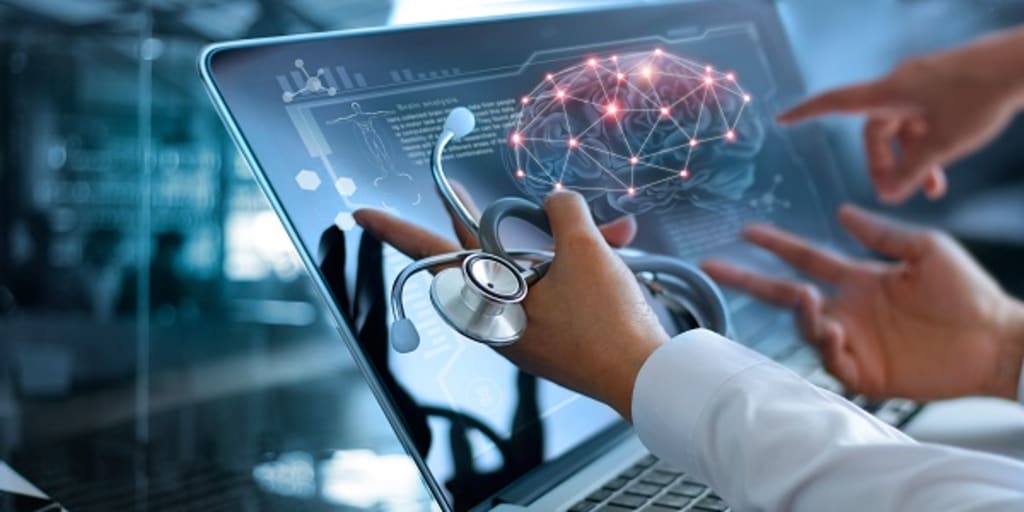
Artificial intelligence (AI) has emerged as a powerful tool in healthcare, revolutionizing various aspects of the industry. Its applications in medical imaging analysis, disease diagnosis, drug discovery, personalized medicine, and patient monitoring have the potential to transform disease diagnosis by providing valuable insights and augmenting healthcare professionals' decision-making processes. By analyzing vast amounts of patient data, AI algorithms can identify patterns and detect early signs of diseases. These algorithms can assist a diagnosing a wide range of conditions, from common ailments to complex rare diseases. With AI's ability to process data at scales and identify intricate relationships, healthcare providers can make more accurate and timely diagnoses, leading to better treatment outcomes and improved patient care.
Traditionally, drug discovery has been a time-consuming and expensive process. However, AI is revolutionizing this field by expediting the identification of potential drug candidates. Machine learning algorithms can analyze large datasets, including molecular structures, genetic information, and clinical trial data to predict the effectiveness and safety of potential drugs. AI-driven models enable researchers to prioritize and optimize drug candidates, significantly reducing the time and cost involved in bringing new medications to the market. This has the potential to accelerate the development of innovative therapies, offering new hope to patients and transforming the landscape of healthcare.
AI plays a crucial role in the realization of personalized medicine, where treatments are tailored and individual patients based on their unique characteristics. By integrating genomic data, medical records, lifestyle factors, and environmental data, AI algorithms can identify optimal treatment strategies for each patient. These algorithms can predict treatment responses, identify potential adverse reactions, and optimize drug dosages. Healthcare providers can deliver more targeted and effective treatments through personalized medicine, improving patient outcomes and minimizing unnecessary interventions.
AI-powered systems are transforming patient monitoring, enabling continuous and real-time analysis of vital signs. Wearable devices equipped with sensors can capture and transmit data to AI algorithms, which analyze trends and identify deviations from normal ranges. This enables early detection of potential complications and allows healthcare providers to intervene proactively. Additionally, AI algorithms can assist in remote patient monitoring, facilitating the management of chronic conditions and reducing the burden on healthcare systems. Patients can enjoy greater autonomy and improved quality of life while receiving personalized and timely care.
While artificial intelligence (AI) has the potential to bring numerous benefits to healthcare, it is essential to acknowledge and address potential challenges and negative effects.
Misdiagnosis and Errors, AI algorithms rely on the quality and quantity of data they are trained on. If the training data is biased, incomplete, or of poor quality, it may lead to misdiagnosis or errors. If not properly validated and tested, AI systems may produce inaccurate results, potentially causing harm to patients.
Lack of Human Judgment, AI systems, while powerful in analyzing vast amounts of data, lack the intuition, empathy, and experience that human healthcare professionals bring to the table. Relying solely on AI-based decisions could lead to a loss of the human touch and the potential oversight of critical factors that may impact patient care.
Ethical and Legal Concerns, the ethical implications of AI in healthcare are complex. Issues such as data privacy, security, informed consent, and algorithmic bias need careful consideration. AI systems may inadvertently perpetuate existing biases present in the data they are trained on, potentially leading to disparities in healthcare delivery and outcomes.
Patient-Provider Relationship, the integration of AI systems in healthcare may alter the patient-provider relationship. Patients might feel uneasy or distrustful if their care is heavily reliant on machine-driven decision-making. It is crucial to maintain open communication and ensure patients are informed about the role of AI in their healthcare journey.
Workforce Disruption, the automation of certain tasks through AI in healthcare may raise concerns about job displacement for healthcare professionals. While AI can augment and support human expertise, it is important to consider the impact on the workforce and ensure appropriate reskilling and reintegration opportunities.
Overreliance and Dependency, overreliance on AI systems can create a dependency on technology, potentially undermining critical thinking and clinical judgment. Healthcare professionals should use AI as a tool and not as a replacement, retaining their own expertise and independent decision-making abilities.
Regulatory and Legal Frameworks, the rapid advancement of AI in healthcare has outpaced the development of regulatory and legal frameworks. Ensuring that appropriate regulations and guidelines are in place is crucial to safeguard patient safety, data privacy, and the responsible use of AI technologies.
It is important to note that these potential negative effects are not inherent to AI itself, but rather the result of its implementation and usage. By addressing these concerns proactively, healthcare providers, policymakers, and technology developers can work together to mitigate risks and maximize the benefits of AI in healthcare, ultimately improving patient care and outcome
The applications of AI in healthcare, including medical imaging analysis, disease diagnosis, drug discovery, personalized medicine, and patient monitoring, have the potential to revolutionize the industry. AI algorithms offer remarkable capabilities, assisting healthcare professionals in making more accurate diagnoses, optimizing treatment plans, and improving patient outcomes. As AI continues to advance, it is crucial to address ethical considerations, such as data privacy and algorithmic bias, and ensure the integration of AI technologies aligns with patient needs and healthcare provider expertise. By embracing the power of AI, we can unlock the full potential of healthcare, ushering in an era of personalized, efficient, and impactful medical care.
About the Creator
berwin añain
I am enthusiastic, self-motivated, reliable, responsible, and hard-working. I enjoy researching the latest trends, and experimenting with new ideas.
Keep reading
More stories from writers in Humans and other communities.
Whiskey At Dusk
Guess the whiskey was more important to you in the end, wasn’t it? It was more than the well-being of your friends; more vital than showing up to the places you promised you would and could come to; more critical of a matter than fulfilling your damn responsibilities and getting the press off your back.
By Snarky Lisa2 days ago in Humans
When AI Makes Decisions About Humans
Artificial intelligence is no longer a distant or abstract technology. It is already deciding which resumes get reviewed, who qualifies for loans, how long prison sentences might be, and which patients receive priority care. These decisions—once made exclusively by humans—are increasingly influenced or executed by algorithms. While AI promises efficiency, objectivity, and scale, it also raises profound ethical questions. When machines make decisions about humans, what values guide them, and who is responsible for the outcomes?
By Mind Meets Machine2 days ago in Humans




Comments
There are no comments for this story
Be the first to respond and start the conversation.