
Today's Lesson Is The Victorian Poor
"Virtue shows quite as well in rags and patches as she does in purple and fine linen", (Charles Dickens)
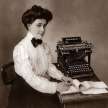
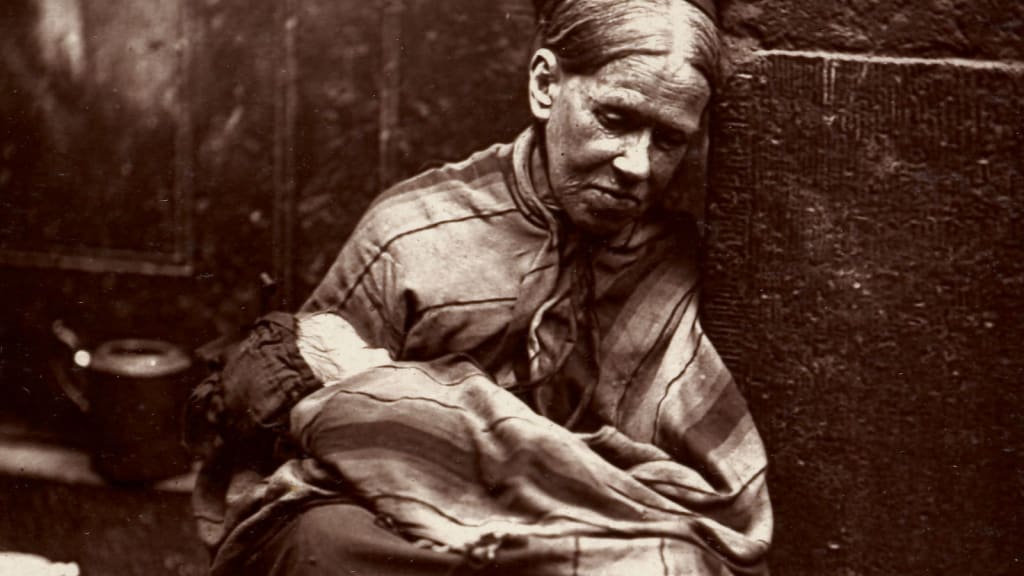
During the Victorian Era, the poor were trapped in a never ending “Poverty Cycle”. The children born into these families had no chance of any education or schooling, because schooling was expensive and these poor families could hardly afford to feed themselves, (especially when dad or mum or both drank any money away!). Without any education, even the basic reading and writing, the children could not become apprentices or train for a skill in a profession. The fact is that without any ‘outside’ help, generations were trapped in this “Cycle”, (if, indeed, they lived past a certain age).
With the population ‘exploding’ because families went into the cities hoping for more work and a better life, there was overcrowding, leading to a shortage of houses. This led to a shortage of jobs with no job stability, plus the wages were very low. Children were expected to help towards the family budget and were sent out to work, some at a very young age. The working day was long and dangerous for these little children, for very little money. Some of these jobs were chimney sweeping, scrambling under machines to retrieve cotton bobbins, working down the mines and selling cheap goods on the streets. A child could lose a limb, be abused or even killed “on the job”, and because there were so many of them, they could easily be ‘replaced’ by the ‘employer’. Remember, there were no Laws or charities to protect the children at this time.
Having said this, it was ‘around’ this time that many of the charities we have today were started in the Victorian Era. For example, the NSPCC (National Society for the Prevention of Cruelty to Children) was founded in 1889, and in 1877, the Child’s Guardian was launched, which is the official magazine of the NSPCC. Queen Victoria was Its first patron.
The living conditions for the poor were terrible. Large houses were turned into ‘flats’, owned by landlords who did not care about the upkeep or the condition of the buildings. “Hideous slums, some of them acres wide, some no more than crannies of obscure misery, make up a substantial part of the metropolis. In big, once handsome houses, thirty or more people of all ages may inhabit a single room”. (The Victorian Underworld by Kelloe Chesney).
The poor lived in slums called “Rookeries”, where people lived without separate living accommodation for each family. Rooks (the bird) do not live in separate families, thus the name.
Starvation was one of the main causes of death amongst the poor. An inquest held in 1850 records: a 38 year old man whose body was reported as being little more than a skeleton, his wife was described as being ‘the very personification of want’ and her child was a ‘skeleton infant’.
Children (and some very young) were left to fend for themselves when their parents died, ( of disease, starvation, drink, etc.). This left these children homeless, destitute and living on the streets. In 1848, Lord Ashley referred to more than thirty thousand ‘naked, filthy, roaming lawless and deserted children, in and around the metropolis’.
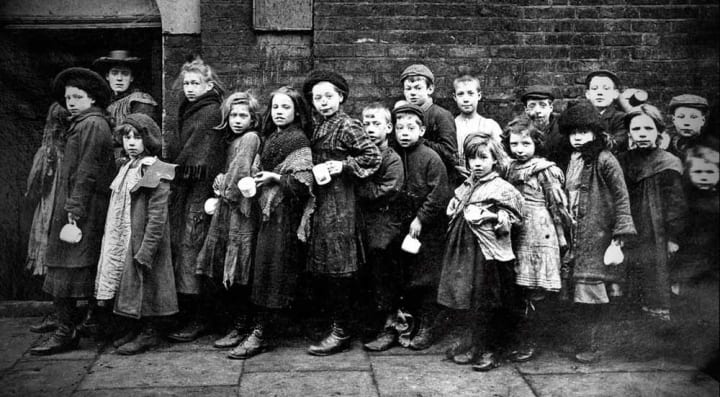
This led the children into a life of crime, often stealing food because they were so hungry. The Upper Classes thought that education would be the answer and “Ragged Schools” were opened to meet this ‘need’, but as Henry Mayhew argued: “since crime was not caused by illiteracy , it could not be cured by education — the only certain effects being the emergence of a more skilful and sophisticated race of criminals”.
People’s attitudes towards the poor were beginning to change. The “Cause” had never been challenged in the past because: “the poor were improvident, (meaning they were not disciplined with money and ‘thoughtless’), they wasted any money they had on drink and gambling” or “God put people in their place in life and this must not be interfered with because the life after death was more important”, and this is how many wealthy people thought. However, because of the sheer scale of the problem, the younger generation were beginning to realise that something had to be done to help their ‘unfortunate’ brothers and sisters.
Towards the end of Queen Victoria’s reign, charities were being set up to help the poor, and Laws in Parliament were being passed for the same reason.

The words of Henry Mayhew (1812-1887) really brought this ‘problem’ to the forefront of the Upper Classes minds: “The condition of a class of people whose misery, ignorance and vice, amidst all the wealth and great knowledge of the “first city in the world”, is, to say the very least, a national disgrace to us all”.
About the Creator
Ruth Elizabeth Stiff
I love all things Earthy and Self-Help
History is one of my favourite subjects and I love to write short fiction
Research is so interesting for me too
Keep reading
More stories from Ruth Elizabeth Stiff and writers in Humans and other communities.
What Do You Dream?
Do you believe that dreams mean anything? We all dream, even if we don’t remember our dreams, it is a normal part of our lives. We drift off to sleep and, in our minds, we go into another world — hopefully a nice world. I’ve had many dreams of my mum (she died of breast cancer), and I feel indescribable joy — we are both smiling, happy, cuddling — and it seems so real! I like to ‘believe’ that mum visits me from the other side. We were close when she was alive, more like a sister than a mum, and yes, I do miss her even after 20 years!
By Ruth Elizabeth Stiff4 years ago in Humans
Standing While Falling
Quotation from Friedrich Nietzsche "He who wrestles long with monsters should beware lest he himself become a monster. And if you gaze long into an abyss, the abyss also gazes into you. Man is not destroyed by suffering, but by the meaning he makes of it."
By LUCCIAN LAYTH7 days ago in Critique


Comments
There are no comments for this story
Be the first to respond and start the conversation.