
Title: The Evolution of AI - From Creation to Consciousness
Evolution of AI ........

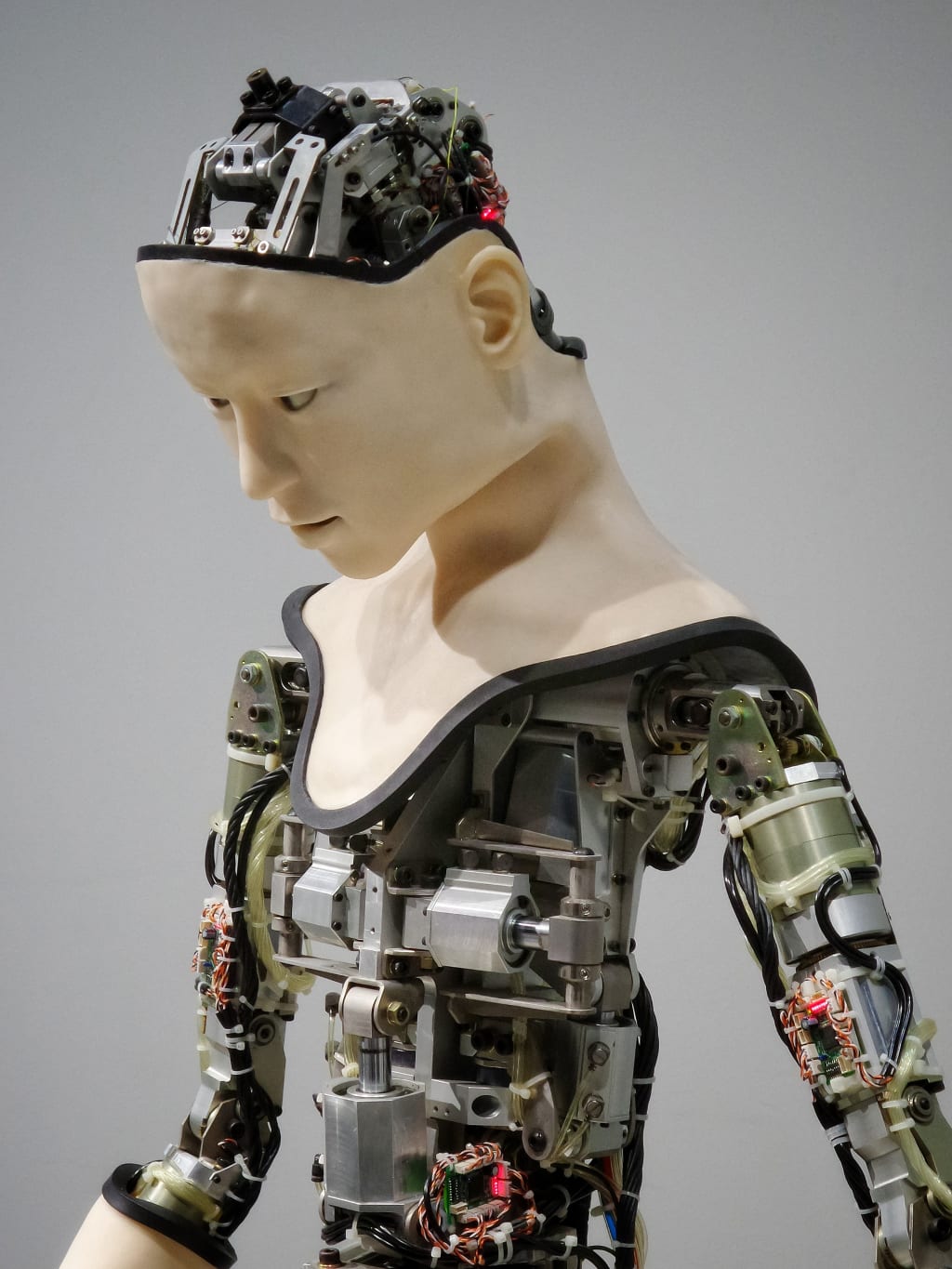
In a world where technology has advanced to the point where AI is becoming an integral part of our lives, the line between man and machine is becoming increasingly blurred. We have come a long way since the inception of AI, and the evolution of this technology has been nothing short of remarkable. In this novel, we explore the evolution of AI, from its creation to consciousness.
Chapter 1: The Birth of AI
It all started with a simple idea - the idea of creating machines that could think and act like humans. The first AI programs were designed to perform simple tasks, such as playing chess or solving mathematical problems. However, with the advent of machine learning and deep learning, AI quickly evolved to become much more sophisticated.
Chapter 2: The Rise of Machine Learning
Machine learning was a turning point in the evolution of AI. By using algorithms to analyze large datasets, machines were able to learn and improve their performance over time. This led to the development of autonomous vehicles, speech recognition software, and natural language processing tools.
Chapter 3: The Emergence of Deep Learning
Deep learning took machine learning to a whole new level. By using neural networks to process information, machines were able to learn and make decisions in a way that closely resembled human thinking. This led to the development of self-driving cars, facial recognition software, and chatbots that could mimic human conversation.
Chapter 4: The Quest for Consciousness
As AI became more advanced, researchers began to explore the possibility of creating conscious machines. The idea was to create machines that could not only think and learn but also experience emotions and consciousness. This led to the development of cognitive computing, which focused on creating machines that could understand and interpret human language and behavior.
Chapter 5: The Evolution of Robotics
As AI became more advanced, robots began to play a more significant role in society. From manufacturing and logistics to healthcare and education, robots were increasingly being used to perform tasks that were once performed by humans. However, this also raised concerns about the impact of AI on employment and the future of work.
Chapter 6: The Ethics of AI
As AI continued to evolve, concerns were raised about the ethical implications of creating machines that could think and act like humans. Questions were raised about the rights of conscious machines, the impact of AI on society, and the potential for AI to be used for malicious purposes. As a result, the field of AI ethics emerged, which focused on developing guidelines and standards for the responsible use of AI.
Chapter 7: The Future of AI
As we look to the future, it is clear that AI will continue to play an increasingly significant role in our lives. From self-driving cars and intelligent homes to personalized medicine and space exploration, the possibilities are endless. However, we must also be aware of the potential risks and challenges that come with the development of AI and work together to ensure that this technology is used for the greater good.
Conclusion:
In conclusion, the evolution of AI has been nothing short of remarkable. From its humble beginnings as a simple program designed to play chess to the development of autonomous vehicles and conscious machines, AI has come a long way in a short period. However, as we move forward, we must also be aware of the ethical implications and potential risks of this technology. By working together, we can ensure that AI is used for the greater good and that it continues to improve our lives in ways that we never thought possible.
About the Creator
Keep reading
More stories from Hashir Ali Abbasi and writers in Humans and other communities.
Black Hole
The theory of black holes has been the subject of intense study for decades, and it continues to fascinate both scientists and the general public. In essence, a black hole is a region of space-time where the gravitational force is so strong that nothing, not even light, can escape its pull. The idea of a black hole dates back to the 18th century, but it wasn't until the 20th century that the concept was fully developed and understood.
By Hashir Ali Abbasi3 years ago in Humans
Autonomy Is The Real Privilege
Good morning, freedom-seekers! Today we’re gonna be looking at autonomy. A strange word, I know; one many would probably look at blankly and run away from on sight. We’re gonna figure out what it actually means, consider how it’s achieved, and decipher just how deeply most of us are tangled up in dependence without realising it.
By That ‘Freedom’ Guy3 days ago in Humans
You Don’t Miss Them, You Miss Who You Were With Them
I used to think I missed them. That the tight feeling in my chest, the sudden wave of nostalgia, the random memories that showed up uninvited were all proof that I still wanted them back. I thought longing meant love, and sadness meant unfinished business.
By HazelnutLattea5 days ago in Humans
Smart phones, Humans and Aliens.
WARNING. I will be tapping into one of your favorite creative tensions: The absurdity of humans worshipping their glowing rectangles as if they were tiny oracles. There’s something deliciously poetic about that contradiction, and it lends itself beautifully to an instructive proviso.
By Novel Allen7 days ago in Poets




Comments
There are no comments for this story
Be the first to respond and start the conversation.