
This Harvard Experiment and Optical Illusion Explain Why We Should Stop Comparing Ourselves to Others
Humans are irrational.The surprising science behind social comparison

At first glance, the choices seemed straightforward.
Would they prefer a job where they made $ 50,000 a year, which is option A
Or
One job where they would earn $100,000 a year (option B)? It seems like a no-brainer. Who wouldn’t choose the job that pays twice as much?
But there was a twist.
In option A, students would earn $50,000 a year, while others around them would only earn $25,000.
In option B, they would earn $100,000 a year, but others would be earning $200,000. So, while option B would give them more money in absolute terms, it would mean they were earning less than their peers.
What did the majority students choose?
Surprisingly, most of them chose option A. They prefer to earn $50,000 not $100,000.
It is irrational.
Why would they chose $50,000 instead of $100,000? Anyone can see that there was too much amount differences.
But as discovered by Noble Prize Winner, Daniel Kahneman, humans are not always rational beings.

Our decision often driven by emotions and biases even when logic clearly points us in different direction.
What actually happened with the Harvard students? What made them choose the lesser amount?
The answer is that the need to feel superior to others, to be better off in comparison, outweighed the desire for more money.
Yes, in option B, they would have the chance to make $100,000. But their peers earned $ 200,000. So they felt inferior.
While in option A, they made only $50,000. But their peers earned only $25,000. So it made them felt superior.
The students chose relative success over absolute gain. They let their need to outperform those around them dictate their choice, even at the cost of their own financial benefit.
This experiment sheds light on a common trap that many of us fall into: comparing outselves to others.
Whether it’s our income, carreer or even personal milestones, we often measure our success by how we stack up against those around us.
The problem is, this kind of comparison can be hamrful.
When we constantly compare ourselves to others, we may end up making choices that might not benefit us in the long run.
For example, a person decided to buy the latest high-end smartphone even though their current phone works fine.
She didn’t really need the upgrade and new phone will cost a small fortune.
But when asked why the purchase was made, she admitted it because everyone in their social circle has the latest model.
A better aprroach is to focus on our own progress. Instead of asking “How do I compare to others” we should be asking, “How far have I come compared to where I started?

Think of it like running a marathon.
If you’re always looking over your shoulder to see where the other runners are, you’re likely to trip, lose focus, or exhaust yourself trying to outpace them.
But if you keep your eyes on your own path, maintaining your own rhythm and pace, you’re more likely to reach the finish line feeling strong and accomplished.
It is also important to recognize that comparing ourselves to others often lead to unfair judgement.
Some people may have the privilege that we may not have, thus it is easier for him to get ahead of us.
To compare it with the marathon, it’s like running a race where some runners start closer to the finish line.
While you’re putting in the hard work and effort, they may have had a head start, access to better training, or even a smoother track.
So stop comparing yourself to others. Try to look at how far you have progressed.
Comparing yourself to others will just make you feel small, ignoring your true worth.
To show you what I mean , look at this picture:
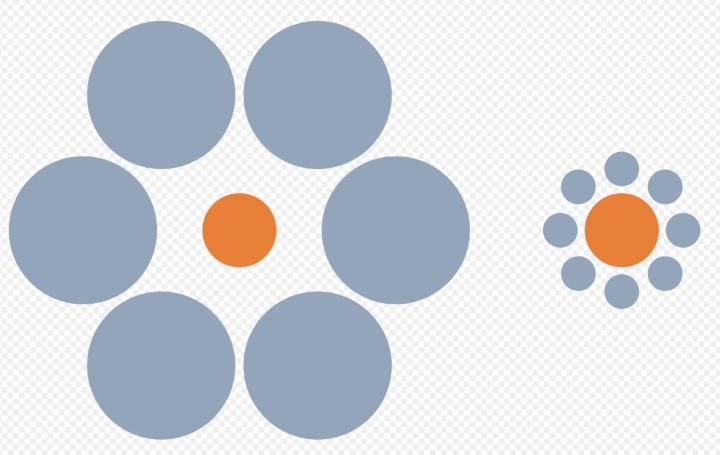
Guess which orange circle is bigger, the left or the right one?
Most people would say the one on the right looks bigger, but the truth is, they’re exactly the same size. This is called the Ebbinghaus illusion.
It demonstrates how the context around us can distort our perception of reality.
Just like the circles, when you compare yourself to others, you might feel smaller or less accomplished eventhough in reality, your value hasn’t changed. Only your perspective has.
About the Creator
Time to change your life.
Is it even possible for you to change your life? A lot of people, more than there should be, are unhappy with their lives. But what are they doing about it? Usually nothing. People talk about how shitty their lives are and want change, but are they not taking the actions to change?
By Jen Phillips3 days ago in Humans
The Power Of Compassionate Listening In Relationships And Mental Health
Compassionate listening refers to the act of attending to another human being, achieving full and non-judgmental attention, and caring and feeling compassion. It is not about hearing but comprehending the emotions, intentions, and untold needs. Compassionate listening in a relationship gives one the feeling that they are being sincerely heard. This emotional presence makes relationships feel safer and more supportive as they increase trust and connection. Emotional tension is reduced and people become more open when they listen to each other, which creates a solid platform of mental and emotional health.
By Robert Smith2 days ago in Humans
The Devil's Triangle
The sails ruffled in the breeze as we cruised along. The Sea Breeze was a mid-size catamaran that sailed out of Royal Naval Dockyard in Bermuda. We had booked this trip weeks in advance and were now looking at our Captain, Spike and two boat hands. Paddy and Wilson seemed like nice guys, joking around with the passengers and telling us some stories about Bermuda that only locals would know. Their island accents sounded almost British but they were pleasant to listen to.
By Barbara Gode Wilesabout 6 hours ago in Fiction


Comments
There are no comments for this story
Be the first to respond and start the conversation.