
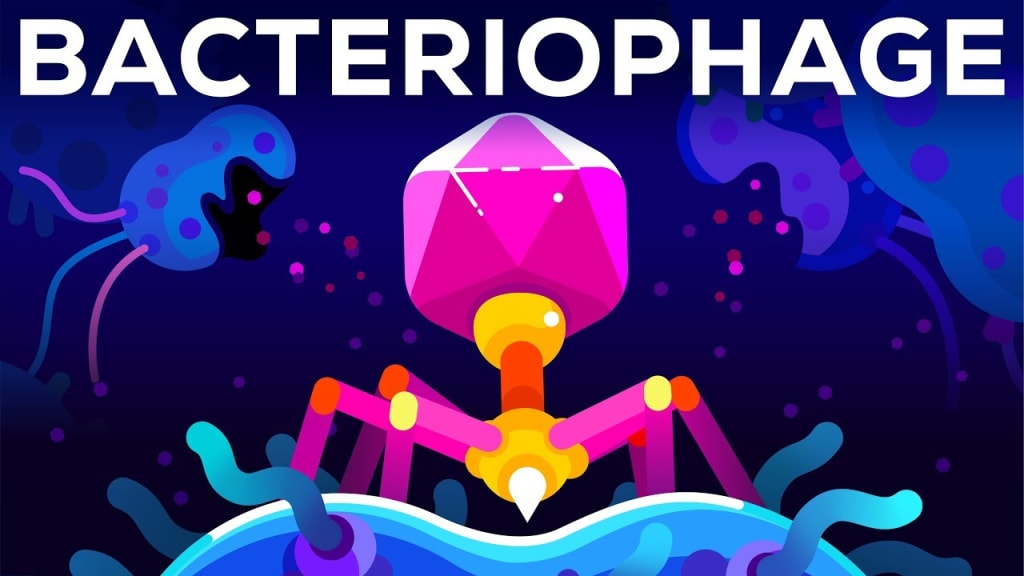
A war has been raging for billions of years, killing trillions every single day, while we don't even notice. The war is fought by the single deadliest entity on our planet: the Bacteriophage or 'phage' for short.
A phage is a virus; not quite alive, not quite dead. Also, they look as if someone made them up. Their head is an icosahedron, a sort of dice with 20 faces and 30 edges. It contains the genetic material of the virus and often sits on a long tail that has leg-like fibers. There are more phages on earth than every other organism combined, including bacteria. And they are probably everywhere living things exist. Billions are on your hands, in your intestines and your eyelids right now. Which might make you nervous since phages are responsible for the majority of deaths on earth.
But you're lucky
While they do commit genocide for breakfast, they only kill bacteria. Up to 40% of all bacteria in the oceans are killed by them every single day. But phages also have major flaws. Like any other virus, phages need a host to survive and reproduce. They're not much more than genetic material in a hull and they specialize.
When a phage finds its victim, it connects its tail fibers with receptors and uses a sort of syringe to puncture a surface. In a weird motion, the phage squeezes its tail and injects its genetic information. Within minutes, the bacteria is taken over. It's now forced to manufacture all the parts of new phages. They only stop when the bacteria is filled up with brand-new phages. In the final step, they produce 'endolysin', a powerful enzyme that punches a hole in the bacteria. The pressure is so high that the bacteria sort of vomits out all of its insides and dies. New phages are released and begin the cycle anew.
But then, about 100 years ago, by accident we found fungi that produced compounds that killed bacteria: antibiotics. Suddenly, we had a powerful super weapon. Antibiotics were so effective that we stopped thinking of bacteria as monsters. Only the old and the weakest among us were killed by them. But bacteria are living things that evolve and one by one they started to become immune against our weapons
This continued until we had created what are called 'superbugs', bacteria immune to almost everything we have. This immunity is spreading across the world as we speak. By 2050, superbugs could kill more humans a year than cancer. The days when a cut or bladder infection or a cough could kill you. In the US alone, more than 23,000 people die from resistant bacteria each year.
But it turns out that phages, our tiny killer virus robots, could save us.
Phages are very very specialized killers of bacteria. So specialized, in fact, that humans are completely immune to them; we are too different. Antibiotics are like carpet bombing, killing everything even the good bacteria in our intestines that we don't want to harm. Phages are like guided missiles that only attack what they're supposed to. It turns out that in order to become resistant to even just a few species of phages, bacteria have to give up their resistance to antibiotics. We might be able to trap them in a catch-22.
The bacteria 'Pseudomonas Aeruginosa', one of the most feared bacteria, infected the man's chest cavity. They are naturally resistant to most antibiotics and can even survive an alcoholic hand gel. After years of suffering, a few thousand phages were directly inserted into his chest cavity together with antibiotics the bacteria were immune to. After a few weeks, the infections had completely disappeared. Unfortunately, this treatment is still experimental and pharma companies are still reluctant to invest the necessary billions.
It might be a weird concept but injecting the deadliest being on planet Earth directly into our bodies could save millions of lives.
About the Creator
Scientific Love
If you want to know more about scientific things, or just want a sad poem or story to remember it all, come more often.
Keep reading
More stories from Scientific Love and writers in Humans and other communities.
Love is the worst curse of them all
2 years have passed it haven't been easy, I can barely wake up, don't want to stop dreaming. Missing your touch like I miss the snow, your green eyes like the spring glows. When I look at you all I feel is love, but deep down I know, I cant have you in my heart.
By Scientific Love2 years ago in Poets
Heartbreaking Loss: 18-Year-Old Crash Victim Remembered as Beautiful, Kind, and Caring
In a world where life can often feel fleeting, the tragic death of an 18-year-old young woman has left an indelible mark on her family, friends, and community. Known for her radiant personality and genuine kindness, she was taken from the world far too soon in a devastating crash that has shocked everyone who knew her.
By Ayesha Lashari6 days ago in Humans




Comments