
The Window That Never Closed
Sometimes, the view outside reflects more than we’re willing to see inside

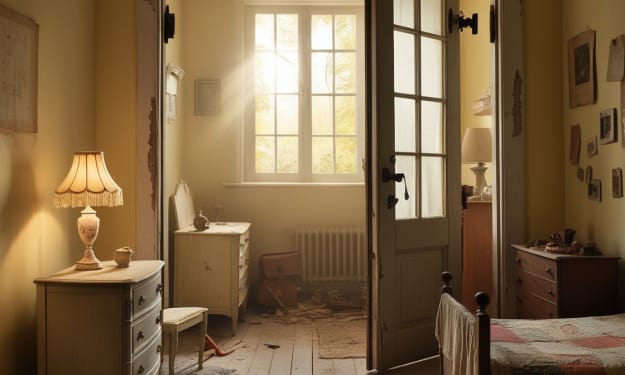
I was thirteen when I noticed the window in our living room never closed fully. It wasn’t broken—it just stopped an inch short, letting the wind slip through like a secret. Mom used to put a thick velvet curtain over it, tucking it tightly as if she could shut out the cold and the world together. But I’d always pull it open the moment she left the room. I wanted to feel the wind. I needed to.
The window faced a plain street, just rows of nearly identical houses with their own cracks and secrets. Still, to me, it was a theater. I watched the seasons change through it. Leaves grew, danced, and died. People came and left. One neighbor painted their fence white every spring. Another sat on his porch at exactly 4:00 p.m. daily, just to stare into nowhere.
Inside our house, everything was stiff. The furniture, the air, even the conversations. My father had long left, his absence packed into boxes in the attic. Mom, once soft and full of lullabies, became someone made of sighs and silence. Her eyes didn’t glow when she looked at me anymore—they just skimmed over like she was trying to recognize a memory.
But that window—it knew me.
Sometimes I’d stand by it for hours, arms crossed on the sill, forehead against the glass. I’d watch the rain blur everything outside, as if the world couldn’t decide what shape it wanted to be. Other times, the sun would fall perfectly on my face, and I’d pretend it was someone reaching out to touch me. Someone who stayed.
One afternoon, I saw her.
She was new. Moved into the pale green house across the street. She wore jeans too big for her and a shirt that looked like it had stories. Her hair was messy in a way that said she didn’t care. She stood at her own window, looking straight into mine. Not at me, but through me.
The next day, she waved.
I didn’t wave back at first. I froze, heart thudding. I wasn’t used to being seen. But the second time, I lifted a hand slowly. She smiled, bright and wild, like she didn’t know how to do anything halfway.
Over the weeks, we became each other’s view.
We held up signs. Mine said “Hello,” hers said “You okay?” I replied with “Not really.” She scribbled back “Same.”
It felt like magic, like something sacred. A friendship built on eye contact, honesty, and handwriting. No phones. No pretending. Just two broken kids trying to tape each other back together from across the street.
I found myself talking to Mom again, in small doses. Telling her I liked the breeze from the window. That I liked writing. That I missed the way she used to hum while cooking.
She listened.
One day, the girl didn’t appear. Her window stayed shut. Curtains drawn. My hands shook as I pressed my face to the glass, as if distance could be shortened by desperation.
Three days passed.
On the fourth, she returned—with a cast on her arm and bruises like smudged ink down her jaw. She looked right at me and held up a sign: “Still here.”
I burst into tears.
I wrote: “Do you want to talk?”
She didn’t write back. She just nodded.
That weekend, I left the house through the front door, heart racing, and walked across the street. For the first time in a long time, I felt real. Felt needed. Felt like that one-inch crack in the window wasn’t a flaw—it was a passageway to something bigger.
Her name was Lyla. She loved stars. Hated loud noises. Could quote movies like scripture. And she, too, felt invisible at home.
We talked for hours. I held her hand when she cried. She touched my shoulder when I couldn’t speak. We understood the language of silence and the comfort of being near someone who didn’t need you to be perfect, only present.
Months later, she helped me write my first short story. I helped her hang glow-in-the-dark stars in her room. We laughed. We healed, not all at once, but gently, the way windows crack open just enough to let in air but not too much to drown in it.
Now, years later, I live far from that old house. But I still leave one window just a little open. I still watch the sky change and wonder who’s watching back.
Because sometimes, the smallest opening is enough to save a life.
About the Creator
Keep reading
More stories from Abuzar khan and writers in Humans and other communities.
The Echo of Empty Rooms
I was twelve when I first realized that silence could be heavy. Not just absence-of-sound heavy, but thick—like molasses in the air. The kind of quiet that clings to your skin, seeps into your bones, and hums in the corners of rooms long after voices are gone.
By Abuzar khan8 months ago in Humans
Early March 2026: 4 Goals Accomplished
It's early March and I've now accomplished my 4th writing goal for the year of 2026. Before diving into the behind-the-scenes of it... why not tell you up front what that accomplishment was? I was published in a 2nd publication for this year. Published in Helix Literary Magazine out of Central Connecticut State University. You can read it for free right now!
By Stephen Kramer Avitabile7 days ago in Writers



Comments
There are no comments for this story
Be the first to respond and start the conversation.