
The Weight You Carry: Understanding Anxiety, Tension & Depression
It’s not just in your head. It’s in your body, your day, and your quiet moments. Let’s talk about it simply.

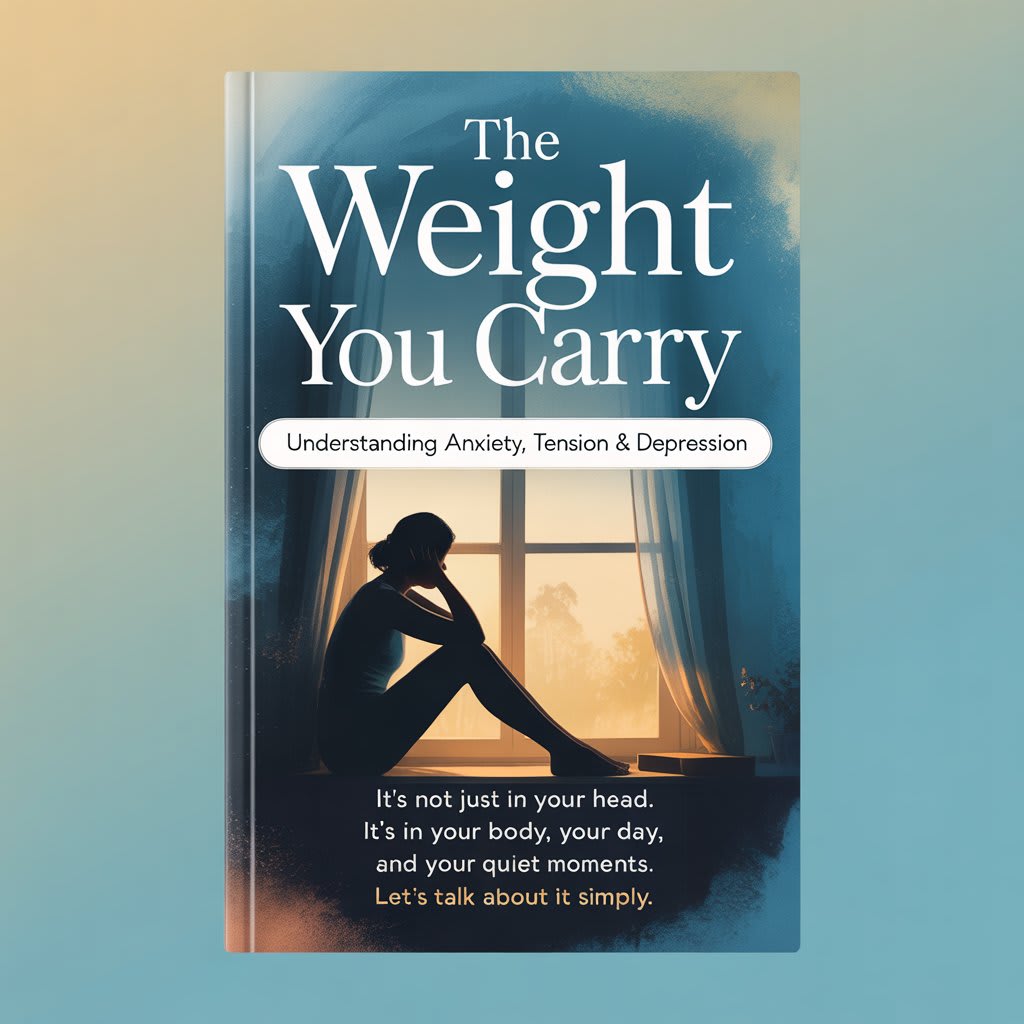
- Introduction
- And maybe you know that it seems like you are weighed down by something you cannot describe or you seem to be worrying about something that will not be gone. Many of us carry around with them unexplainable stresses, tension, and depression. This isn’t about “just be happy.” It consists of waking up to the reality of what is really going on and locating necessary little actions to manage it.
- What Does It Really Feel Like?
- Let’s name these vibes.
- The feeling of anxiety can be likened to an endless alarm clock, your heartbeat at a prospective issue, your mind buzzing with what if thoughts as you attempt to relax, and a fear that has no obvious cause.
- Stress is the ringing of the alarm in your body--ache in your shoulders, sore jaw in clenching, headaches or knotty stomach. The stress created by your mind is captured in your body.
- Depression is not simply sadness. It is as though a thick cloud that leaves everything gray, exhausts all your strength and passion, leaves what you enjoy in life meaningless, and even wakes up a monumental undertaking.
- Often, these feelings mix. You may be nervous and depressed, and your body may be tense. Naming them is the first step. They’re experiences, not you.
- First Aid in Age of Overwhelm.
- These can be quick steps that are more practical when the weight becomes too heavy. Don’t overthink—just do one.
- The 5 Grounding Trick:
- Look around. Name:
- 1 things you can see.
- 2 things you can touch (feet on the floor, watch on the wrist.).
- 3 things you can hear.
- 4 things you can smell.
- 5 thing you can taste.
- This causes your brain to point your mind to now, not panic.
- Move the Tension Out:
- It is impossible to see through a narrow muscle.
- Set a timer for 60 seconds. Shake your hands fast. Roll your shoulders. Stretch your arms high.
- It is a direct message to your body: Let go.
- The “One Tiny Thing” Rule:
- When depression makes one think that nothing is possible, do not see the entire mountain as a whole.
- Question: What can I do now that is the least?
- Examples: Drink a sip of water. Stand up for 10 seconds. Open the window.
- Do that one thing. That’s your win.
- Keep a “Weather Report” Note:
- At the end of every day, compose a sentence regarding the mental state of the day.
- Ex. sunny morning, anxious evening. or foggy all day.
- This isn’t a diary. It’s tracking data. It makes you see patterns and differentiate yourself with the storm.
- The Long-Term Psychic: Your Shelter.
- These feelings are addressed on a daily basis. Compassion towards yourself is the greatest resource you have.
- Speak to the Feeling, Not to the Feeling:
- Use say rather than I.
- This minor variation opens space. You observe the weather, but not the storm.
- Lower the Bar—Radically:
- During the bad days, the only thing you do is aim to be nice towards yourself.
- Success appears like: I have eaten something. I drank water. I rested.
- Cleaning your teeth is an accomplishment. Getting through the day, take pride in it.
- Find Your “Anchor Person”:
- Disclose one safe person. Use simple, clear words:
- “My anxiety is high today.”
- “I’m feeling really low.”
- You need not be explained long. You know, all by saying it, you make it a little lighter and you think: You are not alone.
- Conclusion
- It is difficult to be carrying anxiety, tension, or depression and you are not weak, you are just in a storm. These are emotions, yet they are not the ones being you. With mere grounding techniques and creating a shelter of self-benevolence, you get to know how to locate peaceful moments. Betterment does not come in a straight line. There are better days and there are worse days. That’s okay. It is not the absence of the storm that will test your courage, not the readiness to continue going through it. Be patient. Little steps, taking in lunges. You’ve got this.
About the Creator
Hazrat Umer
“Life taught me lessons early, and I share them here. Stories of struggle, growth, and resilience to inspire readers around the world.”
Keep reading
More stories from Hazrat Umer and writers in Humans and other communities.
How a Human Life Really Grows
I can recall the first time I even considered growing as a human being. I was not reading a goal-setting book. I was not listening to a serious podcast. At 2 a.m. I was sitting on the side of my bed, looking at my phone and questioning what was wrong with my life even though, technically, I was doing everything right.
By Hazrat Umerabout 17 hours ago in Humans
Time to change your life.
Is it even possible for you to change your life? A lot of people, more than there should be, are unhappy with their lives. But what are they doing about it? Usually nothing. People talk about how shitty their lives are and want change, but are they not taking the actions to change?
By Jen Phillips6 days ago in Humans
After the End
What living inside the Book of Revelation for seven years revealed about empire, endurance, and Christian complicity I didn’t begin a PhD in the UK because I wanted to be reshaped. I began it because I wanted to master something that was already causing me spiritual and existential discomfort.
By SUEDE the poetabout 3 hours ago in Humans
Off the Book
It ended like every other stupid idea. Badly, and alone. I’m researching digital confession ethics, he said. A tech ethicist. He gestured at floating data I couldn’t see then pulled out a physical notebook. Actual paper, fountain pen. He held it up like he was showing me scripture.
By Nicky Frankly7 days ago in Fiction



Comments
There are no comments for this story
Be the first to respond and start the conversation.