
The Unseen Suffering: A Humanitarian Call for Justice in Palestine
Exposing the everyday oppression, displacement, and violence faced by Palestinian civilians under Israeli occupation.

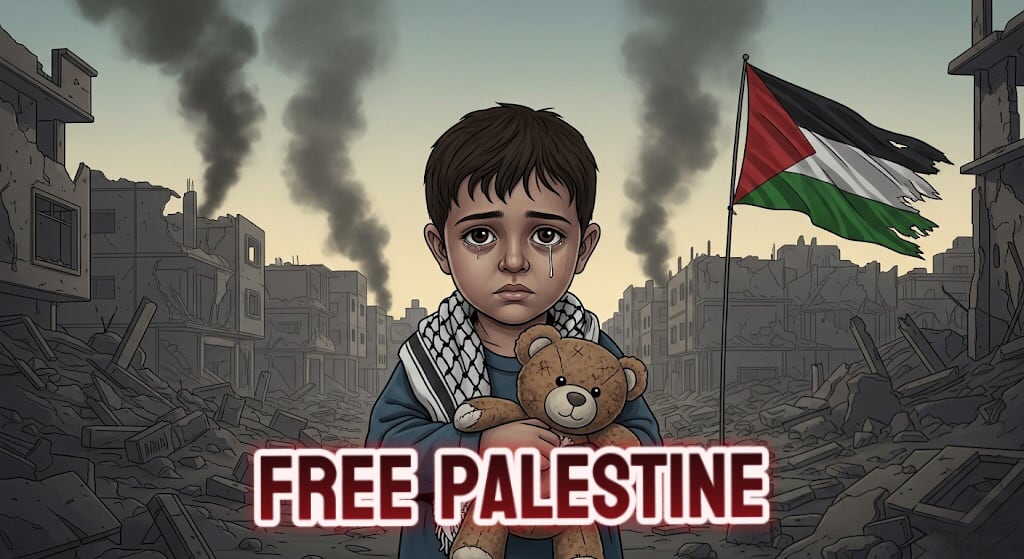
For generations, the Palestinian people—particularly those living in the Gaza Strip and the West Bank—have endured the weight of one of the longest-running conflicts in modern history. Behind the headlines, beneath the layers of political strategy and diplomatic jargon, lies a human story too often ignored. It’s a story of mothers putting their children to bed under the echo of distant explosions, of fathers waiting in endless lines for clean water, and of children growing up under skies they’ve only known as dangerous.
This is not just a geopolitical issue. It is a humanitarian crisis. And at the center of it are millions of innocent civilians who live every day under the strain of occupation, blockade, and systematic violence. Their voices are muffled, their pain overlooked, and their humanity too often forgotten.
Gaza: Life in an Open-Air Prison
Since 2007, the people of Gaza have been living under a strict blockade enforced by Israel by land, sea, and air. More than two million people are trapped in a narrow coastal strip, denied basic rights and resources that most of the world takes for granted. Clean water, consistent electricity, medical care, and freedom of movement are not guaranteed—they are luxuries.
Gaza has been described by human rights organizations as an "open-air prison," and that’s not hyperbole. Imagine living with only a few hours of electricity each day. Imagine hospitals forced to decide which patients to save when fuel runs low. Imagine being a student with dreams but no access to proper books or the internet. Now imagine this being your life—not for a week or a month—but your entire childhood, your whole existence.
These are not mere side effects of conflict. They are the consequences of deliberate policies. Children who have lived through three, four, or even five wars carry emotional scars that will last a lifetime. Mental health professionals warn of a generation growing up with trauma embedded in their bones—and yet, the world looks away.
Violence Without Proportion
The Israeli military often justifies its operations as acts of self-defense. But time and again, the scale of violence unleashed on Palestinian communities is alarmingly disproportionate. Entire neighborhoods in Gaza have been flattened by airstrikes. Schools, hospitals, residential towers, and even UN shelters have been bombed.
In the 2021 and 2023 escalations, hundreds of civilians were killed—many of them women and children. International organizations like Amnesty International and Human Rights Watch have documented multiple instances where Israel violated international humanitarian law. Yet, despite the evidence, accountability remains out of reach. Protected by powerful allies and shielded by international politics, these actions often go unpunished.
It’s crucial to remember: targeting civilians, no matter the justification, is not only morally indefensible—it is a war crime.
Displacement and the Theft of Home
In the West Bank and East Jerusalem, a quieter but equally devastating form of injustice plays out daily. Palestinian families are being evicted from their homes—often ones they’ve lived in for generations—to make way for Israeli settlers. It is a slow, creeping form of erasure.
These settlements, deemed illegal under international law, continue to expand, carving the West Bank into fragmented enclaves and making a viable Palestinian state nearly impossible. But this is not just about territory. It is about identity, memory, and belonging. It’s about watching your grandfather’s olive trees uprooted, your neighbors displaced, your history rewritten.
Silencing the Voices that Cry Out
It’s not just physical barriers that Palestinians face. Their voices are systematically silenced. Journalists reporting on the ground risk their lives to tell the truth. Activists, both Palestinian and international, face smear campaigns, censorship, and in some cases, arrest. Even in Western democracies, speaking out for Palestinian rights can invite accusations of extremism or antisemitism.
But advocating for Palestinian human rights is not antisemitic. It is not anti-Jewish to criticize the policies of a government. In fact, many Jewish voices around the world, including in Israel, stand in solidarity with Palestinians, calling for justice, coexistence, and peace.
A Responsibility That Belongs to Us All
What is happening in Palestine is not just a local tragedy—it’s a global moral crisis. As Dr. Martin Luther King Jr. once said, “Injustice anywhere is a threat to justice everywhere.” When we turn a blind eye to the suffering of Palestinians, we become complicit in their oppression.
We can no longer afford to remain neutral. Neutrality in the face of oppression favors the oppressor. Governments, institutions, and individuals must take a stand—not just with words, but with action. This includes supporting peaceful resistance movements, advocating for an end to military aid that fuels the conflict, and standing with Palestinian civil society in their call for freedom and dignity.
Let Palestine Live
The suffering of the Palestinian people is not accidental. It is not collateral damage. It is the result of systemic policies aimed at controlling, displacing, and dehumanizing an entire population. And still, through it all, the Palestinian people remain—resilient, proud, and full of hope for a better future.
Now is the time to match their courage with our conscience. To reject the apathy that allows injustice to thrive. To say, unequivocally, that every child deserves safety. Every family deserves a home. Every people deserves freedom.
Let Palestine live—not just in statements or sympathy, but in real, transformative solidarity.
I hope that this website will not remove my article but instead make it go viral so that this message can reach the world.
Who is standing with Palestine? Let us know in the comment section.
About the Creator
Taimoor Khan
Hi, I’m Taimoor Khan. Writing is my way of capturing the quiet moments of life that often go unnoticed.
Keep reading
More stories from Taimoor Khan and writers in Humans and other communities.
The Simpsons and Their Mysterious Predictions: Coincidence or Clairvoyance?
For over 30 years, The Simpsons has been more than just a cartoon. It's a cultural staple—clever, biting, and endlessly quotable. Created by Matt Groening, the show has taken aim at everything from American politics to pop culture, always with a sharp eye and a sense of humor. But in recent years, fans have noticed something else about the show: it seems to have an odd knack for predicting the future.
By Taimoor Khan8 months ago in Humans
My First Time Skiing and I Got Lost, Alone, in the French Alps
Looking back, I can trace some of my life’s biggest adventures to a simple action from my sister. She’d introduced me to Tommy (a very long time ago), a colleague of hers, who had overshared his penchant for Italian-looking women, and I ticked that box.
By Chantal Christie Weiss2 days ago in Humans
Historicity
Question #1 You are speaking with a new friend in the neighborhood. The conversation takes a turn towards religion, and you begin to share your faith and your background with your friend. This friend smirks, then states that he doubts of Jesus ever lived. How would you respond to him?
By Colleen Walters3 days ago in Humans


Comments
There are no comments for this story
Be the first to respond and start the conversation.