
The Sundial of Second Chances
It Didn't Tell the Time. It Showed the Paths Not Taken.
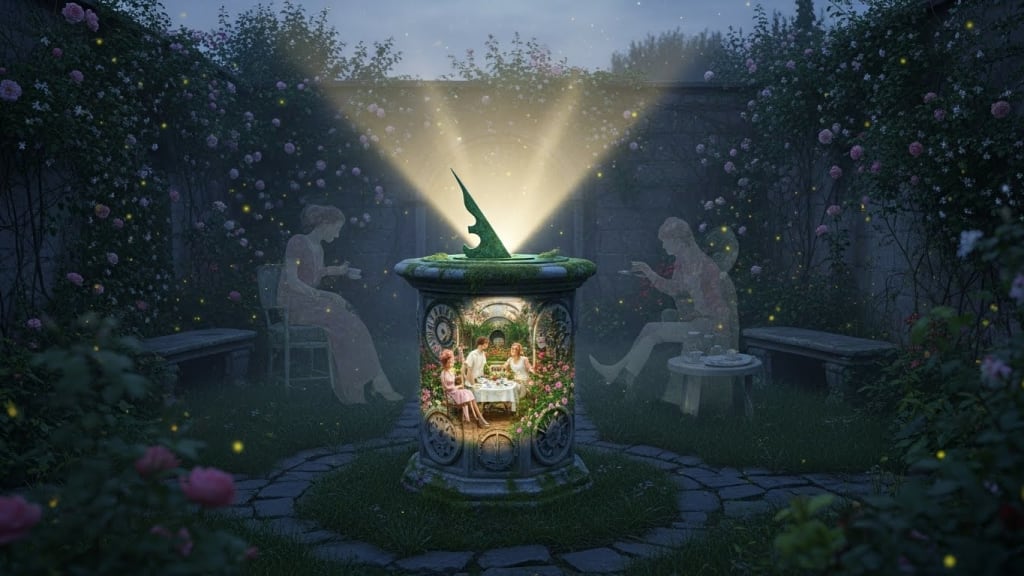
In the forgotten corner of the city's oldest botanical garden stood a sundial that no one understood. Its Latin motto was worn smooth, but if one could read it, it would say: "I do not show the hour, but the opportunity."
Most visitors assumed it was broken, for its gnomon cast no shadow. Elara, the garden's newest and quietest groundskeeper, was the only one who saw its true function. On the day of the summer solstice, as the sun hit the brass gnomon at a perfect angle, it didn't cast a shadow of darkness. It cast a light of possibility.
A beam of liquid gold shot from its tip, and on the worn stone base, a scene flickered to life. It was her, but not her. In this shimmering vision, she was on a stage, bowing to a cheering crowd, a violin in her hand. It was the life she had given up when she’d chosen the safe, practical path of a stable job.
The Sundial of Second Chances didn't show the future. It showed the vibrant, breathing ghost of a past decision, the road not taken, playing out in the present moment.
Shaken, Elara began to research. She found the journal of the garden's original designer, an eccentric clockmaker. He had built the sundial not to measure the sun's journey, but to illuminate the soul's. It showed a person their deepest, most potent "what if," not to torment them, but to offer a peculiar form of clarity.
Elara became the sundial's secret keeper. She noticed that people with heavy hearts were drawn to it, often without knowing why. A businessman would stand before it and see himself as a teacher in a rural village, surrounded by laughing children. A retired woman would see the ghost of the artist she could have been, her hands covered in clay instead of arthritis cream.
The visions weren't always happy. A man saw the grim reality of the rock star life he'd craved—exhausted, addicted, and alone. The sundial showed the truth of the path, not just its fantasy.
One afternoon, she found a young man named Leo staring at the dial, his face a mask of anguish. The light showed a simple, joyful scene: him laughing in a warm kitchen, a small child on his hip, a woman smiling at him from the stove. It was a life of quiet domesticity he had sacrificed for a high-pressure, high-paying career that was currently crumbling around him.
"It's too late," he whispered, his voice cracking. "I made my choice. That life is gone."
Elara stepped out of the shadows. "The sundial doesn't show the past," she said gently. "It shows a potential that was born from a single choice. That potential... it doesn't just vanish."
He looked at her, desperate for hope. "What does that mean?"
"It means the essence of that path—the love, the connection, the simplicity—that isn't locked away in a past you can't reach. It's a quality you can still choose to build into your life, right now, in a different way. The sundial isn't showing you a life you lost. It's showing you a part of yourself you've neglected."
The words hung in the air. Leo looked back at the glowing image of the happy father and husband, and then down at his own expensive, empty hands. The vision wasn't a taunt; it was a diagnosis. It was showing him the symptom of his deep unhappiness—the lack of connection, of simple joy.
He didn't quit his job the next day. But he did call his estranged brother. He started volunteering with a youth program. He began to build, brick by brick, the feeling of that other life into the one he already had.
Elara watched him go, then looked at the sundial. The sun had moved, and the vision had faded. The stone was just a stone again.
She understood now. The Sundial of Second Chances didn't offer a way back. It offered a mirror to the present, reflecting not the person you were, but the person you still had the potential to become. It reminded those who looked upon it that a path not taken is not a life lost, but a compass pointing toward the missing pieces of the soul. And it was never, ever too late to follow its bearing.
About the Creator
HAADI
Dark Side Of Our Society
Thief In The Night
To the thief in the night that took and replicated what once was mine: Honestly, I feel kind of bad for you. It’s funny, because we hardly know each other. I only know of you through the magazines you’ve written and the broadcasts you have televised in the past — as well as through the public mentions of you from your show business connections there.
By Snarky Lisa7 days ago in Humans




Comments
There are no comments for this story
Be the first to respond and start the conversation.