
The Glassblower of Frozen Breath
He Didn't Shape Glass. He Captured Winter's First Words.
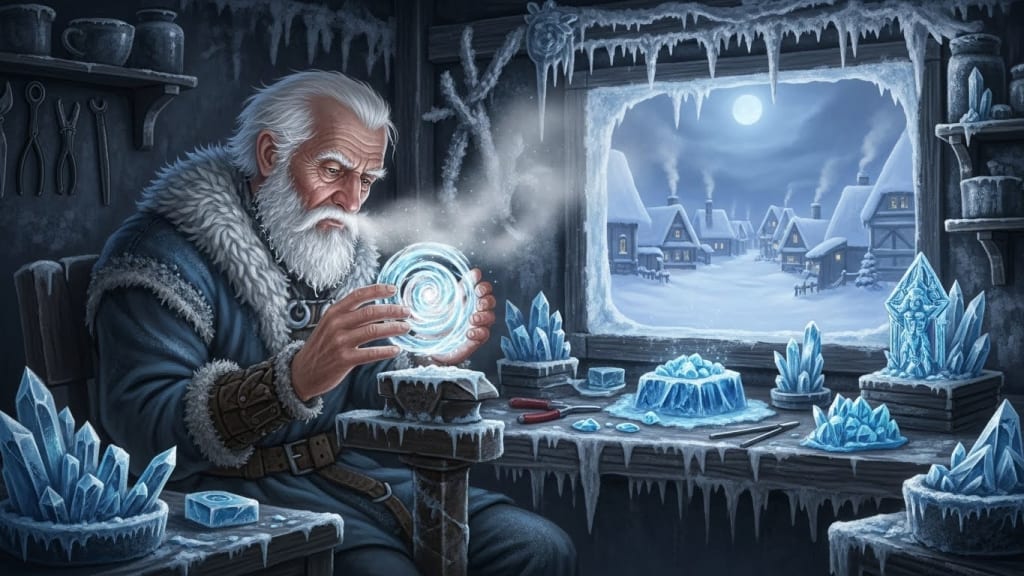
In a village nestled so high in the mountains that the clouds slept in its streets, there lived an old man whom the children called the Frost-Father. His true name was Emil, and he was the last Glassblower of Frozen Breath.
His craft was not of fire and sand, but of cold and air. On the morning of the first snowfall, when the world held its breath in anticipation, Emil would rise before the sun. He would take his delicate tools—tongs of silver birch and a blowpipe carved from a single icicle—and venture into the silent, white world.
His material was the very essence of winter: the first exhalation of a fox tracking its prey, the surprised gasp of a child seeing the snow, the soft sigh of a pine tree settling under its new, white coat. To him, these breaths were not empty air. They were stories waiting to be told, emotions suspended in the cold.
He would find a perfect, unblemished plume of breath hanging frozen in the air—a visible puff of life in the stillness. With the patience of a glacier, he would gently coax it with his icicle pipe, not melting it, but shaping it. He would spin it, stretch it, and fold it, trapping the moment forever in a shell of clear, hardened air.
The results were not mere sculptures. They were memories made tangible. A glass sphere containing the excited breath of newlyweds building their first snowman would radiate a fizzy, joyful energy. A delicate icicle-shaped vial holding the weary but content sigh of an old woodcutter returning home would emanate a profound, warm peace.
The villagers cherished his work. They didn't display them in windows where the sun could melt them, but kept them in cool, dark places. On a sweltering summer day, one could hold the sphere of a child's laughter-filled breath and feel a wave of winter's joy. During a tense argument, the vial of a mother's lullaby-breath could fill a room with calming stillness.
Emil’s most sacred task was the "Final Breath." When a villager lay dying in the deep winter, he would be summoned. He wouldn't speak, only listen. As the soul departed, he would capture the last, soft cloud of breath that left their lips. This was not a work of art for display. It was a quiet, private vessel for a family's grief—a way to hold the very last piece of a loved one's presence, not as ash or bone, but as the air that once gave them voice and song.
One year, the first snow did not come. The sky remained a hard, grey iron. The air was cold, but dry and silent. The village grew anxious. Without the first snow, Emil had no material. Without his creations, the long, dark winter felt hollow and joyless.
For weeks, Emil waited. Then, on the longest night of the year, he walked to the highest peak. He stood there, facing the starless sky, and did the only thing he could. He took a deep breath of the barren, frozen air, and he blew.
He blew not to shape, but to give. He poured into that exhale all the memories he held—the sound of sleds on snow, the taste of frost, the feeling of a warm hearth against the cold. He blew the very idea of winter into the sky.
His breath, laden with a lifetime of captured moments, crystallized before him. It did not form a single piece, but shattered into a thousand glittering motes. They rose into the air, dancing on a wind that had not been there before.
And then, it began to snow.
The flakes were not plain ice. Each one was a tiny, perfect replica of his creations—a miniature glass tear, a star, a sleeping animal. They fell upon the village, each one containing a tiny spark of a story, a laugh, a sigh.
The children caught them on their tongues and tasted magic. The villagers knew then that Emil was not just a craftsman. He was the bridge between the season and their soul. As long as he breathed, winter would never be silent, and no beautiful moment, not even a single breath, would ever be truly lost.
About the Creator
HAADI
Dark Side Of Our Society


Comments
There are no comments for this story
Be the first to respond and start the conversation.