
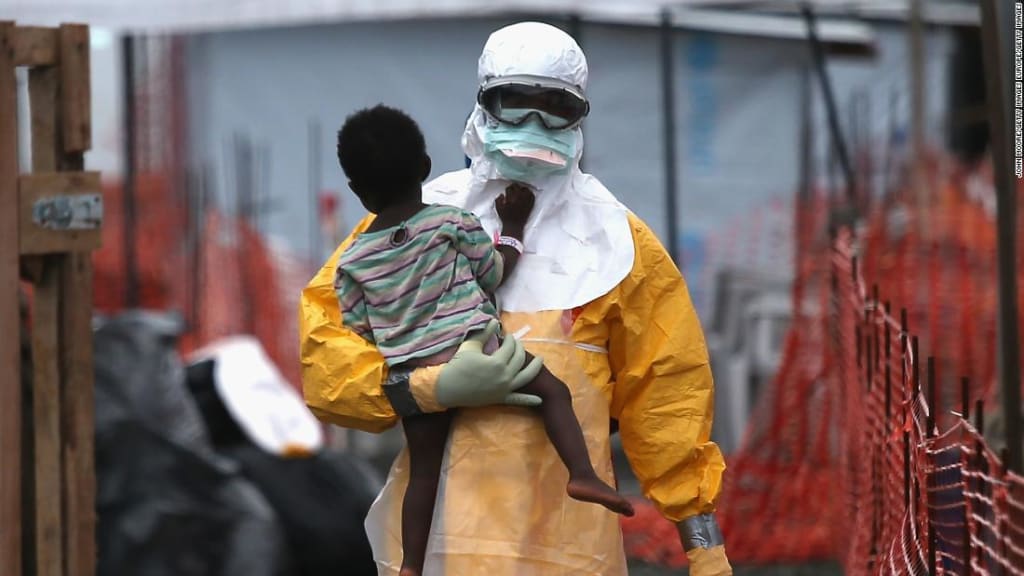
This is the story of how my village survived Ebola. We unknowingly carried the tiny, invisible Ebola germs—so small yet so dangerous. Without realizing it, my grandfather rubbed a little blood in his eye, allowing the Ebola germs to enter his body.
Days went by, and then my grandfather developed a terrible fever and weakness. We thought it was malaria, but he soon got much worse, experiencing vomiting and diarrhea as his fever soared. I ran to get the nurse, but by the time I returned, my grandfather had already died. I was heartbroken.
The nurse suspected it might be Ebola, a disease caught from bushmeat but that spreads from person to person. Others in our region had already died from this new disease. She explained that unless we understood the disease and followed strict rules, it could spread further and kill many more people. She told us that Ebola is present in the body fluids of someone who is sick or has died from it—sweat, tears, mucus, saliva, vomit, diarrhea, urine, breast milk, sexual fluids, and blood. When we touch a sick person's body fluids, the Ebola germs can enter small breaks in our skin or our eyes, nose, or mouth. The germs then spread through our bodies, making us sick. When someone dies from Ebola, their body becomes highly contagious, and no one should touch it.
The nurse advised us to wash our hands with soap and water immediately. She contacted the trained burial team to help us bury my grandfather safely. The burial team arrived, comforted us, and explained what they had to do to protect us. They wore protective clothing to shield themselves from the germs and sprayed grandfather's room and body with chlorine to destroy the Ebola germs. They safely enclosed his body in a bag to prevent the spread of the disease. They also burned his mattress, bedding, and clothes—anything that might carry the germs. These actions made us safer, although we couldn't follow all our traditions. We still honored my grandfather in the time of Ebola.
Our chief gathered all the villagers after grandfather's death. He explained that while it's natural to fear Ebola, trusting our health workers and following their rules could stop the disease. The nurse told us that if someone shows symptoms like fever, we shouldn't touch them but take them to the treatment center immediately. This gives them the best chance of survival and prevents the spread of Ebola. She also advised us to wash our hands with soap and water many times a day. The whole village agreed to follow these rules.
Since we had close contact with my grandfather, we were at risk of getting Ebola and had to stay home. A health worker visited us daily to check for fever or other signs of sickness. If we had Ebola, we would show symptoms within 21 days.
Many days passed, and I hoped we would all stay healthy. But one morning, I found my mother burning with fever. I knew I couldn't touch her—she was now contagious. My father decided to take her to our uncle's house in a nearby village, afraid to bring her to the treatment center and possibly never see her again. I stood up to both of them, insisting that if it was Ebola, she needed to go to the treatment center immediately. We had to trust the health workers to save her, ourselves, and our village. They understood that running away would only lead to more death and suffering. My mother tested positive for Ebola and was given a bed at the treatment center.
At first, the health workers looked scary in their protective suits, but I knew they wore them to stay safe. Inside, they were just normal people like the nurse. They took good care of my mother, providing fluids, medicine, and food to help her body fight Ebola. I missed her very much but was able to talk to her on the phone. Sadly, some people in my village didn't survive, but my mother got better day by day. Soon, we could see her from a safe distance.
One day, the nurse announced that my mother would live. We could finally hug and kiss her—it was a day to celebrate. Our village followed the rules, trusted our health workers, brought the sick for care immediately, called for the safe burial team when someone died, and always washed our hands with soap and water.
About the Creator
Keep reading
More stories from Shinzou Wo sasageyo and writers in Humans and other communities.
What causes haedaches?
In ancient Greece, headaches were considered powerful afflictions. Sufferers prayed for relief from Asclepius, the god of medicine. If the pain persisted, a medical practitioner might resort to trepanation—a procedure involving drilling a small hole in the skull to drain supposedly infected blood. This dire technique often replaced the headache with a more permanent condition.
By Shinzou Wo sasageyo2 years ago in Humans
From Fire Escapes in El Paso to the Heartbeat of New York
My first job started just after I turned fifteen: volunteering at KXCR 89.5 FM, “The Heart of El Paso.” It's a small, local jazz station in El Paso, Texas. On air, I used the name Steve Young, starting the first of many radio personas, with record spinning, letting the sounds of jazz wash over me. The station was also home to the Latin America News Service, which helped me discover journalism. I started to see storytelling, and photography as a way to capture life and revealed the first glimmer of a larger ambition.
By Steven Zimmerman6 days ago in Humans
Early March 2026: 4 Goals Accomplished
It's early March and I've now accomplished my 4th writing goal for the year of 2026. Before diving into the behind-the-scenes of it... why not tell you up front what that accomplishment was? I was published in a 2nd publication for this year. Published in Helix Literary Magazine out of Central Connecticut State University. You can read it for free right now!
By Stephen Kramer Avitabile8 days ago in Writers



Comments