
The Silent Collapse: How AI is Harming Mental Health, Education, and Our Future
Why a Smarter World May Be Making Us More Disconnected, Distracted, and Disposable

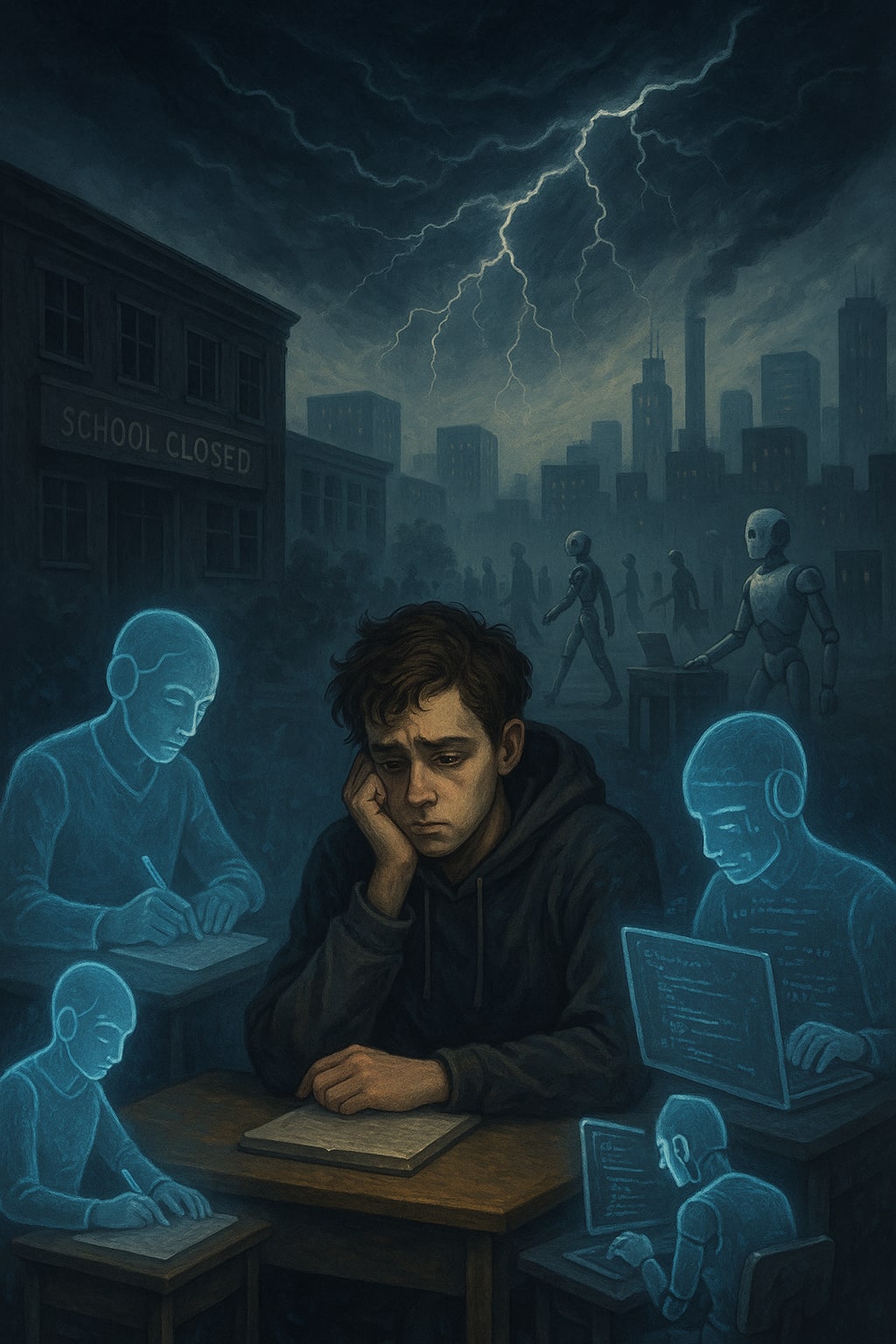
In the past decade, artificial intelligence has gone from science fiction to science fact. It's now embedded in the tools we use, the decisions we make, and increasingly, the jobs we lose. But beyond the flashy headlines and corporate optimism, a darker narrative is unfolding one that speaks not of innovation, but erosion. Erosion of mental well-being. Erosion of critical thinking. And, perhaps most devastating of all, erosion of purpose for future generations.
This isn't paranoia. It's happening now. And it's happening fast.
Mental Health: When Thinking Becomes Obsolete
At first, AI felt like magic. It could write our emails, generate our resumes, plan our trips, even design our homes. But as it's crept into every corner of life, a quiet crisis is taking hold: the emotional disconnection that comes from having nothing left to do.
Students, freelancers, creatives, and professionals are beginning to ask: What's the point? When a chatbot can write a better poem, a design generator can make better logos, and an AI therapist can mimic empathy, where does that leave the human mind?
We are hardwired for contribution. Purpose is medicine. But when our skills are automated, our relevance becomes negotiable. Psychologists are reporting growing cases of “AI-induced burnout” a blend of anxiety, helplessness, and identity confusion, especially among young people entering the workforce. The idea that you are your ideas becomes fragile when those ideas can be instantly generated by a machine.
Education: Faster Doesn't Mean Smarter
In classrooms across the world, ChatGPT and its cousins are doing the homework. What once required hours of reading, thinking, and writing can now be accomplished in seconds with a single prompt. On the surface, this feels efficient. But efficiency isn't the same as learning.
Educators are finding themselves in a losing battle one where AI not only outpaces the traditional methods of assessment but actively encourages academic laziness. Why study Plato when you can just ask an AI to summarize his philosophy in three bullet points?
The long-term consequences are dire. When students no longer need to engage in the mental wrestling that builds comprehension, nuance, and resilience, they become intellectually fragile. Surface-smart. Quick with answers, but shallow in understanding.
In short: AI is giving us knowledge without wisdom. And education without struggle is not education it's outsourcing intelligence to a machine.
The Future of Work: Degrees Without Destiny
The generational promise of higher education used to be simple: get a degree, get a job. But in a world increasingly governed by AI, even that contract is being broken.
Tasks once reserved for entry-level graduates data analysis, legal research, financial modeling, coding are now being done faster and cheaper by AI systems. And as the tech improves, it's not just blue-collar jobs that are disappearing. It's white-collar ones. Creative ones. Strategic ones.
Imagine spending four years and tens of thousands of dollars on a degree, only to graduate into a job market where your role is already automated or worse, obsolete. This is the future facing Gen Z and Gen Alpha. For many, it's not just about unemployment it's about existential disillusionment.
What happens when ambition meets a wall built by algorithms? What happens when no matter how hard you work, you can't outpace the machine?
The Psychological Fallout: A Generation Adrift
We're not just witnessing a technological revolution. We're watching the slow erosion of identity, confidence, and motivation. Studies are already emerging that show a spike in depressive symptoms, loneliness, and imposter syndrome linked to increased AI use particularly among young adults.
And why wouldn't they feel this way?
If AI can code better, write faster, analyze deeper what's left for us?
If AI is the “partner” in every creative or corporate endeavor are we collaborators or just middlemen?
If education becomes just managing prompts and plagiarism tools what value does learning even have?
These aren't philosophical questions. They're the unspoken fears keeping a generation up at night.
What We Lose When We Stop Thinking
There's a myth that AI makes us more productive. But what if it's actually making us less human?
Thinking, struggling, failing these are the crucibles through which identity and intelligence are forged. When we no longer have to wrestle with ideas, solve complex problems, or even write our own thoughts, we become disconnected from the very things that define us.
The brain is like a muscle. Use it, and it strengthens. Let AI do the heavy lifting for too long, and atrophy sets in. Not just mentally, but emotionally. We begin to feel less capable, even when we know more.
In a world where everything is automated, we risk raising a generation that's passive, reactive, and hollowed out. A generation fluent in prompts, but illiterate in purpose.
Is There a Way Forward?
Yes but it requires more than just regulation. It requires reinvention.
We need to redesign education to reward process, not just output. To teach students how to think with AI, not let it think for them.
We need to redefine work in a way that prioritizes human creativity, empathy, and adaptability traits machines can simulate but never truly possess.
And most importantly, we need to have honest conversations about the psychological impact of being constantly compared to a machine that never tires, never doubts, and never struggles.
We Built the Machine. Now We Must Rebuild Ourselves.
AI isn't evil. It's a tool a powerful one. But like any tool, it reshapes the hand that uses it.
If we're not careful, the generation growing up in the shadow of AI won't just lose jobs. They'll lose confidence, connection, and clarity about their place in the world.
The solution isn't to destroy AI. It's to reclaim what it means to be human. To revalue struggle. To reframe intelligence. To remind ourselves that we don't need to be faster than the machine just more alive than it.
Because in the end, the future isn't about artificial intelligence.
It's about authentic humanity.
About the Creator
FutureVoices
Storyteller, tech enthusiast, and advocate for digital innovation. Exploring the intersection of culture, technology, and personal growth. Join me in navigating the evolving digital landscape and sparking meaningful conversations.
Keep reading
More stories from FutureVoices and writers in Humans and other communities.
BYD: Redefining the Electric Vehicle Landscape Beyond the Headlines
In an automotive industry long dominated by familiar names and loud headlines, one company has quietly emerged to redefine what an electric vehicle can be. This is not just about making a car, it's about crafting a technological ecosystem on wheels. Enter BYD – a name that might not command the same flash as some of its competitors, but is quietly and confidently reshaping the future of electric mobility.
By FutureVoices8 months ago in Wheel
What I Say vs What I Do
We all have attitudes, and psychology textbooks tell us that an attitude is defined by a "prevailing and consistent tendency to think, feel or act a certain way about something or someone in the world around us"( George, S. Kelly, B. Piferi,2023). Attitudes influence our behaviors, but can be altered by perception of the ability to change behaviors, which leads to the attitude being altered to accommodate the behavior. This leads to the question asked this week about how we say we would act and how we do act in situations.
By Colleen Walters7 days ago in Humans




Comments
There are no comments for this story
Be the first to respond and start the conversation.