
The Silence Between Generations
A Grandmother’s Gaze, A Boy’s Burden, and the Weight of Unspoken Love

The village of Narayanpur stirred each morning not with alarm clocks or smartphones, but with the rooster’s crow and the rhythmic clang of women drawing water from the well. It was a village caught between eras — its cracked mud houses and dusty courtyards whispering stories from the past, while the younger generation dreamt of distant cities they could barely pronounce.
Among these houses stood a frail, quiet home shaded by an old neem tree, with walls patched more times than remembered and a verandah barely holding onto its wooden pillars. This house belonged to Kamala Devi, a widow in her late seventies, and her only grandchild, Manu, a boy of eight.
Manu’s mother had passed away during childbirth. His father, Raghav, had gone to the city in search of work and hadn’t returned for years — at first writing, then calling, and eventually disappearing into the black hole of migration that swallowed so many poor men.
So Manu and his Dadi lived together — one with memories too heavy to speak, the other too young to understand the depth of loss that shaped his world.
Kamala Devi was once a woman of steel — known in the village for her sharp tongue, quick hands, and the ability to manage a household with precision. Now her body bent like the sickle she once used in the fields. Her eyes, though, had not dulled. They still scanned the horizon each evening, as if waiting for a figure to emerge from the path — a son with a tattered bag, a broken sandal, and the humility to return.
But only silence came.
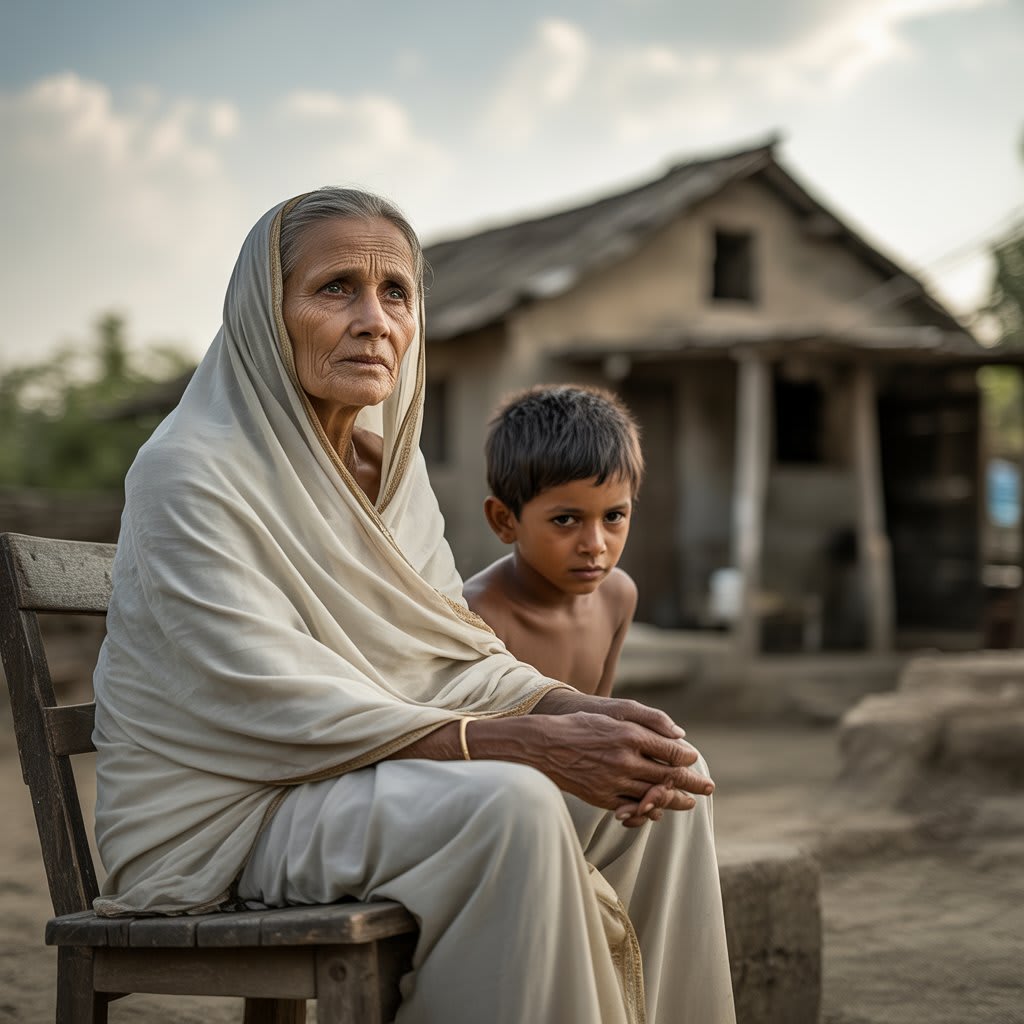
Each day, after washing a few clothes and boiling rice, she would sit on the wooden chair in the courtyard, draped in a white cotton saree that matched her hair. Manu would sit by her feet, often shirtless in the heat, his knees dusty from play, his eyes curious and filled with unsaid questions.
He had asked once, “Dadi, where is Baba?”
Kamala had only looked at the road and replied, “He’s working. He’ll come when the work is done.”
Manu didn’t ask again. But the question never left him.
They had little, but enough. A small ration from the government, a patch of land that gave a few vegetables, and the kindness of neighbors who respected Kamala Devi’s dignity enough to offer help without announcing it.
But what they lacked in material comforts, they made up for in companionship.
Every evening, after dinner, Kamala would tell Manu stories. Not fairy tales or gods descending from the skies — but real stories. Of floods and famines. Of how she once carried water pots balanced on her head and hips. Of the time when her own mother had walked fifteen kilometers to save her child’s life from fever. Of wars and weddings and betrayals.
And sometimes, of Raghav — a quiet boy, like Manu, who loved to draw with charcoal on mud walls.
“But Baba went away,” Manu would murmur.
“Yes,” Kamala would say softly. “And we stayed. That is our story now.”
Kamala had one prized possession — an old photograph framed in cracked glass. It showed her, a younger Raghav, and a smiling woman with kind eyes — Manu’s mother. Every few weeks, Kamala would take it down, dust it, and run her fingers over their faces.
Manu watched her one day and asked, “Will we ever take a photo again?”
She smiled faintly. “Maybe. But we have memories. They don’t break.”
As the seasons passed, Manu started school. Kamala insisted, despite the cost of uniforms and notebooks.
“He must learn,” she said to the village sarpanch. “If not for himself, then for all of us.”
Manu didn’t excel in class, but he listened. He copied words carefully, asked questions, and often returned to teach his Dadi what he learned — about how the Earth rotated, how rain happened, and how one day he would become “an engineer.”
“Do you know what that means?” she asked once.
“No,” he grinned. “But it sounds big.”
She laughed — a rare sound that startled even the birds perched on the thatched roof.
Then came the monsoon that changed everything.
The rains were cruel that year. The roof began to leak. The fields drowned. Kamala fell ill — a fever that wouldn’t break, a cough that rattled her chest.
Manu tried to care for her. He brought herbs from the jungle, fetched water, made flatbread as she had taught him. But he was only eight.
A neighbor finally took her to the government clinic on his scooter. The diagnosis was clear — pneumonia, worsened by age and poor nutrition.
“She needs rest and warm food,” the doctor said. “And someone to look after her.”
“I will,” Manu said, clutching her hand.
Kamala smiled at the boy — her warrior. Her blood. Her purpose.
It took her weeks to recover. And in that time, something shifted. Manu became quieter, more observant. He swept the yard before school, fed the chickens, and even started helping a grocer nearby in the evenings to earn a few rupees.
One morning, as Kamala sat on her usual chair in the soft light of dawn, Manu came and sat beside her.
“What will happen when you’re gone?” he asked bluntly.
She looked at him, startled.
“You’ll go too someday,” he added, matter-of-factly. “Everyone goes.”
Kamala didn’t answer immediately. She looked toward the horizon, where the sky blushed with the first hints of sunrise.
“I’ll be here,” she finally said. “In this house. In these stories. In you.”
Manu didn’t fully understand. But he nodded.
That morning, a neighbor saw them — the old woman and the boy — sitting in silence, the bond between them thicker than blood, woven with sacrifice, grief, and enduring love.
She took a picture.
And that is the picture you see — of two generations caught in a moment between past and future, their eyes reflecting what they never said aloud.
Epilogue
Years later, when Manu became a teacher in a nearby town, he kept that photo on his desk.
When students asked who they were, he would smile and say, “My roots.”
Kamala Devi never lived to see the day he graduated, but Manu believed she knew. In every exam he passed, in every child he taught, in every life he touched — her presence echoed.
Because some people never leave.
They become the silence in our strength, the quiet in our courage.
About the Creator
AFTAB KHAN
SUBSCRIBE ME AND READ STORY
Storyteller at heart, writing to inspire, inform, and spark conversation. Exploring ideas one word at a time.
Writing truths, weaving dreams — one story at a time.
From imagination to reality
Keep reading
More stories from AFTAB KHAN and writers in Humans and other communities.
The Weight of Fifty
When Harold turned fifty, no bells rang. No confetti fell. The world did not pause to acknowledge his half-century on Earth. It was a drizzly Tuesday in late March. He woke up with a mild backache, brushed his teeth, and stared at his reflection with the kind of squint that tries to search the soul behind crow's feet.
By AFTAB KHAN8 months ago in Humans
System Failure
The email arrived at 2:14 AM. I know the time because I wasn't sleeping. I was refreshing. There is a specific kind of insomnia that comes when you are waiting for a system to decide your future. You wake up at odd hours. You check the phone. You check the spam folder. You check the junk.
By Edward Smithabout 13 hours ago in Humans
Belle of the Bayou
Bad move, cher. Not just the slip of her kitten heel on the rainy February cobblestones in the Fourth Ward. She got caught snooping. Detective Deleon clucked and strutted like a rooster in his rush to clear her from the scene, waving cigar smoke to and fro as he gesticulated amid the thick air of the speak easy. An experienced crime reporter, Marie knew better than to let the coppers catch her on the wrong side of the line, but curiosity had gotten the better of her.
By Maia Gadwall the metAlchemist6 days ago in Fiction




Comments
There are no comments for this story
Be the first to respond and start the conversation.