
The Roman Saturnalia
Liberation, licentiousness, and the brief creation of an upside-down reality
It is well known how the colonization by Christianity across Europe — during the Roman Empire and after the fall of the greatest Empire the world had ever known — involved turning ancient pagan festivals throughout the pagan changing of the seasons, an ancient pre-Christian astronomical calendar, into fully Christian-inspired ceremonies and celebrations.
This was the soft power of the early Roman church to assimilate paganism without burning or slaughtering the non-believers, and it has been a very successful project. We still celebrate these festivals that are mostly about the life, death, and resurrection of Jesus Christ in his form of both a child and Son of God.
Yet we have surely lost a great deal from this Catholic colonisation, although a deep echo of those pagan elements does remain and has itself become metastasized further not by a religious creed but by Capitalism and the marketing and selling of manufactured products. Christmas has become the biggest commercial celebration in the history of modern Capitalism.
The similarities between the ethos of Capitalism and the Christian/Catholic festivals of Easter and Christmas are to sell. One ideology sells goods, the other sells Christ and God. Such a duality is still highly successful, but through this dual combination, we forget our shared history of the real meaning of this time, which was a political and social festival of disruption and disorder. Saturnalia was the original creation of a fictional upside-down world that has inspired every fictional creation since.
The Saturnalia was one of the oldest Roman festivals, its origins stretching back to the early Republic, probably to even earlier. It honored Saturn, an ancient god of agriculture and time; this winter festival embodied the spirit of joy, freedom, and social upheaval. Saturn’s reign, according to myth, marked an age of peace and equality before the rise of Jupiter and the Olympian gods.

Depictions of the god in surviving art have him wearing a veil and brandishing either a sickle or a pruning knife, suggesting a close relation with agriculture and especially seed-growing or seed-corn. With links to indigenous Italian deities and perhaps, too, a version of the Greek god Kronos, he was regarded as a primordial deity who had taught humanity important agricultural skills.
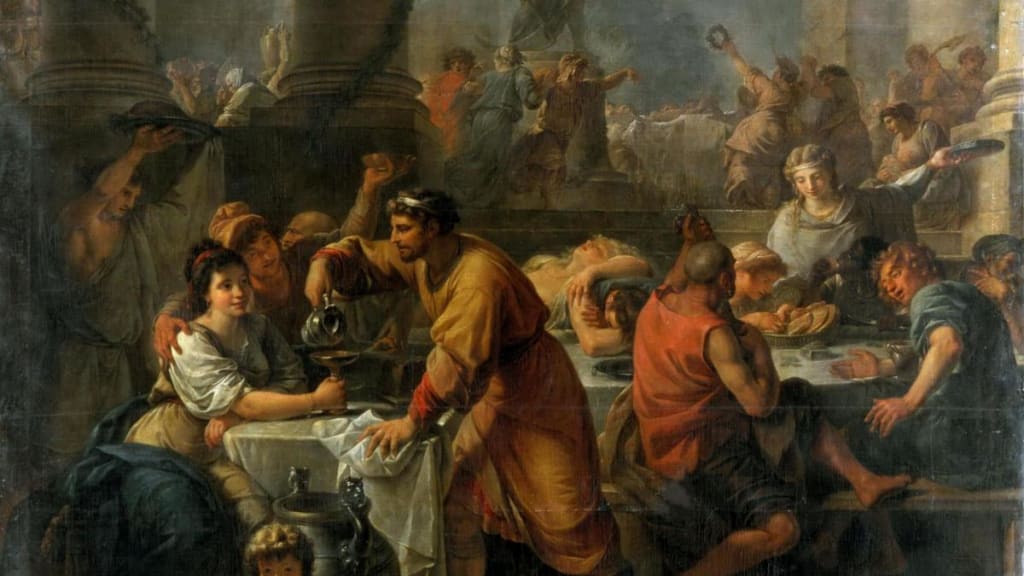
For a brief period each December, the rigid hierarchies of Roman society dissolved, and chaos became celebration. Masters served slaves, gambling was permitted, and laughter echoed through the streets of Rome — all in the name of Saturn’s golden age. The festival began on December 17 and was later extended to a week-long celebration. Its timing coincided with the winter sowing season, symbolizing hope for renewal and abundance. The Roman historian Livy recorded that the earliest celebrations took place at the Temple of Saturn in the Forum.
The Saturnalia was presided over by a king, chosen especially for the occasion, known as the Saturnalicius princeps or ‘leader of the Saturnalia.’ Sometimes he is referred to as the ‘Lord of Misrule’ as he was selected from the lowliest members of a household and given the right to conduct light-hearted mischief.
It was a festive period when people gave gifts to one another. Slaves had the freedoms enjoyed by ordinary citizens and were now able to gamble, get drunk in public, and throw aside the cloak of decorum they were meant to present at any other time of the year. More informal clothes (synthesis) were worn by citizens instead of the usual toga, and there was a general round of feasts, partying, game playing, and merrymaking for all. These events made it the jolliest Roman festival in the calendar; a fact which led Catullus to famously describe it as ‘the best of times.’
One striking feature of the Saturnalia was not merely the relaxing but reversal of ordinary roles and social conventions, whereby, for example, masters would wear the freed-slave felt hat (pilleus) and wait on their slaves — or at least eat together in the same room — who were permitted to do as they wished and even display a touch of insolence.
This strikes me as a very clever Roman addition to an ancient pagan festival that had now moved into an urban environment with strict class barriers and rigid social conventions attuned only to the Empire. It was a safety valve that helped ease the tensions of such a hierarchy of entitlement embedded from birth to death. For 7 days, the slaves could rule and be the masters. It may have been a reason why the Roman Empire lasted for so long.
The end of the celebrations was marked by the buying and giving of candles, such trifles as jellied figs, and especially the small terracotta figurines or sigilla which were on sale in the special market, the sigillaria. This fair gave its name to the last day of the festivities, and it was traditional for people to give money to their dependents so that they could buy the cheap goods on offer there. We can see here both the duality of our modern-day celebrations with those candles and the buying of goods.
However, the main theme for me that I take from this pagan festival, which has its roots way back into our past, where humanity existed through the changing seasons and the changing duality of day and night with increasing and decreasing levels of daylight from the Sun, is the approach and then celebration of the Winter Solstice. A pivotal moment in the cycle of agriculture and the beginning of human civilisation, which would develop from small but resource-rich communities into urban centers and then into Empires.
More Sun would bring the end of winter and the start of new growth and less of the darkness that must once have been full of fear and trembling. A time of increasing death, no doubt, for many in these communities. But the turn would mean that these days of darkness were being banished by the light — a time for celebration. Here are the roots of the Saturnalia.
Yet added to this original celebration of life and rebirth is the urban and political darkness of civil disorder and class rebellion within the Empire. Within all Empires, ancient or modern. The Saturnalia is a celebration of liberation allowed for 7 days. “Allowed” being the operative word. It is making good use of an upside-down reality to sustain its overwhelming, harsh, and violent power over its urban population.
The only aspect of liberation in the Christian Christmas celebration is the birth of Christ as a potential liberator from the yoke of Rome. But that is a modern rendition of Christ as a political figure. It is one I, as an atheist, find it possible to justify from his own declarations in the New Testament. The Nativity is a historical account of his birth, yet embellished with mythic iconography. The birth not of the Son of God but of a proto-revolutionary leader against the Empires of the World, both ancient and modern.
Nietzsche would castigate the weakness inherent in this master-slave moral dialectic — the Judeo-Christian moral system — and demand of us a “revaluation of all values”, but for 7 days, it actually happened in Rome during the Saturnalia. Yet the slaves in Rome were the first Christians who believed in this moral system and proselytised it with their martyrdom in the Colosseum. It is here that the Saturnalia must have faced the reality of the Roman world and lost its meaning.
And as for our modern-day Capitalist Christmas with those ‘Black Friday’ sales that last from the end of November through December and onward, way beyond the Winter Solstice, the meaning of Christmas as a time to celebrate the birth of baby Jesus is now a reason to just sell, to put people into higher levels of debt, and to obscenely obliterate any spiritual depth to the event.
We need the Saturnalia back in all its liberating glory to turn everything not upside-down but the right way round. We should remember why we are celebrating at this time of year. Not for Jesus or for the profit motive of Capitalism, but for the end of the darkness and the true beginning of the Light.
About the Creator
Marc Barham
Ancient and Justified.
Keep reading
More stories from Marc Barham and writers in Humans and other communities.
‘The Prestige’ (2006)
“Any sufficiently advanced technology is indistinguishable from magic.” — The 3rd Law of Arthur C. Clarke “Knowledge kills action, for action requires a state of being in which we are covered with the veil of illusion.” ― Friedrich Nietzsche, The Birth of Tragedy
By Marc Barham28 days ago in Geeks
Golden Globes 2026 Reflect a Changing Hollywood Awards Night
Award shows often feel distant from everyday life, but every so often, one night captures a deeper mood. The Golden Globes 2026 did exactly that. It was not just about trophies or fashion. It was about where Hollywood stands right now. Audiences are changing. Stories are changing. Expectations are changing too. This ceremony felt quieter in some ways, yet heavier with meaning. There was pride, discomfort, nostalgia, and uncertainty all sharing the same room. The Golden Globes have always been a mirror of the industry, and in 2026, that mirror showed both growth and lingering cracks. To understand why this night mattered, we need to look beyond the red carpet and into what the evening truly revealed.
By Muqadas khana day ago in Humans
Center Stage with Gina C.
*** I'm keen to republish the interviews I did for my series with Vocal creators. It's been a few years and I thought it might be nice to revisit these wonderful conversations. I'll be releasing them one at a time for a few weeks/months.
By Heather Hubler6 days ago in Interview


Comments
There are no comments for this story
Be the first to respond and start the conversation.