
The Role of Scholars and Society’s Apathy — An Intellectual Tragedy
A powerful look into the role of Islamic scholars — and how growing hostility threatens the very soul of our spiritual heritage.
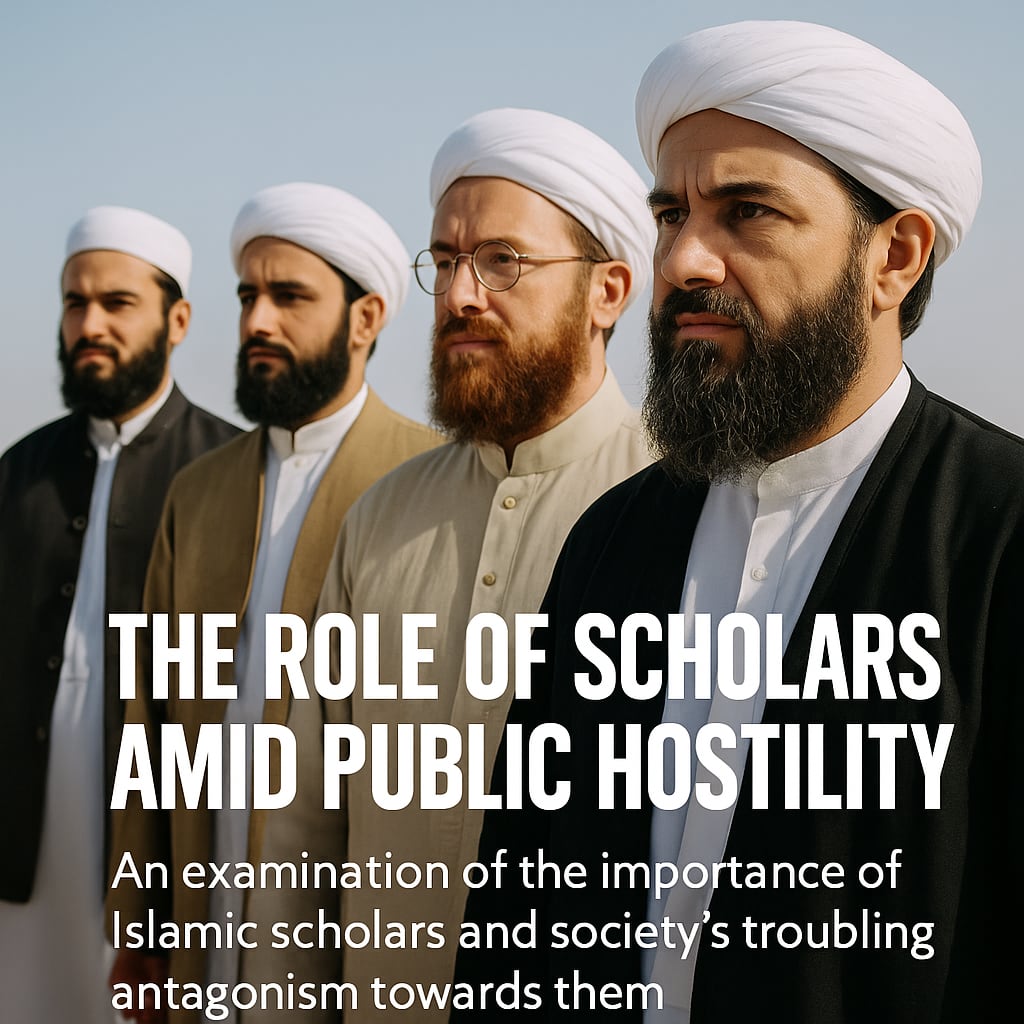
In every Muslim society, scholars — or Ulama — are the spiritual backbone and guiding light. Islam places immense importance on those who acquire and teach knowledge. The Qur’an says:
> “It is only those who have knowledge among His servants that fear Allah.” (Surah Fatir: 28)
The Prophet Muhammad ﷺ also said:
> “The scholars are the heirs of the prophets.” (Hadith — Abu Dawood)
It is these scholars who preserve the purity of Islam, interpret the Qur’an and Hadith, protect the faith from distortion, and educate generations in the principles of righteousness. Without them, the light of religious guidance would flicker and fade.
Scholars are not confined to the pulpit. They serve as intellectual, ethical, spiritual, and even political leaders of the Muslim Ummah. Throughout history, revolutions and reformations were led or supported by scholars — from the scholarly foundations of the Ottoman Empire to the anti-colonial struggles in South Asia. Their efforts have shaped the moral and spiritual landscape of entire civilizations.
But sadly, the modern era paints a disturbing contrast.
Instead of respecting and valuing scholars and religious students, many communities now regard them with suspicion or even hostility. The very students who dedicate their youth to memorizing the Qur’an, learning Arabic, studying Islamic jurisprudence, and mastering the science of Hadith are sometimes labeled as “backward,” “extremist,” or “a burden on society.”
This prejudice has reached dangerous levels.
Recently, a horrifying incident came to light: more than 45 students and teachers at a religious school were poisoned through food — bread laced with toxic substances. The victims are now fighting for their lives in hospitals. This wasn’t a random act of cruelty — it was targeted hatred towards innocent people devoted to seeking knowledge of faith.
How have we reached this point?
These students — future imams, preachers, and teachers — did not rob anyone, vandalize property, or incite violence. Their only "crime" is studying the religion of Islam. They wake up for Fajr, spend their days immersed in scripture and scholarship, and live simple, humble lives in service to God and humanity.
Harming such people is not just a crime against individuals — it’s a crime against knowledge, against divine guidance, and against the spiritual heritage of the Muslim world. When society turns against its scholars, it turns against its own moral compass.
There are several reasons why this hostility exists:
A lack of awareness about the vital role scholars play
Media portrayal of ulama as outdated or extreme
Neglect of religious institutions by governments and elites
Misconduct by a few self-proclaimed “scholars” that tarnish the image of genuine ones
Yet none of these reasons justify violence, hatred, or dehumanization. The solution is not to fight knowledge with ignorance, or faith with fear — but to restore respect, reform education, and reconnect with our roots.
Scholars have always stood as beacons of wisdom and reform. They are the ones who:
Teach us how to pray, marry, and bury our dead
Guide us through moral dilemmas and spiritual confusion
Keep the message of the Qur’an alive
Offer solutions to modern challenges through faith-based ethics
Preserve Arabic, Islamic law, and prophetic traditions for future generations
We, as a society, must respond to this crisis of conscience. We must:
Respect scholars regardless of their school of thought
Support religious students by providing financial aid, food, and housing
Invest in mosques, seminaries, and Islamic centers
Speak out against violence and injustice towards religious communities
Promote interfaith and intra-faith dialogue led by scholars
Let us not forget: scholars are not relics of the past — they are architects of the future. Their pens have preserved what swords could not. Their voices echo in hearts long after they are gone. And their prayer, sincerity, and wisdom hold the power to uplift societies lost in darkness.
The recent poisoning incident is not just a tragedy — it’s a wake-up call.
If we allow such hatred to continue, we risk raising generations disconnected from their faith, their values, and their identity. The destruction of a scholar is not the fall of one man — it is the fall of a community’s hope.
Let us choose to be protectors of knowledge, not its enemies. Let us honor the sacred, not poison it. Let us support students of faith, not abandon them.
For in honoring them, we honor our future
About the Creator
Time to change your life.
Is it even possible for you to change your life? A lot of people, more than there should be, are unhappy with their lives. But what are they doing about it? Usually nothing. People talk about how shitty their lives are and want change, but are they not taking the actions to change?
By Jen Phillips7 days ago in Humans
Why Modern Life Feels Heavy Even When Nothing Is Actually Wrong
I’ve been thinking about something for a while now, and I don’t fully understand it yet — but I can feel it. Life isn’t falling apart. Nothing terrible is happening. There’s no crisis demanding immediate attention. On paper, things are mostly fine. And yet, there’s this quiet heaviness that doesn’t seem to leave, no matter how much I try to ignore it.
By Jennifer Davidabout 23 hours ago in Humans
Our Song
Evening has given way to night. Gently, I settle next to you on the comfortable, old love seat and reach for your hand. You snatch it away, again. It cuts me to the quick, but I hide the pain, understanding that the reaction is but part of your demented state. Since the accident, your presence here in our cozy home has been clouded by a haze I can't see. Nevertheless, I feel the frigidity of your expressions and it serves as an excruciating reminder of the immeasurable distance between us.
By Dana Crandell3 days ago in Fiction


Comments
There are no comments for this story
Be the first to respond and start the conversation.